What it actually does.
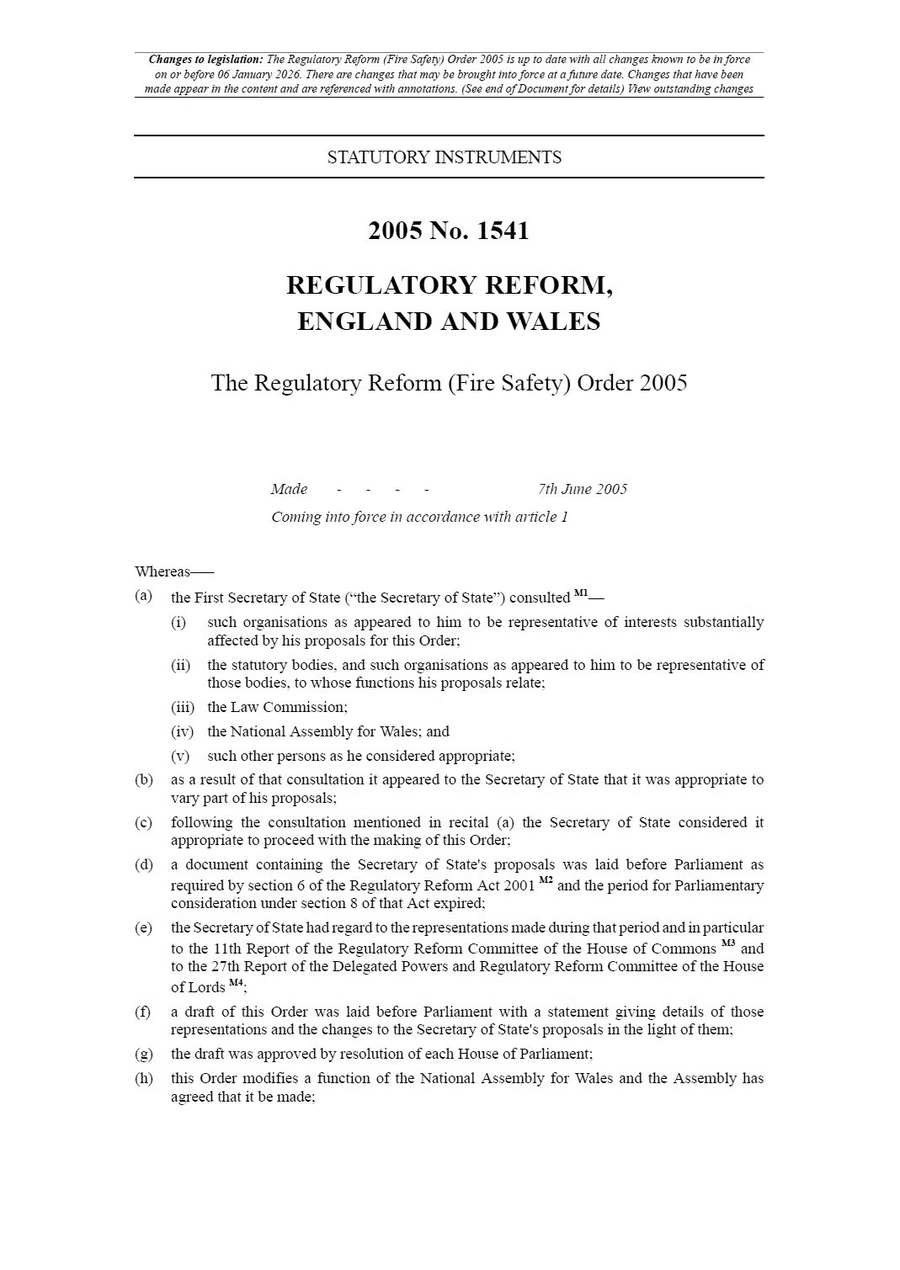
The Regulatory Reform (Fire Safety) Order 2005 replaced over seventy separate pieces of fire safety legislation when it came into force on 1 October 2006. It applies to every non-domestic premises in England and Wales: workplaces, shops, hotels, hospitals, schools, the common parts of residential blocks, every mixed-use scheme.
For every premises in scope, a Responsible Person must conduct and keep current a fire risk assessment, take general fire precautions to protect anyone who might be on the premises, and maintain those precautions, including every fire door, in efficient working order. The Order is the engine room underneath Regulation 10, the Building Safety Act, and most of the rest of UK fire safety law.
Five things you must do.
Fire risk assessment
The bedrock duty under Article 9. Identify the fire hazards, the people at risk, the precautions required to remove or reduce that risk, and review whenever significant changes occur. Significant findings must be recorded; for five or more employees, the whole assessment must be recorded.
General fire precautions
Article 8 requires the Responsible Person to take such fire precautions as are reasonable to ensure the safety of any relevant person. Means of escape, fire detection and warning, firefighting equipment, training, prevention of fire, limitation of spread.
Maintenance of safety measures
Article 17 requires the Responsible Person to keep the premises and any facilities, equipment and devices provided in respect of the premises in an efficient state, in efficient working order and in good repair. Fire doors live inside this article. Self-closing devices, intumescent seals, leaf damage, frame integrity, all of it.
Information, instruction, training
Articles 19 to 21 require the Responsible Person to provide employees and other occupants with information about fire risks, the precautions in place, evacuation procedures, and proper training for anyone with a specific fire safety role. Information must be provided in a form people can understand.
Cooperation and coordination
Article 22 applies where two or more Responsible Persons share a workplace or premises (multi-tenanted buildings, common parts of residential blocks, mixed-use schemes). Each must take reasonable steps to coordinate with the others and inform them of risks arising from their part of the operation.
Article 32 is criminal law.
Offences under the Fire Safety Order are prosecuted by the local Fire and Rescue Authority. The exposure ranges from an enforcement notice up through unlimited fines and personal liability for the directors signing off the arrangements.
The FSO, mapped to the platform.
Article 17 maintenance evidence
Every fire door, every check, every defect, every remedial action retained as a structured digital record that demonstrably satisfies the Article 17 efficient-state duty. The evidence is generated from the inspection, not retyped into a spreadsheet later.
Fire risk assessment integration
Fire door condition surfaces into the Responsible Person's fire risk assessment. Open defects, overdue inspections, closer failures, gap exceedances, all visible against the buildings the FRA covers.
Multi-Responsible-Person workspace
Multiple Responsible Persons across one building (freeholder, managing agent, individual lessees of demised units) modelled in one workspace, with a coordination view that satisfies the Article 22 sharing duty without ten copies of the same spreadsheet flying around.
Article 19 occupant information
QR plaques on every fire door give occupants live compliance information from their own phone. Supports the Article 19 occupant information duty without printed leaflets at the building entrance.
FRA inspection evidence pack
One-click export of the full fire door audit trail for a Fire and Rescue Authority inspection, an insurer survey, a managing agent renewal, or the next round of fire risk assessment review.
Multi-site Responsible Person
A Responsible Person managing one workplace, ten care homes, or three hundred retail units sees the whole portfolio in one view, with per-site compliance, per-door history, and per-occupier coordination thread.
Adjacent rules.
Regulation 10 (FSER 2022)
The residential-specific fire door inspection duty that sits on top of the FSO.
Building Safety Act 2022
The post-Grenfell regime for higher-risk buildings, layered on the FSO.
Golden Thread
The digital information duty under Part 4 of the BSA.
BS 8214
Technical inspection standard for fire door assemblies.