
The regulations every industrial site works to.
Industrial assets carry the standard non-domestic regulatory stack and then an industrial-specific overlay on top: DSEAR for dangerous substances, COMAH for the top-tier sites, and a working environment shaped by forklift traffic, racking density, and three-shift operations. The compliance picture is fewer doors, higher stakes per door.
Fire Safety Order 2005
Article 8 imposes the Responsible Person duty across every non-domestic part of an industrial site, including the warehouse floor, mezzanine offices, plant rooms, transformer rooms, and the yard. Article 9 requires a documented fire risk assessment, reviewed regularly, available to the enforcing authority. In a logistics shed, the FRA covers a building large enough to need its own internal road network.
Workplace (Health, Safety and Welfare) Regulations 1992
Sets the workplace standards for means of escape, signage, lighting, and the maintenance of safe routes for staff. In a high-bay warehouse this overlaps every aisle, every cross-aisle, every mezzanine staircase, and the fire-rated egress doors that connect them. Fire door condition is squarely inside this regulation.
Health and Safety at Work Act 1974
The parent legislation. Section 3 imposes a duty on every employer and self-employed person to conduct their undertaking without exposing third parties to risk. In industrial that third party can be a delivery driver, a contractor banksman, an agency picker on a first-day induction, or a visiting health and safety inspector.
Dangerous Substances and Explosive Atmospheres Regulations 2002
The industrial-specific overlay. Where the site stores or handles flammables, oxidisers, dust-prone solids, or pressurised gas, DSEAR requires zoned ATEX classification, ignition-source control, and segregated compartmentation. The fire doors around DSEAR zones are not just life-safety: they are part of an explosion-protection strategy.
BS 9999:2017
Code of practice for fire safety in the design and management of buildings. The framework that travel-distance modelling, sprinkler density calculations, and smoke ventilation strategies for high-bay industrial sites are built against, and the framework BS 8214 routine inspections reference for door performance.
BS 8214
Code of practice for fire door assemblies. The technical inspection standard DoorTRACE checklists follow as default, and the methodology competent inspectors apply across the full industrial estate: warehouse compartment lines, mezzanines, plant rooms, transformer rooms, and yard gatehouses.
Built for the way logistics actually runs.
DoorTRACE configures around the industrial reality: a compartment-line door population, racking and fire-loading constraints on egress routes, three-shift operational cycles, and the DSEAR overlay that makes some doors part of the explosion-protection strategy.
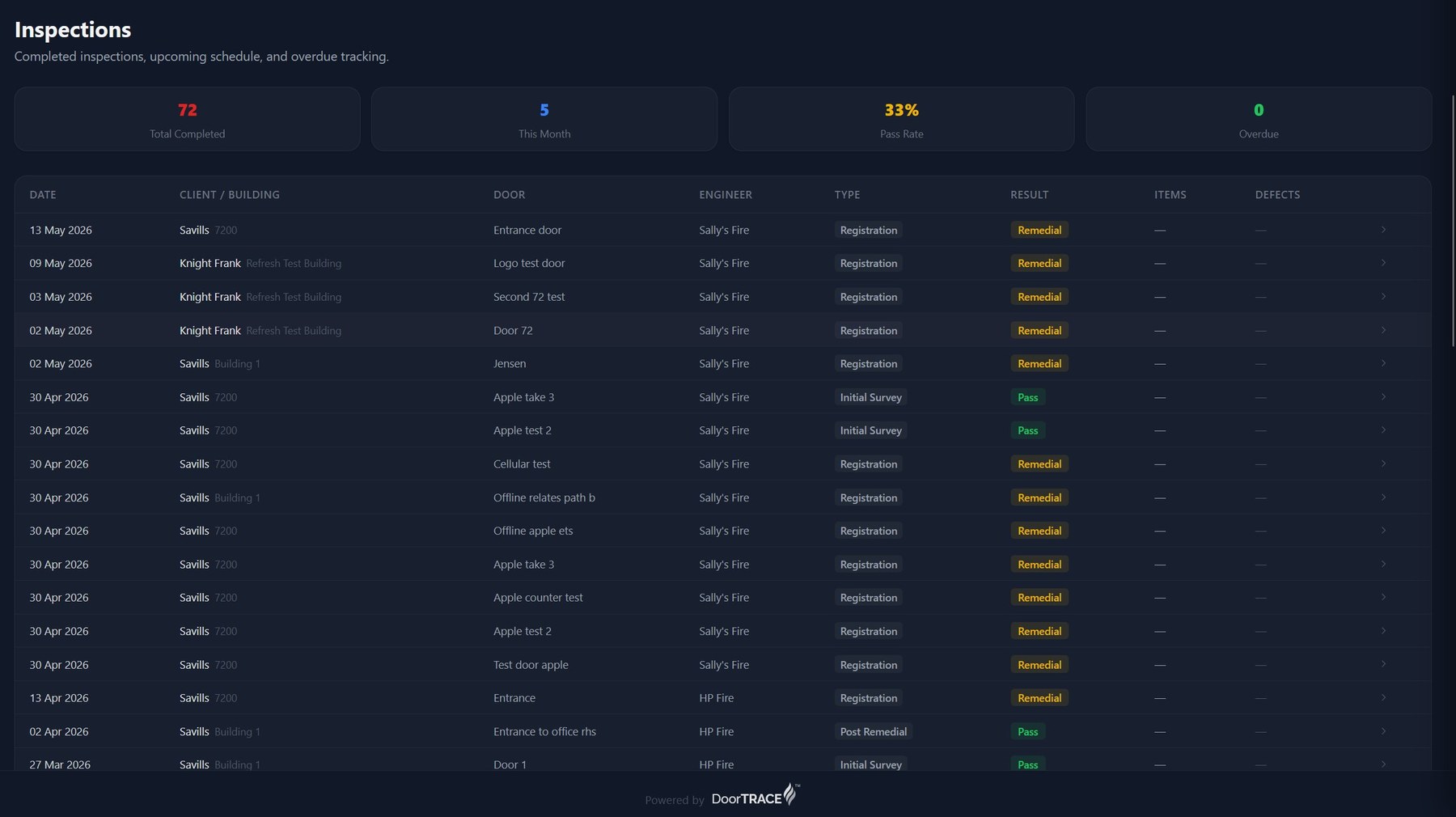
Inspection cycles aligned to the 24/7 shift pattern.
Inspection cadence configured per zone, per access window, per shift. Compartment-line doors on planned-shutdown windows. Mezzanine office doors on day-shift slots. DSEAR-zoned doors on banksman-covered access only. Yard doors during scheduled HGV-free intervals. The site operations manager sees every zone from one screen, with the 3PL client or logistics REIT seeing the rolled-up portfolio view in their portal.
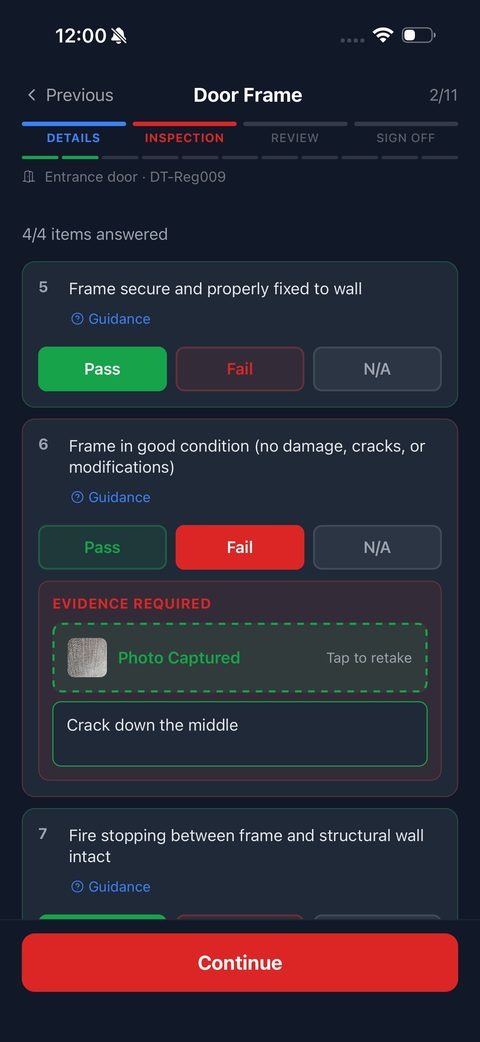
An engineer app that respects the warehouse floor.
Engineers see the access protocol before they arrive: gatehouse sign-in, PPE requirements, banksman escort for high-MHE zones, key cabinet for plant rooms, lock-out tag-out for DSEAR-zoned doors. They can defer if a zone is in active picking or HGV unload, photograph the timestamped reason, and the site operations manager routes the rebook with the right cover arranged. The audit trail evidences the operator's reasonable steps under the FSO without ever stopping the line.
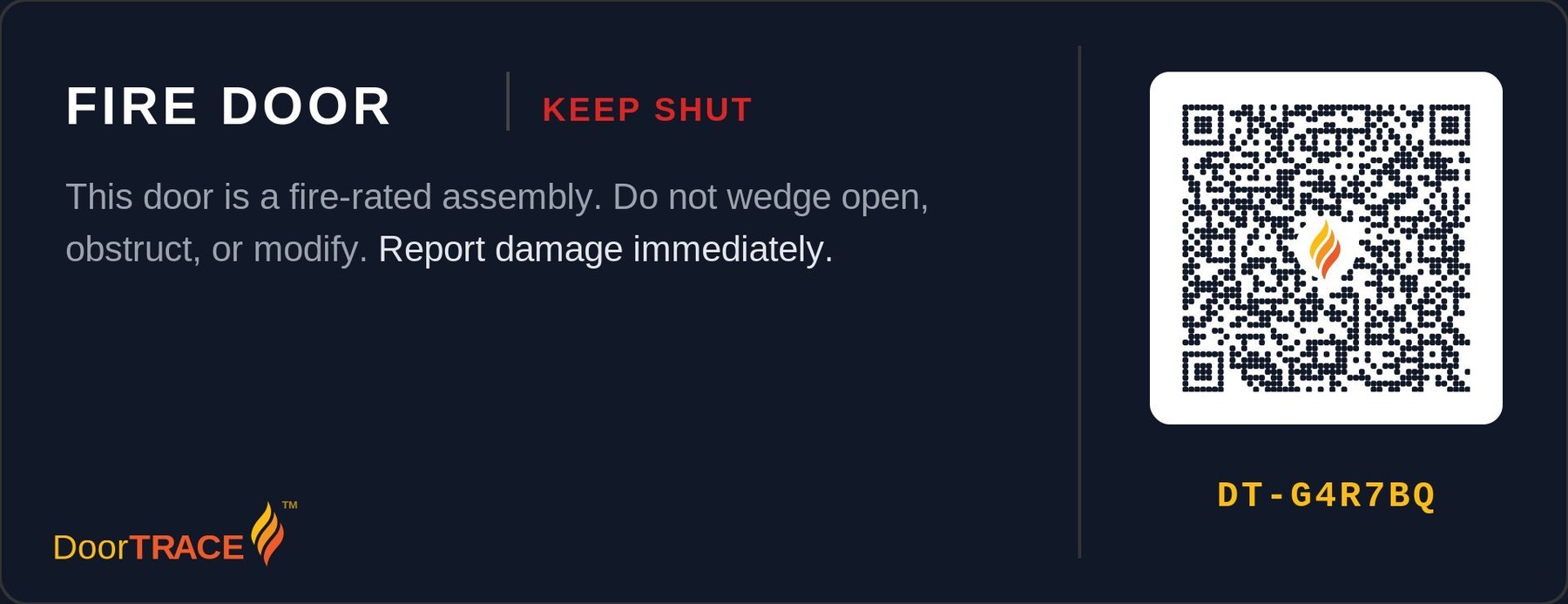
A plaque every banksman, contractor, and picker can scan.
Every fire door across the site carries a QR plaque, including the compartment-line doors, the mezzanine egress doors, the plant-room doors, and the DSEAR-zoned doors most generic platforms ignore. Banksmen, contractors, agency staff on first-day induction, and the visiting H&S inspector can verify a door's compliance from their own phone in seconds. Plaques survive forklift impact, pallet abrasion, and twenty years of warehouse traffic.
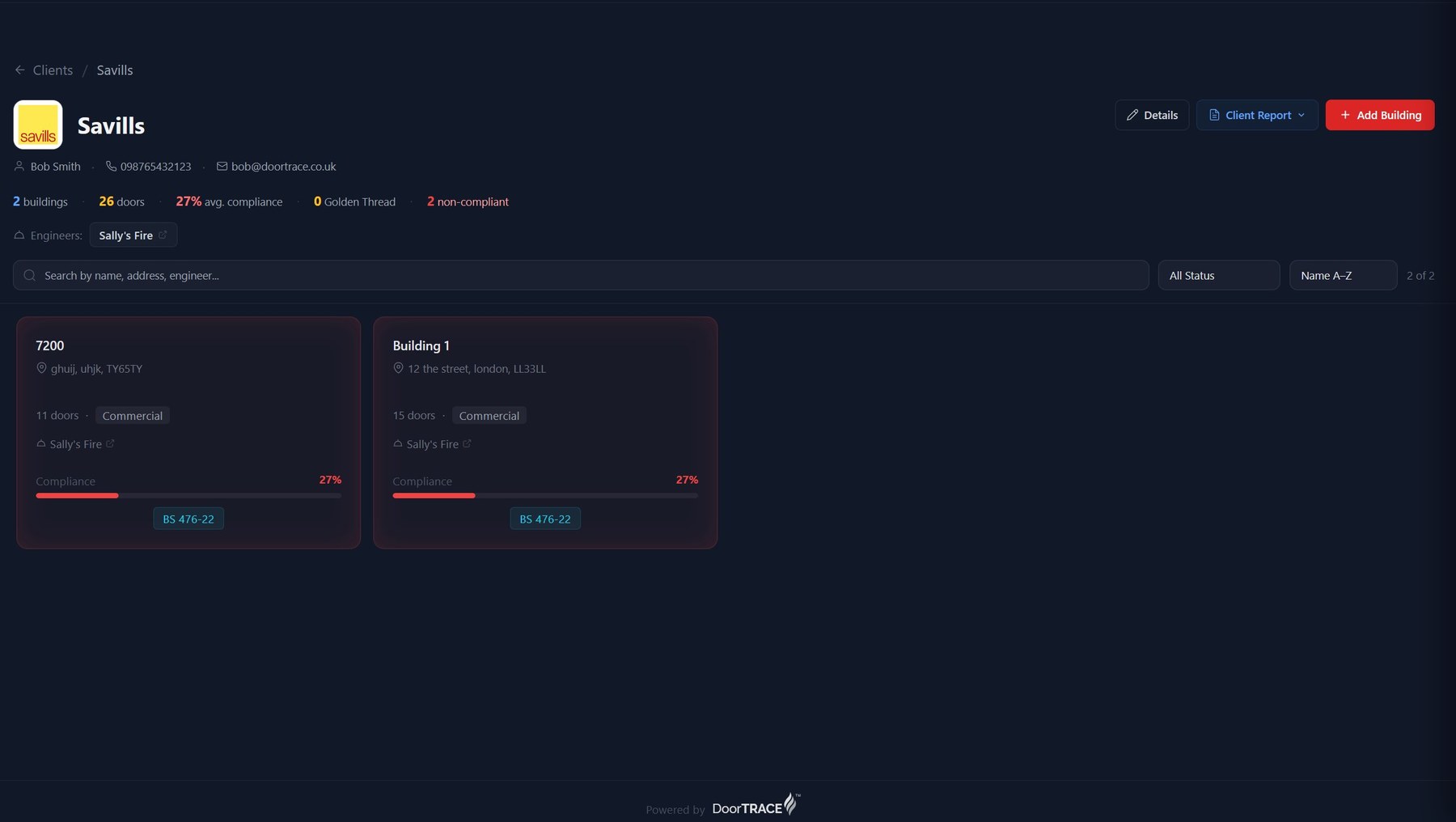
Twelve distribution centres, one operations committee pack.
Compliance status by site, by client, by lease event, by capital plan line. Drill into any zone for compartment-line history, DSEAR-zone evidence, MHE-impact defects, and the insurance evidence pack the loss-prevention underwriter asks for. Export a 3PL operations committee report in two clicks, a logistics REIT portfolio pack in five minutes, an insurance renewal evidence file in fifteen.
The UK industrial market, in fire door terms.
A week at a national distribution centre.
It is 06:00 on a Monday morning at shift handover. The Site Operations Manager at a 920,000 square foot regional distribution centre, the hub for one of the UK's largest grocery chains, opens DoorTRACE in the gatehouse before the day-shift huddle.
Pre-handover sweep across the yard and the eastern dock spine. The engineer logs two yard fire doors propped open from overnight HGV unloading, one mezzanine office door with a wedge under the closer arm, one transformer-room door with a missing intumescent seal. Photos timestamped to the shift. Non-compliance notices fire to the yard team lead and the H&S manager with the lease clause cited and a forty-eight-hour rectification deadline.
DSEAR review meeting with the insurance loss-prevention surveyor. The Site Operations Manager pulls the chemical-storage compartmentation evidence pack from DoorTRACE in five minutes: every door on the ATEX-zoned perimeter, every inspection in the last twelve months, every defect rectified or outstanding, the signed engineer record for each. The surveyor signs off the annual renewal without a follow-up site visit.
Night-shift mezzanine refit. A contractor is installing a new pick tower across the north end of the warehouse. The proposed door schedule was lodged in DoorTRACE the previous week and the compartmentation impact reviewed. Tonight's alterations consent is pulled up on a tablet at the works gate, the FD60S specification verified against the strategy, and the contractor briefed before the first steel is cut.
Quarterly portfolio review with the 3PL operator's CFO across twelve UK distribution centres. The Site Operations Manager presents the rolled-up compliance status by site, top defect categories by site cohort, MHE-impact patterns, and the insurance renewal evidence pack the loss-prevention team is assembling. Pack includes the audit-grade trail every regulator and underwriter on the call expects.