
The regulations every commercial office works to.
Commercial offices sit firmly inside the non-domestic regulatory stack. The Fire Safety Order names the Responsible Person; workplace and equality legislation sit alongside it; British Standards set the inspection methodology. The complexity is not in which laws apply, but in which party to the lease actually carries each duty.
Fire Safety Order 2005
Article 8 imposes the Responsible Person duty across every non-domestic part of the office building. Common parts almost always rest with the landlord; demised parts depend on the lease. Article 9 requires a documented fire risk assessment, reviewed regularly, available to the enforcing authority.
Workplace (Health, Safety and Welfare) Regulations 1992
Sets the workplace standards for means of escape, signage, lighting, and the maintenance of safe routes. Sits alongside the FSO and is enforced by the Health and Safety Executive in practice. Fire door condition is squarely inside this regulation.
Health and Safety at Work Act 1974
The parent legislation. Section 3 imposes a duty on every employer and self-employed person to conduct their undertaking without exposing third parties to risk. Office landlords carry duties to occupiers, occupiers carry duties to their staff and visitors.
Equality Act 2010 (PEEPs)
Reasonable adjustments include Personal Emergency Evacuation Plans for disabled occupants, visitors, and customers. Fire door operating force, ironmongery type, and signage all fall under the access duty. A PEEP cannot work if the fire doors on the route do not.
BS 9999:2017
Code of practice for fire safety in design and management of buildings. The framework BS 8214 inspection routines reference for door performance, hardware specification, and operational fire safety across commercial office buildings.
BS 8214
Code of practice for fire door assemblies. The technical inspection standard DoorTRACE checklists follow as default, and the methodology competent inspectors apply across UK commercial office estates.
Built around how multi-let offices actually operate.
DoorTRACE configures around the commercial office reality: a lease-driven duty split, multi-let occupier coordination, constant fit-out and dilapidations activity, and the institutional reporting cadence your asset manager and sustainability committee actually need.
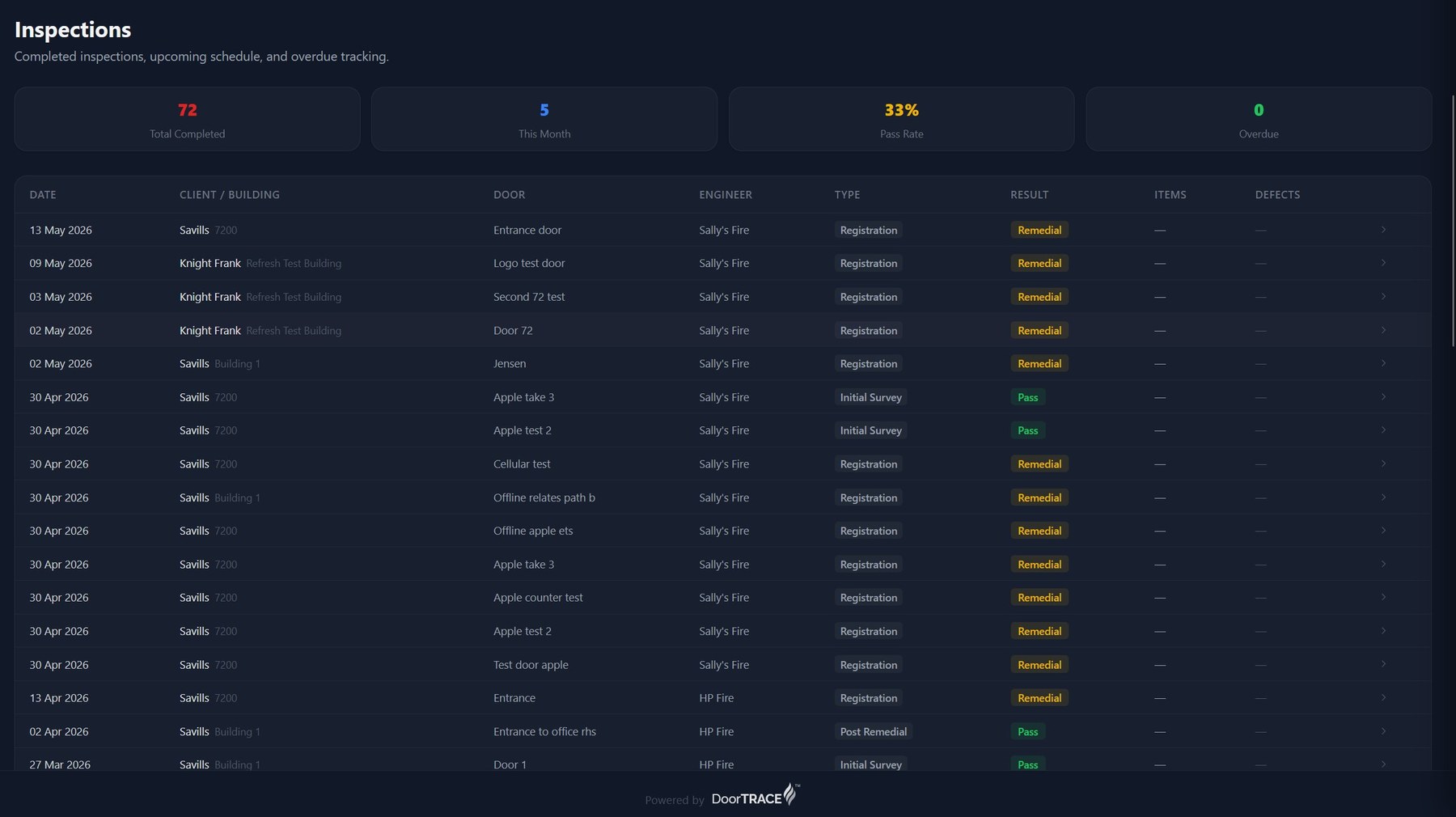
Inspection cycles aligned to the lease structure.
Inspection cadence configured per building, per zone, per occupier demise. Common parts on the landlord cycle. Demised floors on the occupier cycle with notice requirements respected. Cross-tenure zones (lobbies, reception, lift cores) flagged for shared evidence. The managing agent sees every building from one screen, with each occupier seeing their own slice in their own portal.
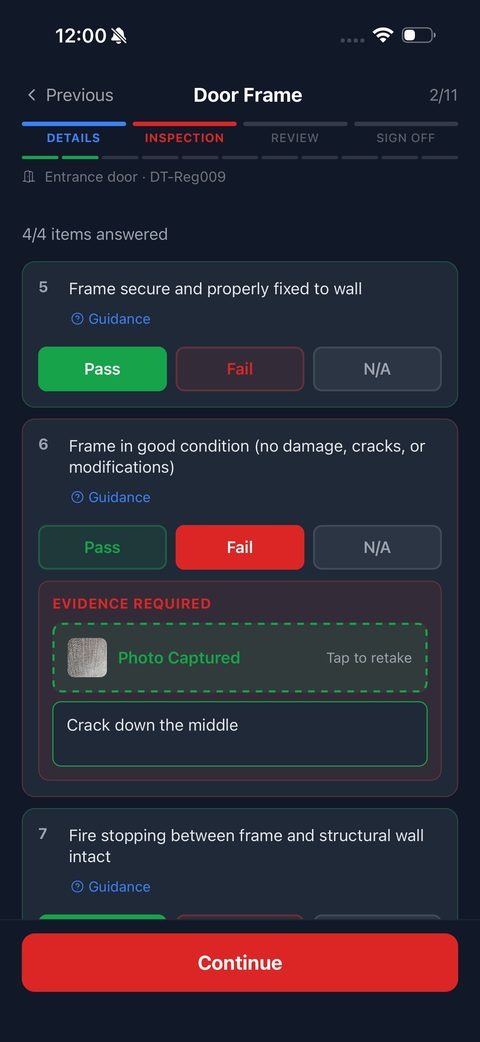
An engineer app that respects building security.
Engineers see the access protocol before they arrive: turnstile passes, reception sign-in, after-hours security escort, occupier liaison contact. They can defer if an occupier refuses access on the day, photograph the timestamped reason, and the managing agent routes the rebook with the right notice period. The audit trail evidences the landlord's reasonable steps under the FSO.
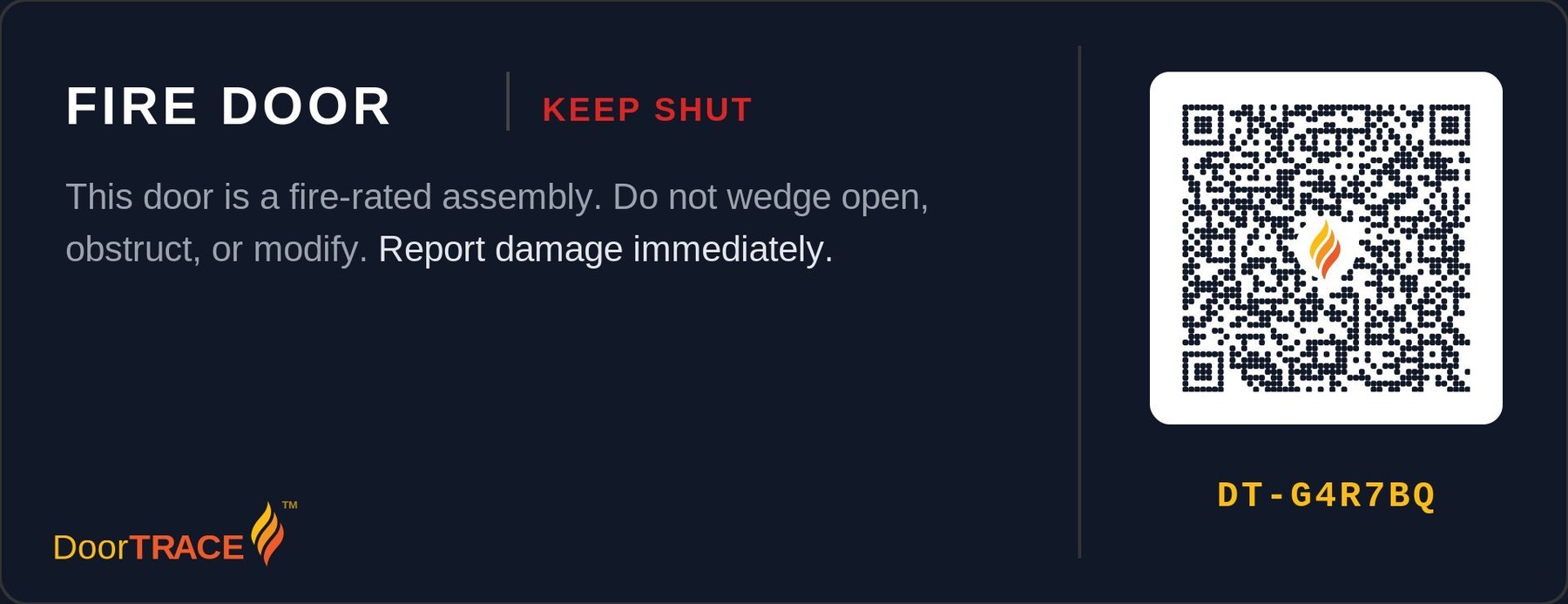
A plaque every occupier and fit-out contractor can scan.
Every fire door across the building carries a QR plaque. Occupiers, fit-out contractors, the building manager, and the landlord's asset manager can verify a door's compliance from their own phone in seconds. Plaques survive office moves, fit-out churn, and twenty years of office traffic. The audit record per door supports dilapidations evidence at lease end.
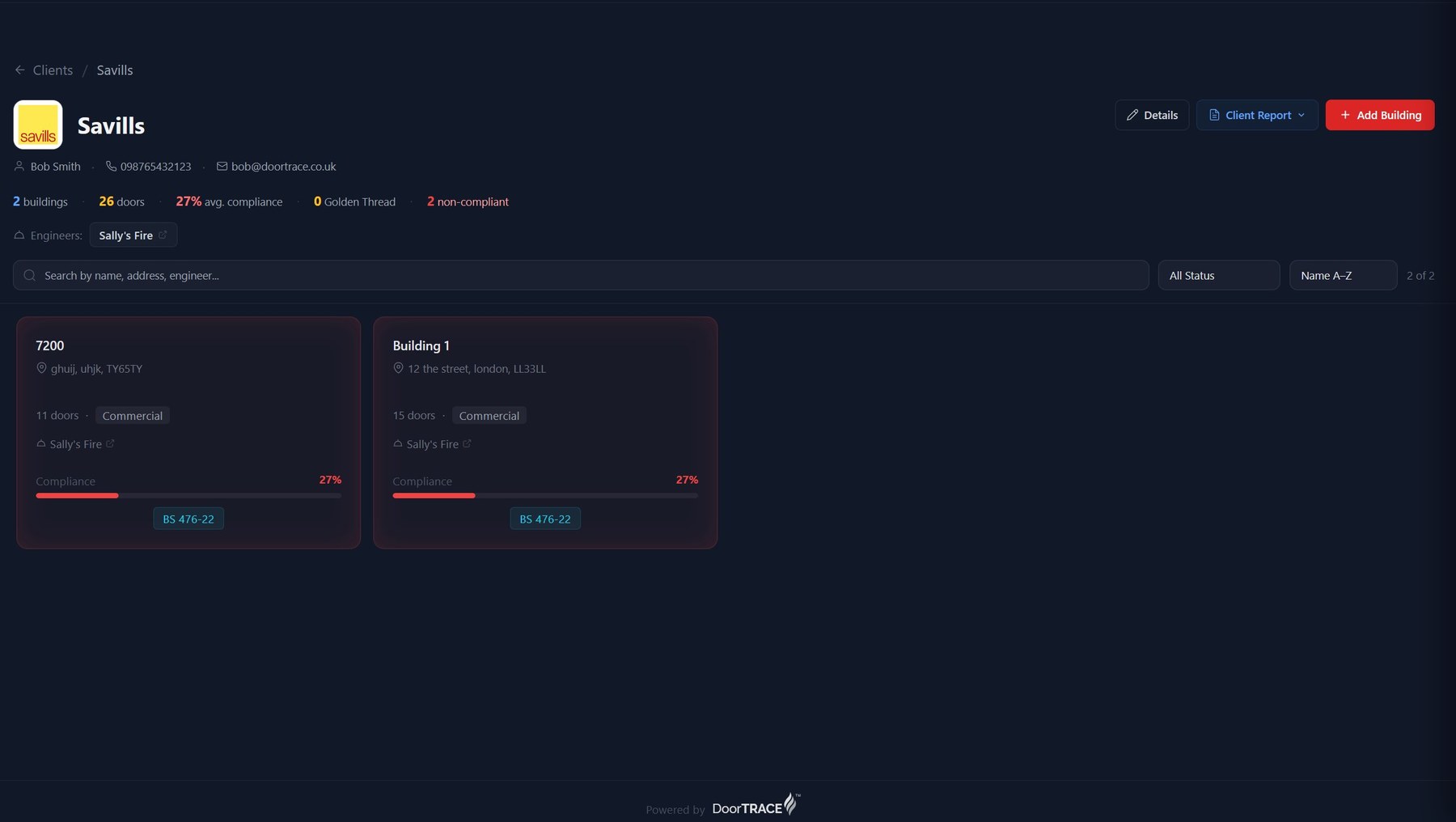
Fifteen buildings, one investment committee pack.
Compliance status by building, by occupier, by lease event, by capital plan line. Drill into any demise for fit-out history, open defects, and the dilapidations evidence pack. Export an asset management report in two clicks, a sustainability committee summary in five minutes, an investment committee compliance pack in fifteen.
The UK commercial office market, in fire door terms.
A week in the life of a managing agent property manager.
It is 09:00 on Monday morning. The Property Manager at a national managing agent, responsible for fifteen multi-let commercial office buildings on behalf of three institutional landlords, opens DoorTRACE alongside the week ahead in Outlook.
A Tier 1 occupier at 100 Cheapside is finalising their fit-out spec ahead of demising-wall installation on Friday. The Property Manager pulls the building's compartmentation plan and the fire door schedule from DoorTRACE, verifies the FD60S specification matches the strategy, and signs off the alterations consent with the audit reference attached.
Routine inspection at 25 Fenchurch Place. The engineer logs three fire doors on the twelfth floor with disabled closers, two wedged open with door wedges, one with the arm physically removed. Photos timestamped. Non-compliance notice raised against the occupier with the lease clause cited and a seven-day rectification deadline. Auto-copied to the building's fire risk assessor.
Quarterly asset management review with the REIT that owns five of the fifteen buildings. The Property Manager presents the portfolio compliance status, top defect categories, contractor performance, and the dilapidations exposure on three buildings approaching lease events. Pack includes the GRESB-aligned compliance summary the asset manager forwards to the sustainability committee.
Occupier B at 60 Threadneedle Court is exiting at end of lease in six weeks. The Property Manager runs the dilapidations export: five-year fire door compliance history for that demise, every fit-out alteration, every inspection, every defect rectified or outstanding. The schedule of dilapidations cites the export by audit reference, defensible at any future negotiation.