What it actually does.
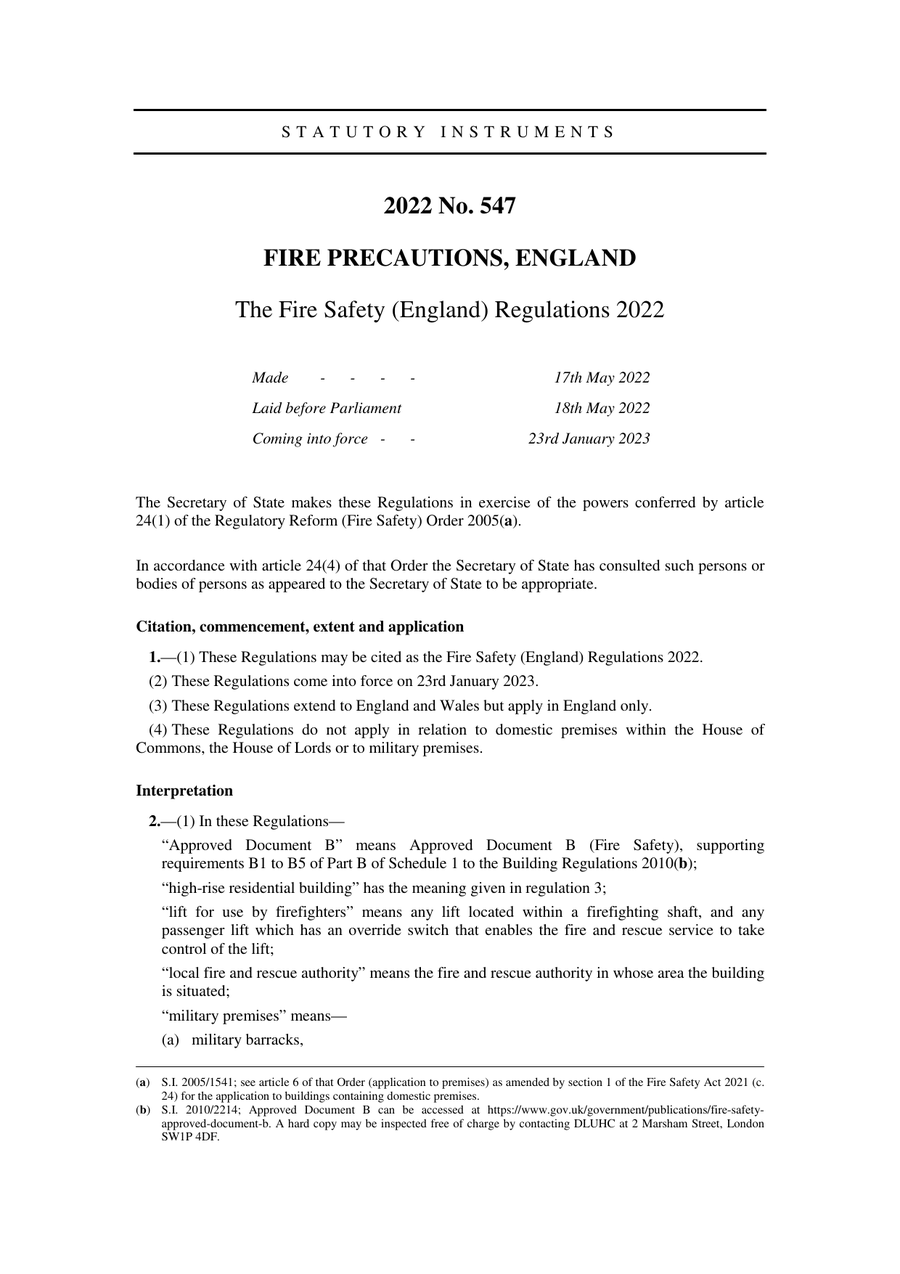
The Fire Safety (England) Regulations 2022 were made under Article 24 of the Fire Safety Order 2005 and came into force on 23 January 2023. They write the Grenfell Tower Inquiry Phase 1 recommendations that required a change in the law onto the statute book.
They place new duties on the responsible person of multi-occupied residential buildings in England, scaled by building height: some apply to every building with two or more sets of domestic premises, more apply above 11 metres, and the full set applies to high-rise buildings of 18 metres or seven storeys. Regulation 10, the fire door checks, is one part of this instrument.
What the Regulations require.
Secure information box
Regulation 4. In a high-rise residential building, the responsible person must install and maintain a secure information box, accessible to the fire and rescue authority, holding contact details and the building plans the Regulations require.
External walls and building plans
Regulations 5 and 6. Record the design and materials of the external walls and the fire risk they present, and prepare floor plans plus a single-page building plan identifying access, firefighting shafts, mains inlets and key equipment.
Lifts and firefighting equipment
Regulation 7. Monthly routine checks of firefighters' lifts, evacuation lifts and essential firefighting equipment. Any fault not rectified within 24 hours must be reported to the local fire and rescue authority by electronic means.
Wayfinding signage
Regulation 8. Clear floor identification and flat identification markings on every landing in the stairways and in the lift lobbies, designed to Approved Document B and visible in low light or by torch.
Residents and fire doors
Regulations 9 and 10. Display fire safety instructions and give residents information on the importance of fire doors in all buildings with communal areas; above 11 metres, check communal fire doors quarterly and flat entrance doors annually.
Enforced under the Fire Safety Order.
Because these Regulations are made under the Fire Safety Order 2005, a breach is an offence under that Order, prosecuted by the local Fire and Rescue Authority. The duties are live now and apply to existing buildings, not just new ones.
The fire door duties, handled.
DoorTRACE covers the Regulation 9 and 10 duties end to end. The firefighter-facing duties (Regulations 4 to 8) sit with the responsible person and their fire engineers.
Regulation 10 checks scheduled
Quarterly communal fire door checks and annual best-endeavours flat-entrance checks for every building above 11 metres, scheduled automatically and recorded against the door, the building and the responsible person.
Best-endeavours access trail
Regulation 10(5) requires a record of attempts to access flat entrance doors where access was refused. DoorTRACE logs every attempt, with date and outcome, so the best-endeavours duty is evidenced rather than asserted.
Self-closing device checks
Regulation 10(7) requires the checks to confirm self-closing devices work. The self-closer test is a mandatory item in every DoorTRACE fire door inspection, with a pass or defect outcome captured.
Resident fire door information
Regulation 10(1) to (3) requires residents to be told fire doors must be kept shut, self-closers not tampered with, and faults reported. QR plaques and the resident view deliver that information from the door itself.
Records for the FRA audit
One-click export of the fire door check history and access-attempt record, ready for a Fire and Rescue Authority audit under the Fire Safety Order, which is how these Regulations are enforced.
Height-aware compliance
The platform knows which buildings sit above 11 metres and applies the right Regulation 10 cadence automatically, so a building that crosses the threshold is not left on the wrong inspection cycle.