The standard DoorTRACE fire door inspection has a new name and a sharper shape. The 41-point checklist that has run every standard inspection since launch is now the DoorTRACE 36-Point Check: 36 items in 11 categories, a handful of Yes/No questions that take whole sections out of play when they do not apply, and a recorded reason behind every failed item. It went live in the engineer app, the portals and the reports on 28 October 2026, and every phone picked it up automatically.
This article covers what changed, why, and what it means for the inspections already on your record.
Why we rebuilt it
The 41 items did their job, but inspectors using them every day told us two things. Some items repeated what another item had already asked, so a damaged seal could be failed twice over. And a failed item recorded a photo and a free-text note, which is evidence, but not data: two engineers describing the same fault would write it two different ways, and nobody could count how often a particular fault came up across a building.
We worked through the form line by line with one of our inspection clients, who had marked up every item with the faults their engineers actually find. The result is a shorter form that asks each question once and captures the answer in a way the platform can use.
What is in the 36-Point Check
The 36 items sit in the same 11 categories as before: Door Leaf, Door Frame, Gaps and Clearances, Intumescent Seals, Smoke Seals, Self-Closing Device, Hinges, Glazing, Hardware and Ironmongery, Signage and Overall. Five items went because another item already asked the same thing; where a removed item added a detail worth keeping, its wording was folded into the item that stays. Every item keeps its plain-English guidance in the app, and the two gap measurements still take a value in millimetres and a photo of the gauge in place, whatever the result.
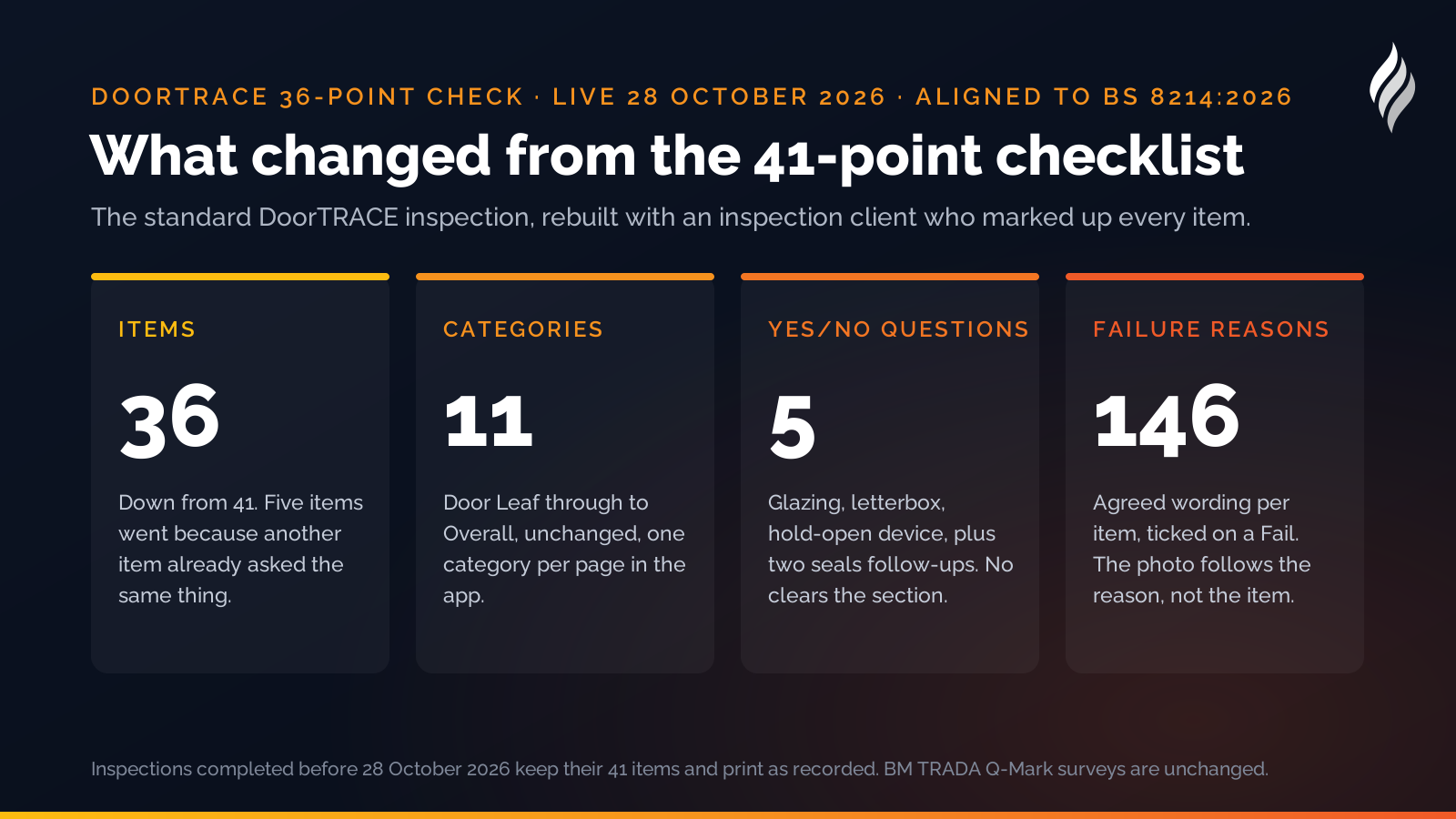
The form is aligned to BS 8214:2026, the code of practice for fire door assemblies, and it stays the default for every company on DoorTRACE. Companies on the BM TRADA Q-Mark scheme are unaffected: the Q-Mark DCS 058 form is unchanged.
Questions that remove what does not apply
Not every door has glazing, a letterbox or a hold-open device, and marking four glazing items N/A one at a time was a chore that added nothing. The 36-Point Check asks once instead. "Is there glazing in this door?" sits above the glazing items; answer No and all four are marked N/A with the reason recorded. The same applies to the letterbox and hold-open device items, and two follow-up questions appear only when a seal item fails: if there are no intumescent seals fitted at all, the engineer says so and the remaining seal items drop out.
Those answers are stored with the inspection, so the report prints why a section was not applicable rather than leaving a row of unexplained N/As.
A reason for every failed item
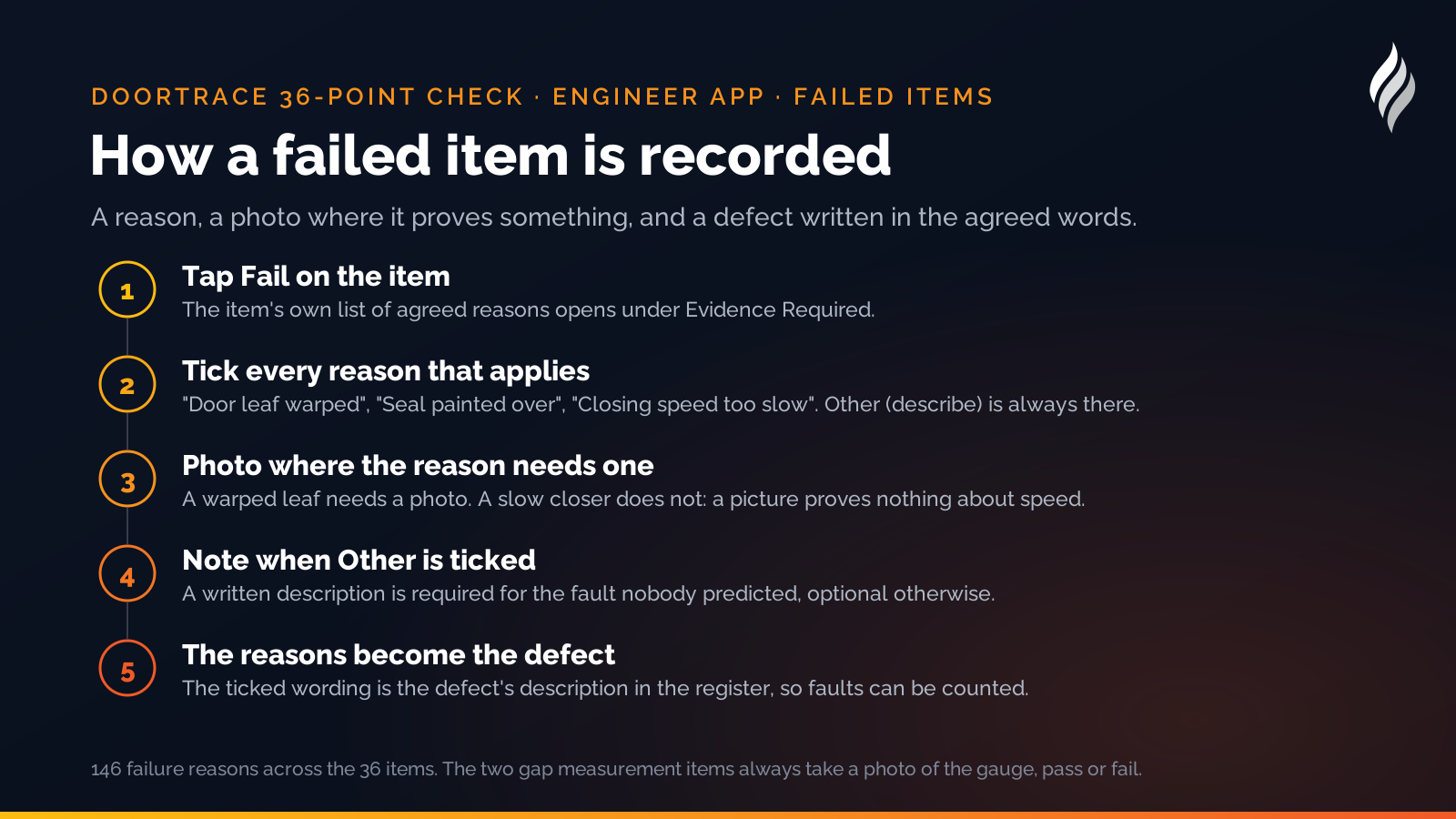
The bigger change is what happens on a Fail. Each item now carries its own list of agreed failure reasons, 146 across the form, and the engineer ticks the ones that apply: "Door leaf warped", "Seal painted over", "Closing speed too slow", "Signage obscured". An "Other (describe)" option is always there for the fault nobody predicted, and ticking it makes a written description required.
The photo rule follows the reason, not the item. A warped leaf needs a photo; a closer that is slow to shut does not, because a photograph of a closer proves nothing about its speed. Sixteen reasons across the self-closing device, lock and handle items need no photo, and everything else does. The reasons ticked become the defect's description in the defect register, word for word, so a portfolio-wide count of painted-over seals is now a filter rather than a reading exercise.
Your existing inspections are untouched
Every inspection completed before 28 October keeps its 41 items, its answers and its report exactly as they were. The old form is kept in the platform, not deleted, so historic records print as they were recorded, and a door's history reads correctly across the change. New inspections from 28 October use the 36-Point Check. Nothing needs re-inspecting.
The free checklist PDF and the help centre
The free fire door inspection checklist PDF has been rebuilt as version 2.0 with the 36 items, the Yes/No questions written in as tick rows, and the measurement boxes for the two gap checks. It is still free, still printable, and still needs no email address. The help centre guides for running an inspection now describe the questions and the reasons step by step.
How DoorTRACE helps
The 36-Point Check runs on the DoorTRACE engineer app, on site and offline, with guidance on every item and the reasons for every fault captured at the door. The results flow into the inspection reports and the defect register without anyone retyping a thing. If you would like to see it on your own doors, book a demo.
After the survey: building a fire door remediation plan
The survey is the easy part. A 300-door building produces a list of defects longer than anyone's budget. Here is how to turn it into a plan the board will sign, the fire officer will accept and the engineers can work from.
Building Notes: your statement on every building report
A customer surveying a heritage church needed a statement on the building report that applied to every door in it. Building Notes is the result: formatted text written once per building, printed on every report.
Fire doors in nurseries and early years settings
A nursery's occupants cannot evacuate themselves, and its doors are opened a hundred times a day by people carrying children. Here is how the Fire Safety Order applies, where the doors usually go wrong, and what to check.