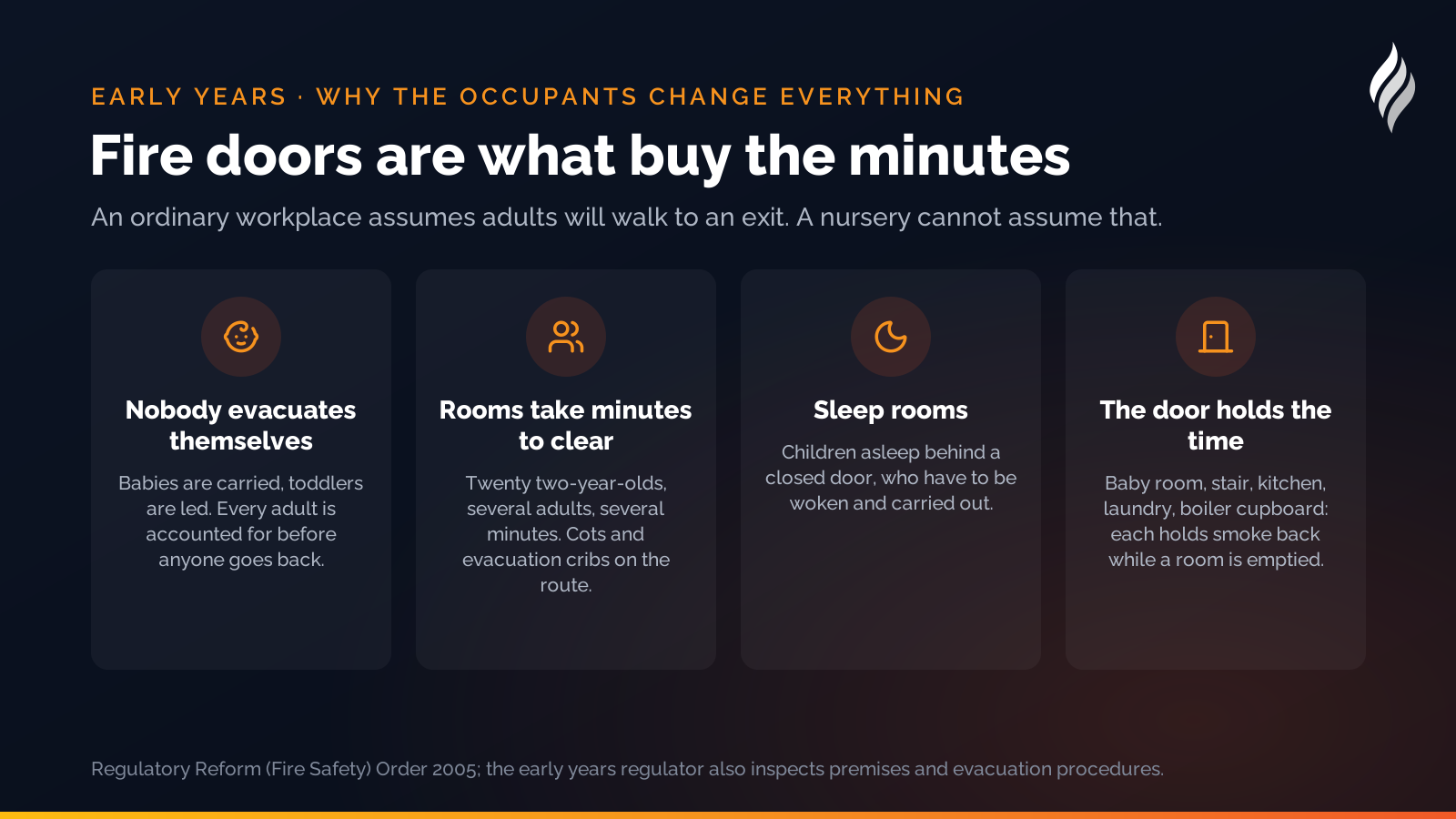
A nursery is a building whose occupants cannot evacuate themselves. Babies are carried, toddlers are led, and a room of twenty two-year-olds takes several adults and several minutes to move. That one fact shapes every fire precaution in an early years setting, and the fire doors most of all: they are what buys the minutes. They are also opened and closed more often than in almost any other building, by staff with a child on one hip, which is why they are so often found propped, damaged or fitted with things that stop them closing.
This guide covers who holds the fire door duty in a nursery, pre-school or childminding setting, why the occupants change the risk assessment, the particular problems of finger guards and hold-open devices, where these doors go wrong, and a routine a small team can keep.
Who is responsible
Under the Regulatory Reform (Fire Safety) Order 2005 a nursery is a non-domestic building and the Responsible Person is the employer, which for a private nursery is the company or owner, for a school-run nursery the school's governing body or trust, and for a committee-run pre-school the committee. A childminder working from home has a smaller duty but is not outside the law entirely: the parts of a home used for the business are covered. Our guides to the Fire Safety Order and who the Responsible Person is cover the hierarchy.
Two other bodies take an interest. The early years regulator in England sets requirements for premises and for emergency evacuation procedures as a condition of registration, and inspects against them. The fire and rescue authority enforces the Order and will usually treat a setting full of young children as a priority for an audit. A fire door fault found by either lands on the same desk.
Why the occupants change everything
The fire risk assessment for an ordinary workplace assumes that adults who hear an alarm will walk to an exit. A nursery's assessment cannot assume that. The time needed to clear a room is longer, the escape routes have to accommodate cots, evacuation cribs and pushchairs, and the staff ratio means every adult is accounted for before anyone can go back for anything. Sleep rooms add a further problem: children asleep behind a closed door, who have to be woken and carried.
Fire doors are what make that time available. The door between the baby room and the corridor, the door at the foot of the stair, the kitchen door and the door to the laundry or boiler cupboard each hold back fire and smoke for the minutes it takes to get a room of children out. A door that does not close, or that has a gap under it a toddler can post toys through, is not doing that.
Finger guards and fire doors
The fitting most often found on a nursery door is a finger guard: a hinge-side shield, usually a flexible strip or a rigid cover, that stops a child's fingers being crushed in the gap at the hinge edge. They are good practice and some inspectors of early years settings expect to see them. On a fire door they raise a question nobody should duck: is the guard compatible with the door's fire performance?
A finger guard screwed into the leaf and the frame bridges the gap the intumescent seal is meant to close, and some guards are made of materials that melt or burn. Fire-rated finger guards exist and are tested for use on fire doors; many ordinary ones are not. The right approach is to fit a guard that the manufacturer states is suitable for fire doors, fitted as they specify, and to record which product is on which door. A guard with no such statement is a modification to the fire door, and our guide to fire door hinges and hardware explains why modifications are judged against the door's evidence. The same question applies to door closers with a soft-close or anti-slam function fitted to protect fingers at the closing edge: a closer is part of the tested assembly, and a replacement must be one the door's evidence allows.
Hold-open devices, not wedges
The second most common finding in a nursery is a wedged fire door. Staff carrying children through a door twenty times an hour will wedge it, because a heavy self-closing door and a child in each arm do not mix. Telling them not to does not work for long. The answer is a hold-open device linked to the fire alarm: the door stands open in daily use and closes when the alarm sounds, which is what the fire door needs and what the staff need. Free-swing closers, which let the door move with no resistance until the alarm, are another option on doors that are used constantly. Our guide to self-closing devices and hold-open systems covers both. The one place a hold-open should be thought about carefully is a sleep room door, which some settings prefer to keep closed for noise and because a sleeping child is already behind it.
Where nursery fire doors go wrong
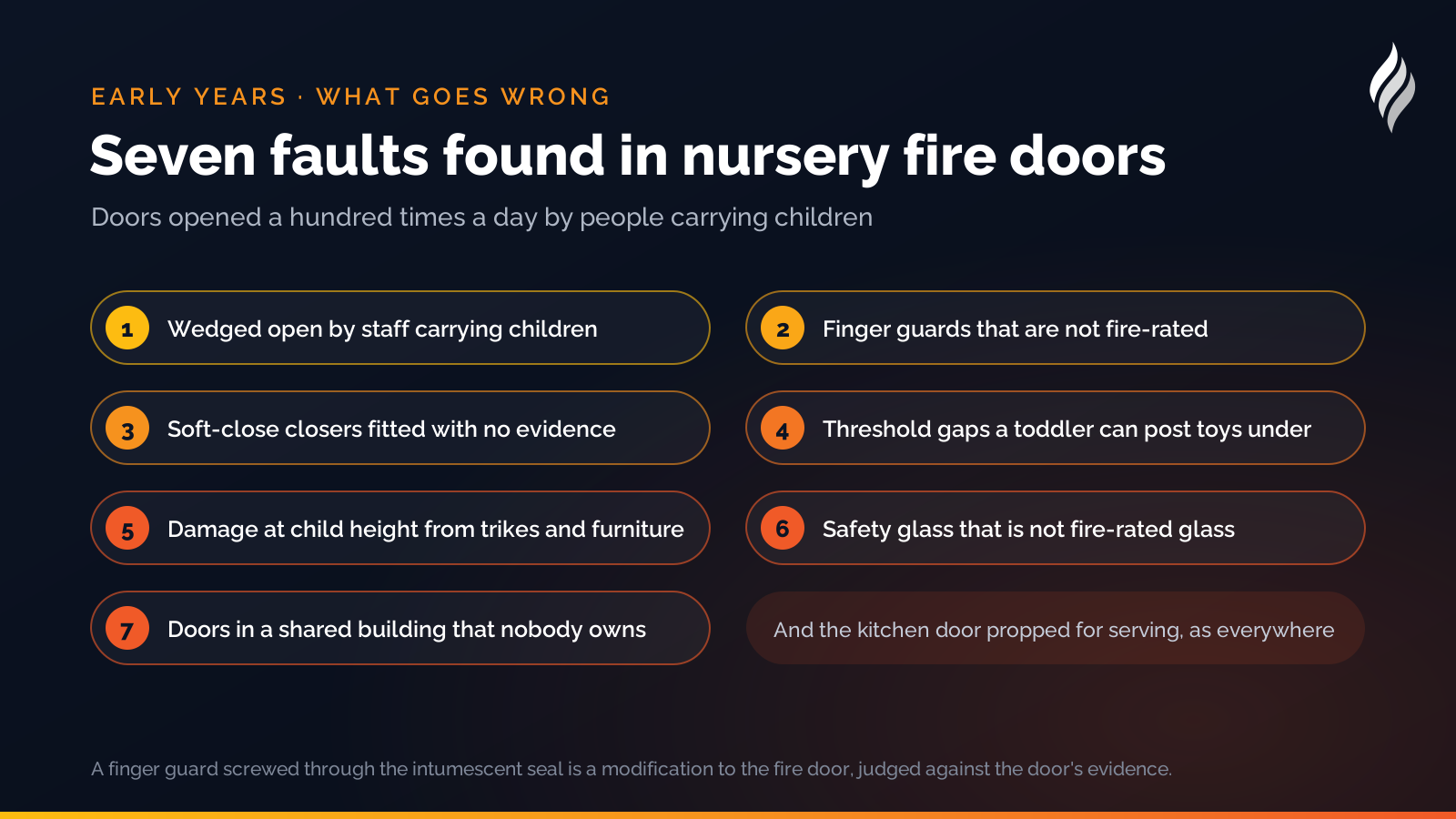
- Wedged open for the reasons above.
- Finger guards and closers that are not fire-rated, or that have been fitted by screwing through the seal.
- Gaps at the threshold large enough to post things through, often because a door has been shortened to clear a new floor covering or a safety mat.
- Damage at child height: dents, splits and missing kick plates from trikes, toy kitchens and furniture, which can breach the leaf's facing.
- Glazing changed for safety glass that is not fire-rated. Low-level glazing in a nursery is often replaced with toughened or laminated safety glass, which is right for impact and wrong for fire unless it is also fire-rated. Our guide to fire door glazing and vision panels explains the difference.
- Doors between the setting and the rest of a shared building treated as somebody else's. A nursery in a church hall, a leisure centre or an office block depends on doors it does not own; the fire risk assessment should say whose they are and who checks them.
- The kitchen door propped for serving, exactly as in a hall or a care home.
A routine a small team can keep
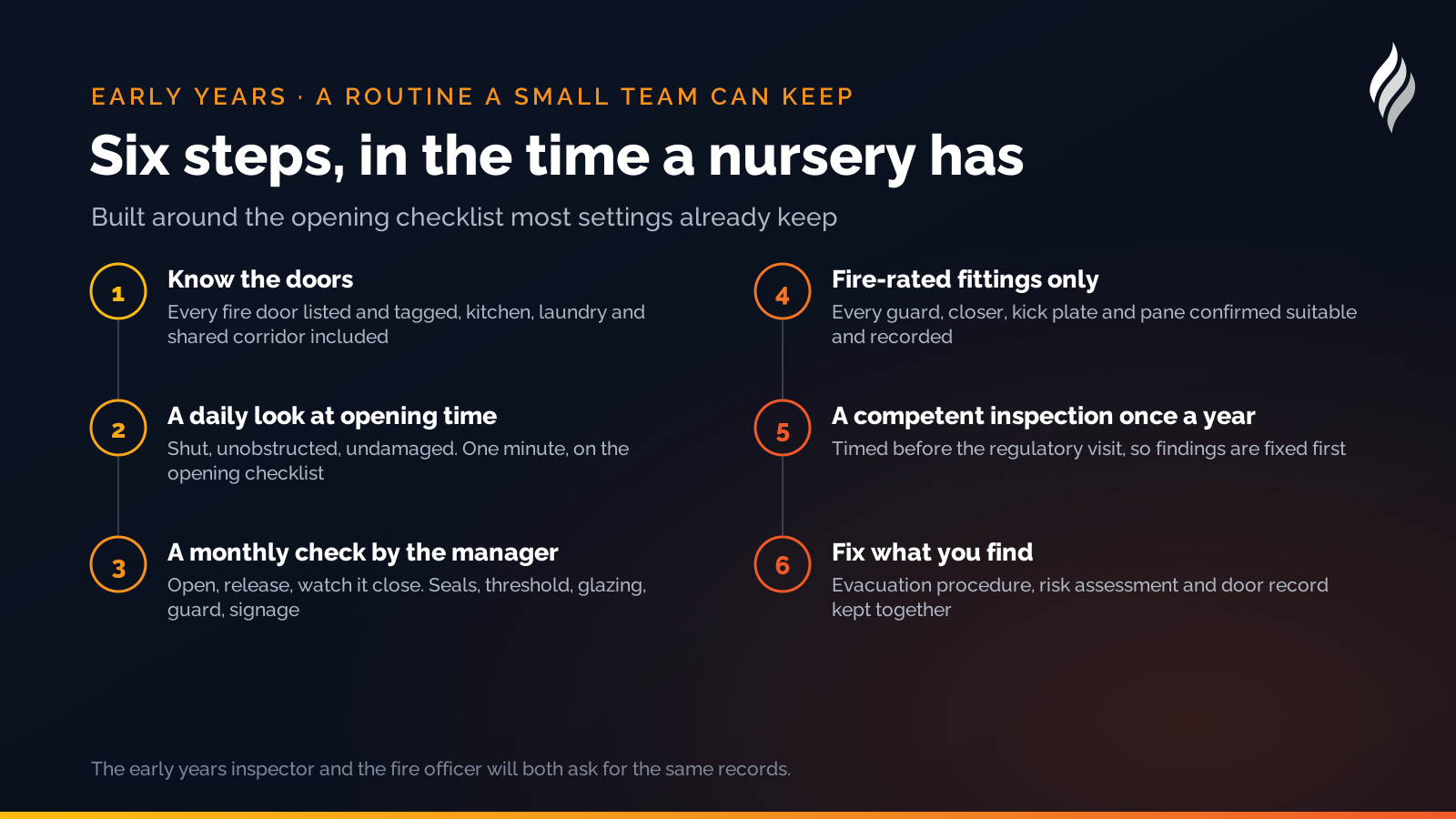
- Know the doors. List every fire door in the setting, including those to the kitchen, laundry, boiler cupboard and any shared corridor, and give each a number or tag. A simple fire door register is enough.
- A daily look at opening time. Whoever opens up walks the setting and checks that every fire door is shut, unobstructed and undamaged. This is a one-minute job and it fits the opening checklist most settings already keep.
- A monthly check by the manager. Open and release each door and watch it close fully onto its latch. Look at the seals, the threshold gap, the glazing, the finger guard and the signage. Our free printable checklist takes about two minutes a door.
- Fire-rated fittings only. Any finger guard, closer, kick plate or glazing fitted to a fire door is one the door's evidence or the fitting's manufacturer confirms is suitable, and the product is recorded against the door.
- A competent inspection once a year, by someone who knows fire doors, timed to fall before the setting's own regulatory inspection so that findings can be fixed first. Our guide to the difference between a check and an inspection explains what a manager can do and when a specialist is needed.
- Fix what you find, and keep the record. The evacuation procedure, the fire risk assessment and the door record belong together, and both regulators will ask to see them.
How DoorTRACE helps
DoorTRACE puts a QR tag on each door so the daily look and the monthly check are done on a phone against the same list, the record builds itself, and the annual inspector works from the same doors. Fittings such as finger guards and closers are recorded against the door with photographs, so the question "is that guard fire-rated?" is answered once rather than at every visit, and the whole history is ready when the early years inspector or the fire officer asks. See the platform, how it works for Responsible Persons and in the education sector, or read about fire door inspection software more generally. Get in touch if you run a setting and would like to talk it through.
After the survey: building a fire door remediation plan
The survey is the easy part. A 300-door building produces a list of defects longer than anyone's budget. Here is how to turn it into a plan the board will sign, the fire officer will accept and the engineers can work from.
Building Notes: your statement on every building report
A customer surveying a heritage church needed a statement on the building report that applied to every door in it. Building Notes is the result: formatted text written once per building, printed on every report.
Fire door frames: the half of the assembly nobody inspects
The leaf gets the gauge, the seals get the scrutiny, and the frame gets a glance. Yet the frame is what holds the door in the wall when the leaf is trying to leave. Here is what to look for.