The survey is the easy part. A competent inspector walks a 300-door building and comes back with a thousand defects: closers out of adjustment, seals missing, gaps too wide, doors with no evidence, leaves that need replacing. The list is accurate, it is longer than anyone's budget, and the Responsible Person now has to decide what to do first, what to do this year, and what to tell the board and the fire officer in the meantime. That decision is the remediation plan, and it is where many fire door programmes stall.
This guide covers how to turn a survey into a plan: prioritising by risk rather than by list order, grouping work so it can be bought and done efficiently, deciding repair against replace, spreading the cost across years without leaving the building unsafe, and keeping the record that shows the plan is real.
Start with what the law expects
The Regulatory Reform (Fire Safety) Order 2005 asks the Responsible Person to keep fire precautions in efficient working order and good repair, and to act on the findings of the fire risk assessment. It does not say every defect must be fixed by Friday. It does expect a reasonable, risk-based approach that a fire officer can follow, which means the plan has to show why some doors come before others, and it has to be moving. A plan with dates and a budget behind it is a defence; a survey in a drawer is not. Our guide to what to do when an enforcement notice arrives describes what happens when the fire service decides the drawer is where it has been.
In a building over 11 metres, Regulation 10 adds the quarterly communal and annual flat entrance checks, so the plan has to assume the next check will find whatever the last one found until it is fixed.
Prioritise by risk, not by list order
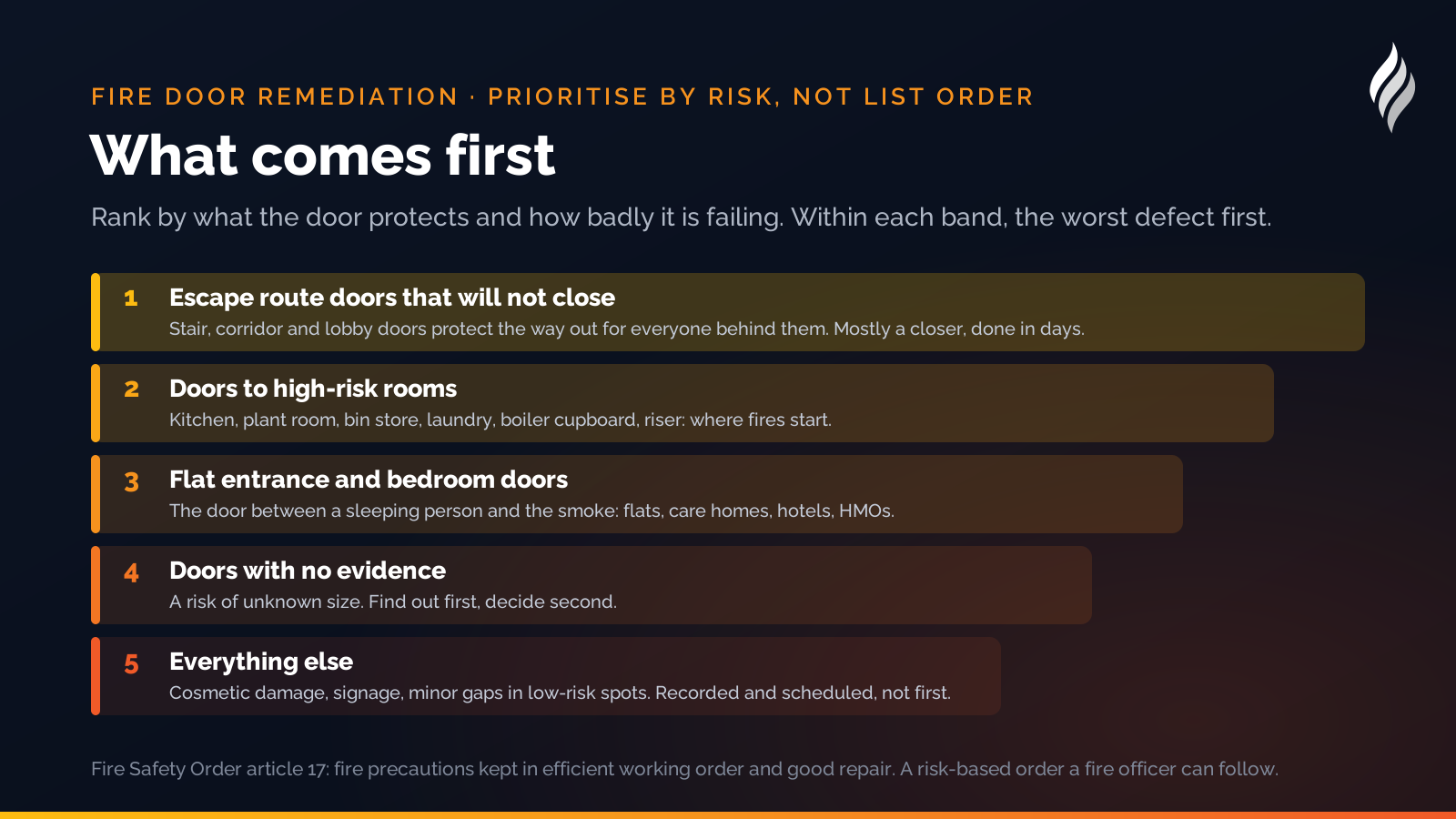
A survey lists defects door by door. A plan has to rank them, and the ranking is about what the door protects and how badly it is failing:
- Doors on the escape route that will not close. A stair door, a corridor door or a lobby door with a failed closer or wedged open protects the way out of the building for everyone behind it. These come first, and most are a closer adjustment or replacement that can be done within days.
- Doors to high-risk rooms. Kitchens, plant rooms, bin stores, laundries, boiler cupboards and electrical risers are where fires start. A door that does not hold here lets a small fire become a building fire.
- Flat entrance doors and bedroom doors in sleeping accommodation. The door between a sleeping person and the smoke. In a block of flats, a care home, a hotel or an HMO, these are the doors the occupants rely on without knowing it.
- Doors with no evidence. A door that may not be a fire door at all is a risk of unknown size; the first job is to find out, the second is to decide.
- Everything else. Cosmetic damage, signage, minor gaps on doors in low-risk positions. Real, recorded, scheduled, but not first.
Within each band, the severity of the defect decides the order: a door that will not close before a door with a worn seal. Our guide to common fire door defects explains what each fault means in a fire, and our article on FD30 and FD60 ratings explains why the same gap is more serious on a 60-minute door.
Group the work
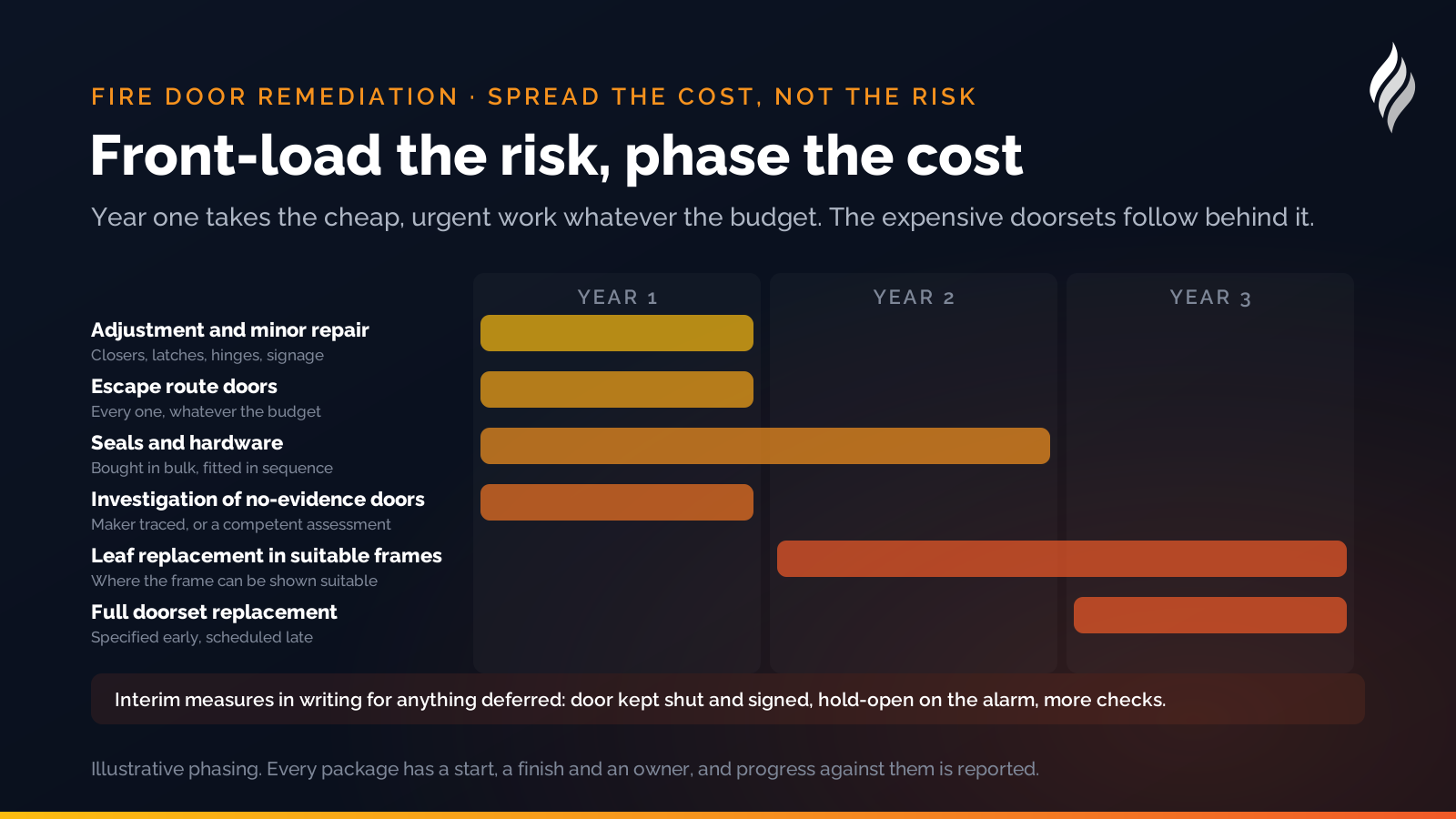
A thousand defects is not a thousand jobs. Grouped by type and location they become a handful of work packages:
- Adjustment and minor repair. Closers, latches, hinges, signage, small gaps. One engineer, one van, a day per floor. This package clears most of the list and most of the band-one risk for the least money, and it should be the first thing ordered.
- Seals and hardware replacement. Intumescent and smoke seals, letterplates, viewers, finger guards. Bought in bulk, fitted in sequence. Our article on letterboxes and apertures covers the fittings that need the right product.
- Leaf replacement in existing frames, where the frame can be shown to be suitable. Our guide to fire door frames explains why the frame decides whether this is a fire door.
- Full doorset replacement, where the frame cannot be shown suitable or the opening has been altered. The most expensive package and the one with the longest lead time, so it is specified early and scheduled late.
- Investigation. Doors with no evidence, which need a manufacturer traced or a competent assessment before they can be placed in any other package.
Grouping also shows the board what the money buys: a modest first package that removes the most serious risk in weeks, and a larger programme behind it.
Repair or replace
For each door in the replacement bands the question is whether repair is worth it. Our guide to repairing or replacing a fire door goes through the decision step by step; the short version for a plan is that a certified door with a single component fault is repaired with the right component, a door with several faults or any damage to the leaf itself is usually replaced, and a door with no evidence is either proved or replaced, never patched. A heritage door is the exception, covered in our guide to fire doors in listed and heritage buildings, where upgrade is almost always preferred to replacement and consent comes first.
Spread the cost without leaving the building unsafe
Few organisations can fund a full programme in one year, and a fire officer does not expect them to. What the fire officer expects is that the risk is managed in the meantime. A credible multi-year plan does three things:
- Front-loads the risk, not the cost. The adjustment package and the escape-route doors go in year one whatever the budget, because they are cheap and they remove the most risk. The expensive doorset replacements are phased behind them.
- Puts interim measures in writing. Where a door cannot be fixed this year, the plan says what is being done instead: a wedge removed and staff told, a faulty door kept shut with a sign, a hold-open device fitted linked to the alarm, an increased inspection frequency, or in the worst case a change to the evacuation strategy. Interim measures are part of the plan, not an admission.
- Has dates and names. Each package has a start, a finish and an owner, and progress against them is reported. A plan nobody reports on is a survey with ambitions.
Keep the record
The plan is only as good as the evidence that it is being followed. For each defect the record should show when it was found, what band it was put in and why, which package it joined, when the work was done, by whom, and the photograph of the result. Our article on what a fire door inspection report should contain covers the survey end; the remediation end needs the same discipline, and the sign-off of the work is as much a record as the finding of the defect. When the fire officer asks what has been done since the survey, the answer should be a list with dates, not a conversation.
The same record is what tells the Responsible Person whether the plan is working. If the next quarterly check finds the same closers out of adjustment, the plan has a maintenance problem as well as a remediation one, and our guide to fire door maintenance is the next read.
How DoorTRACE helps
Every defect a DoorTRACE engineer raises carries its door, its photograph and its severity, so the whole estate's defect list can be sorted by risk and booked to an engineer as scheduled work. Each remedial visit is signed off on the phone with before and after photographs, and the door's status updates the moment the work is done, so the plan's progress is the record and the record is the plan. Reports for a building or a whole client can be produced at any point to show a board or a fire officer where the programme stands. See the platform, the defects and remedial work features, or how it works for facility managers and estates teams. Our fire door inspection software page gives the whole picture; get in touch if you have a survey and no plan yet.
Building Notes: your statement on every building report
A customer surveying a heritage church needed a statement on the building report that applied to every door in it. Building Notes is the result: formatted text written once per building, printed on every report.
Fire doors in nurseries and early years settings
A nursery's occupants cannot evacuate themselves, and its doors are opened a hundred times a day by people carrying children. Here is how the Fire Safety Order applies, where the doors usually go wrong, and what to check.
Fire door frames: the half of the assembly nobody inspects
The leaf gets the gauge, the seals get the scrutiny, and the frame gets a glance. Yet the frame is what holds the door in the wall when the leaf is trying to leave. Here is what to look for.