An inspection is only as good as the report it leaves behind. When the inspector drives away, the report is the evidence: it is what you show a fire and rescue authority, an insurer, a client or, in the worst case, a court. Yet reports vary enormously, from door-by-door records with photographs to a single sheet saying "inspection completed, issues noted". If you commission fire door inspections, this guide covers what a good report contains, and what should make you push back.
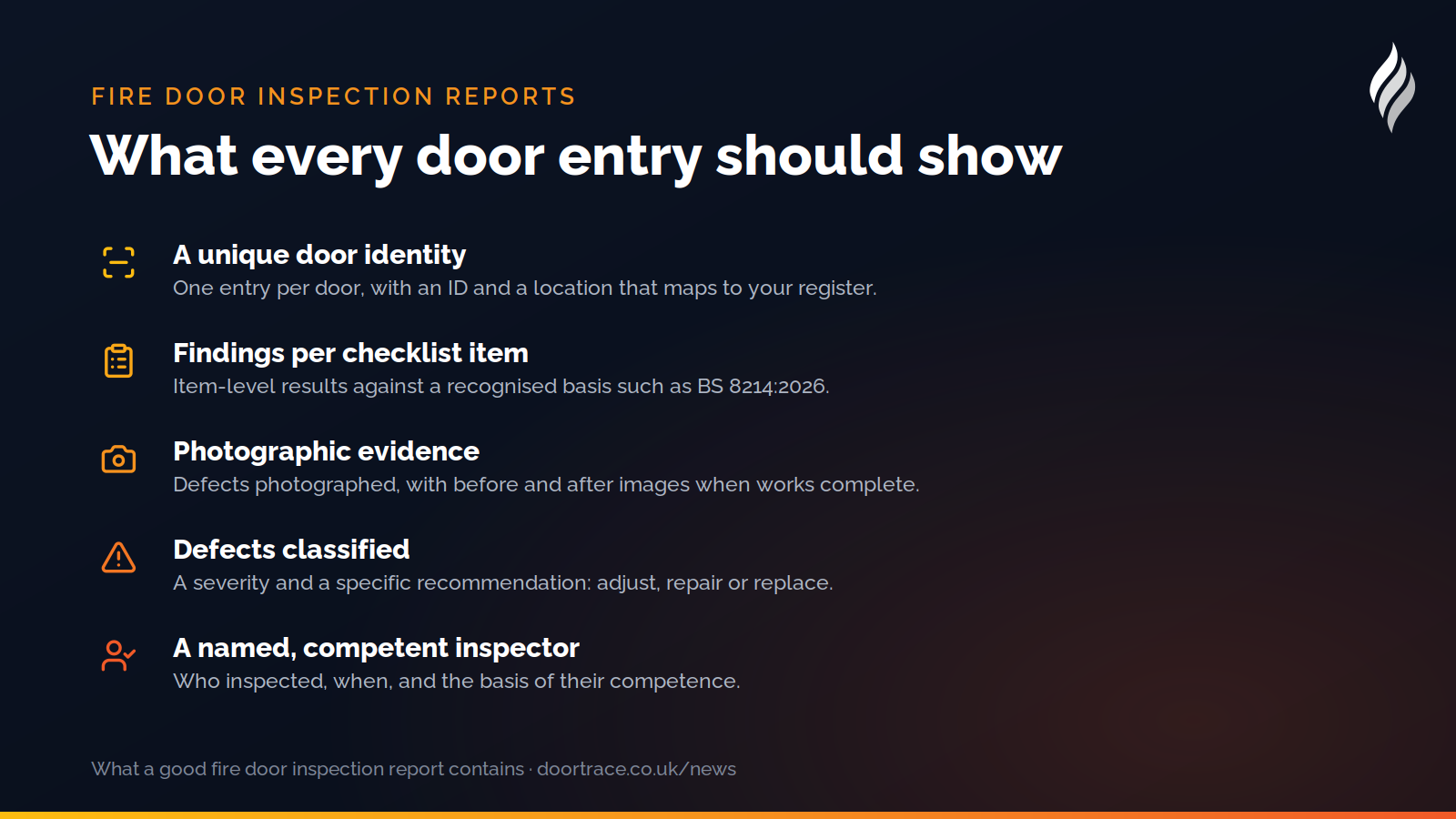
Every door, individually identified
The foundation is granularity. A good report addresses each door as a unique item, with an identity and a location: "FD-014, second floor, east stair" rather than "various doors checked". Without door-level identity you cannot track a door's history, target remedial work, or prove which doors were actually looked at. This is the same principle that makes a fire door register work, and the report should map onto your register door for door.
Findings against a recognised checklist
For each door, the report should show what was assessed, not just a verdict. That means item-level findings across the things that make a fire door perform: gaps and seals, hinges and hardware, the closer, glazing, the frame, signage, the leaf itself. The reference point should be a recognised basis such as BS 8214:2026, and the structure should look a lot like a proper inspection checklist with a recorded outcome per item. "Fail" with no detail tells you a door has a problem; it does not tell you what to fix.
Photographic evidence
Defects should be photographed. Photos remove argument about what was found and what state the door was in on the day, they let a remedial contractor price and plan without a second visit, and paired before-and-after images close the loop when works complete. A report with no images asks everyone downstream to take its word for it.
Defects classified, with clear recommendations
A good report does not stop at findings. Each defect should carry a severity or priority, and a recommendation specific enough to act on: adjust, repair, or replace, and why. The repair or replace call has real cost consequences, so the reasoning should be visible, and the defect types should be named precisely rather than gathered under "general wear".
A named, competent inspector
The report should say who inspected, when, and on what basis they are competent to judge a fire door. Competence is the difference between an opinion and evidence, and if enforcement ever tests your records, an unnamed inspector is a weak place to stand. Our guide to what makes a competent fire door inspector covers what to look for before you commission.
A format that survives
Finally, think about the report's life after delivery. Fire door records are long-lived safety information: the golden thread expects it to be accurate, current, digital and accessible, and a PDF attached to a two-year-old email is none of those things when you need it quickly. Reports should arrive in a form you can store, search and export, connected to the door's ongoing history rather than orphaned from it. If your reports currently live in a drawer, our comparison of paper and digital fire door records shows what that costs you.
Summary numbers that mean something
Above the door-level detail, a good report gives you the portfolio picture: how many doors were inspected, how many passed, how many defects were found and at what severity, and which buildings or floors carry the most. Those numbers are what a board, a client or an insurer actually reads, and they only mean something when the door-level evidence underneath supports them. A summary page with no detail behind it is marketing; detail with no summary makes you do the counting yourself. You want both.
What should make you push back
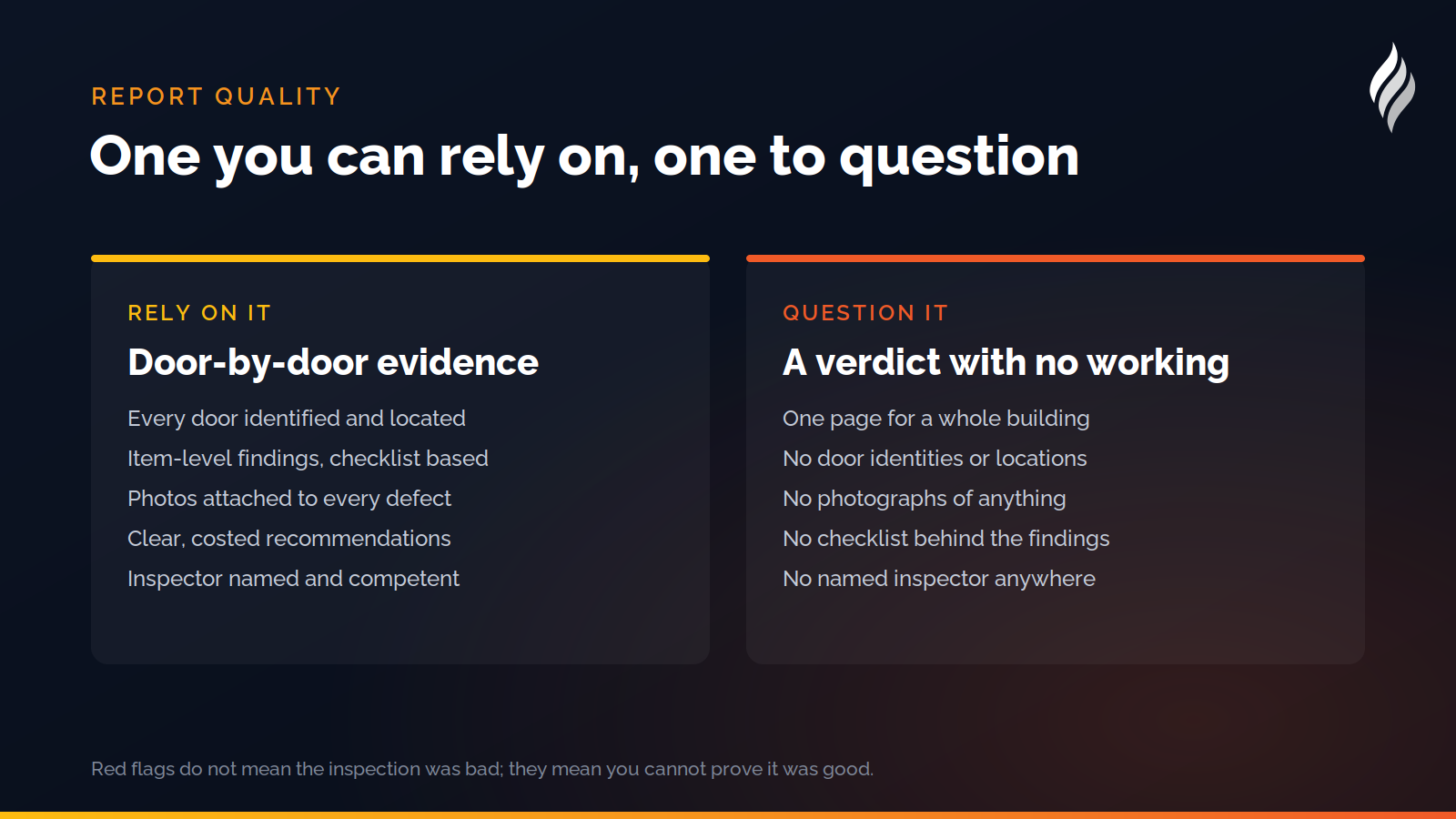
Some red flags are reliable: a single page covering a whole building, no door identities, no photographs, no checklist basis for the findings, no named inspector, or a quote for remedial works with no report behind it at all. None of these mean the inspection was bad, but all of them mean you cannot prove it was good, and proof is the product you are paying for.
When the report arrives
A good report also deserves a good landing. When it comes in, reconcile it against your register so every inspected door's history is updated, turn each defect into a tracked remedial action with an owner and a date, and diarise the next inspection while the current one is fresh. A report that gets read once and filed has done half its job; a report that updates the record and drives the fixes has done all of it.
How DoorTRACE helps
DoorTRACE generates door-by-door inspection reports automatically: every door identified, findings per checklist item, photos attached to defects, the inspector named, and everything stored against the door's permanent history, exportable whenever someone asks. See how fire door inspection software produces evidence instead of paperwork, or talk to us.
Approved Document B: the second staircase era starts today
The amendments to Approved Document B come into force today: more than one common stair in new blocks of flats with a storey 18m or more, evacuation shafts to support evacuation lifts, and new escape guidance. What changes, who it touches, and the fire door angle.
Remedial work is now free to record on DoorTRACE
Only inspections are charged on Pay-As-You-Go from now on. The form that closes out remedial work joins registrations and reports on the free list, so the cost of a door for the year is known before it starts.
Fire doors in warehouses and industrial units
An open warehouse floor resists traditional compartmentation, so its fire doors concentrate around the edges and take the hardest knocks in any sector. Where the doors are, the fork-lift problem, and a check regime for a hard-wearing site.