A fire door earns its rating as a solid barrier between two spaces. Every hole cut into it afterwards, for the post, for a viewer, for ventilation, for the cat, is a hole in that barrier, and the question is never whether the hole is small. A letterplate opening is big enough to pass a hand through, and in a fire it will pass flame and smoke unless something closes it. The question is whether the hole and the thing fitted into it were part of the door's test evidence.
This guide covers the apertures found in fire doors, especially flat entrance doors and HMO bedroom doors where they are most common: which a fire door can carry and on what terms, which it never can, what the inspector should look for on each, and what to do when a door has been cut after it was fitted.
The principle: tested as a set, or not at all
The rating of a fire door belongs to the whole assembly as tested: leaf, frame, seals, hardware and any apertures with what fills them. A manufacturer who wants to sell a flat entrance door with a letterplate tests the door with that letterplate, in that position, and the evidence says so. A different letterplate, or the same one in a different place, or a second hole for a spyhole that was not in the test, is a door the evidence no longer describes. Our guide to inspecting steel, composite and glazed fire doors covers the same rule for the whole door; this article is about the holes.
The fittings that make an aperture acceptable all work the same way. An intumescent material, one that swells many times its size when heated, lines the aperture or sits behind the fitting. When the fire comes, it expands and seals the hole. A letterplate without an intumescent liner, a spyhole without an intumescent sleeve or a grille without an intumescent block is a hole with a decoration round it. Our article on intumescent and smoke seals explains the material.
Letterplates
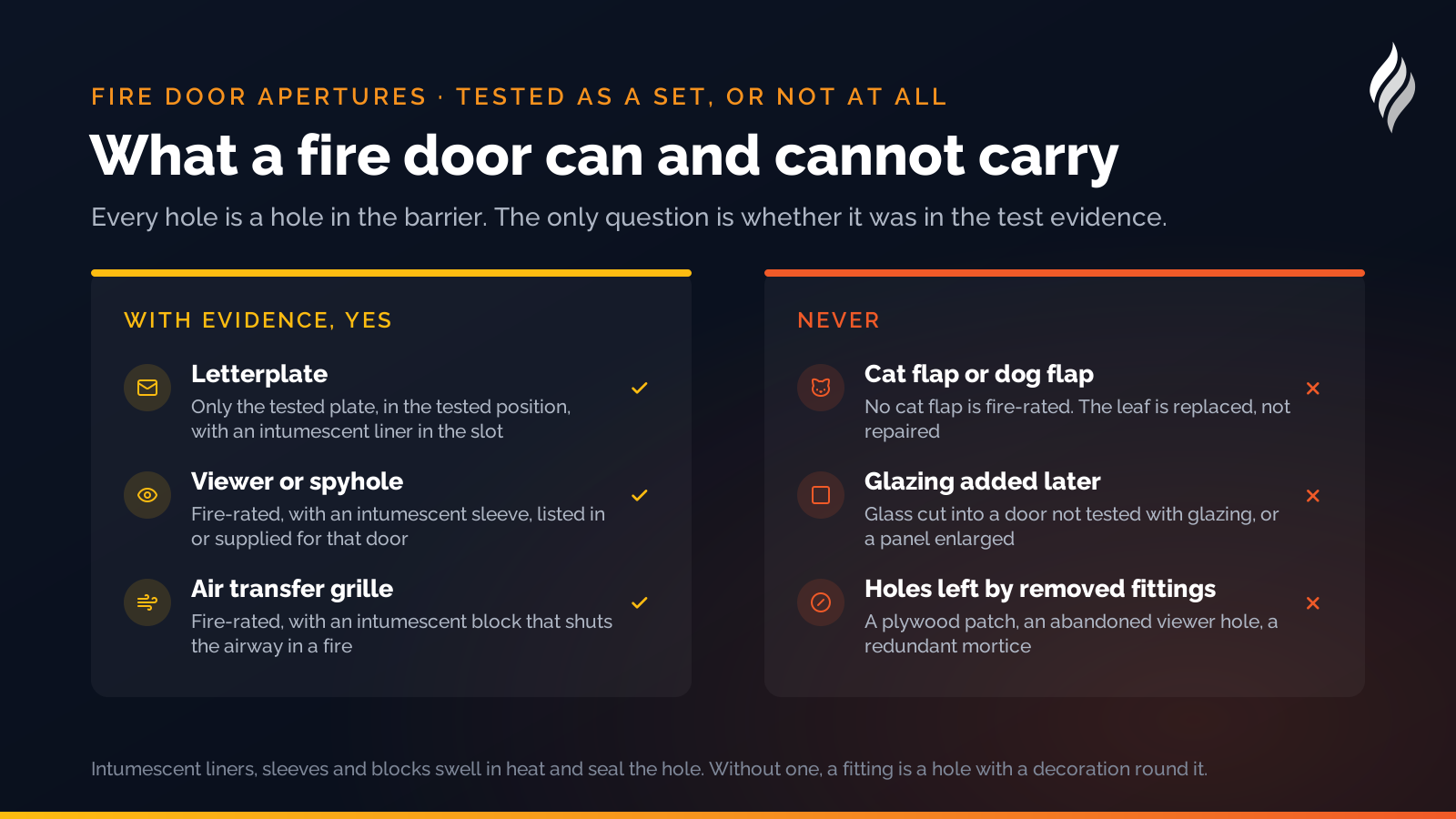
The letterplate is the aperture an inspector meets most, and the one most often changed. A fire-rated letterplate is a set: an outer plate, an inner flap, and an intumescent liner in the slot through the leaf, tested in a door of that construction. Things to look for:
- Is it the tested one? The door's evidence names the letterplate, or at least a specification. A plate changed for a smarter brass one, a draught excluder brush fitted inside, or a second inner flap added for security may each take the door outside its evidence. On a composite door this is the component most often swapped.
- The liner. Look into the slot with the flaps held open. An intumescent liner is usually visible as a sleeve or strips lining the cut. A bare timber or foam edge means no liner.
- The flaps. Both must close under their own spring and sit flat. A flap wedged open by a draught excluder or stuck with paint is a permanent opening.
- The position and size. Evidence limits where in the leaf a letterplate may sit and how large the cut may be. A slot that has been enlarged for a bigger plate, or one cut low down near the threshold where the fire is hottest, is a finding.
- Security add-ons. Letterplate cowls and internal cages fitted to stop fishing for keys are common on flat doors. Some are tested with the door; many are not. Ask the question.
Where post security is the concern, the simplest answer that keeps the fire door whole is to move the letterbox off the door altogether, to a wall-mounted box or a communal bank of boxes, and fill the aperture with a tested blanking plate. Many blocks have done exactly that since 2017.
Viewers and spyholes
A door viewer is a small hole, but it passes straight through the leaf at eye height. A fire-rated viewer has an intumescent sleeve and is listed in the door's evidence or supplied by the manufacturer for that door. A viewer bought online and fitted with a hole saw on a Saturday is neither. Look for the manufacturer's mark on the viewer, for a sleeve where it meets the leaf, and for a hole that is the viewer's size and no larger. Where a viewer has been removed, the hole should have been filled with a tested plug, not filler.
Grilles and ventilation
Air transfer grilles are cut into fire doors in some buildings to ventilate plant rooms and cupboards. A fire-rated grille carries an intumescent block that expands and shuts the airway in a fire. A plain louvred grille does not, and a plain grille in a fire door is one of the clearest failures an inspector can record. Grilles are also the aperture most often added years after the door was fitted, by someone solving a ventilation problem and not thinking about fire. Check the evidence, check for the intumescent block inside the grille, and check that the cut has not been enlarged. Our article on forgotten fire doors in risers, cupboards and plant rooms is where these doors tend to live.
Cat flaps and other holes that never pass
Some things are never acceptable in a fire door, because nothing can be fitted into the hole that restores the barrier:
- Cat flaps and dog flaps. No cat flap is fire-rated. A fire door with a cat flap has a hole in it with a plastic door that melts. The leaf is replaced, not repaired, and the conversation with the resident is worth having gently but having.
- Decorative glazing added after the fact. Glass cut into a fire door that was not tested with glazing, or a panel enlarged beyond the tested size, is covered in our guide to fire door glazing and vision panels. The short version: no evidence, no glass.
- Holes left by removed fittings. An old letterplate removed and the slot filled with a plywood patch, a redundant lock mortice, an abandoned viewer hole. Each needs a tested repair or a new leaf, and a tested repair for an aperture is rarer than people hope.
- Numerals, knockers and smart locks screwed or cut into the leaf. Surface fixings through the facing are usually acceptable within the evidence; a smart lock that needs a new mortice or a cable route through the leaf is a cut, and the same rule applies. Our guide to fire door hinges and hardware covers ironmongery generally.
When a door has been cut after fitting
Finding an aperture that was not in the door's evidence does not always mean a new door, but it always means a decision rather than a shrug. The options, in rough order of preference:
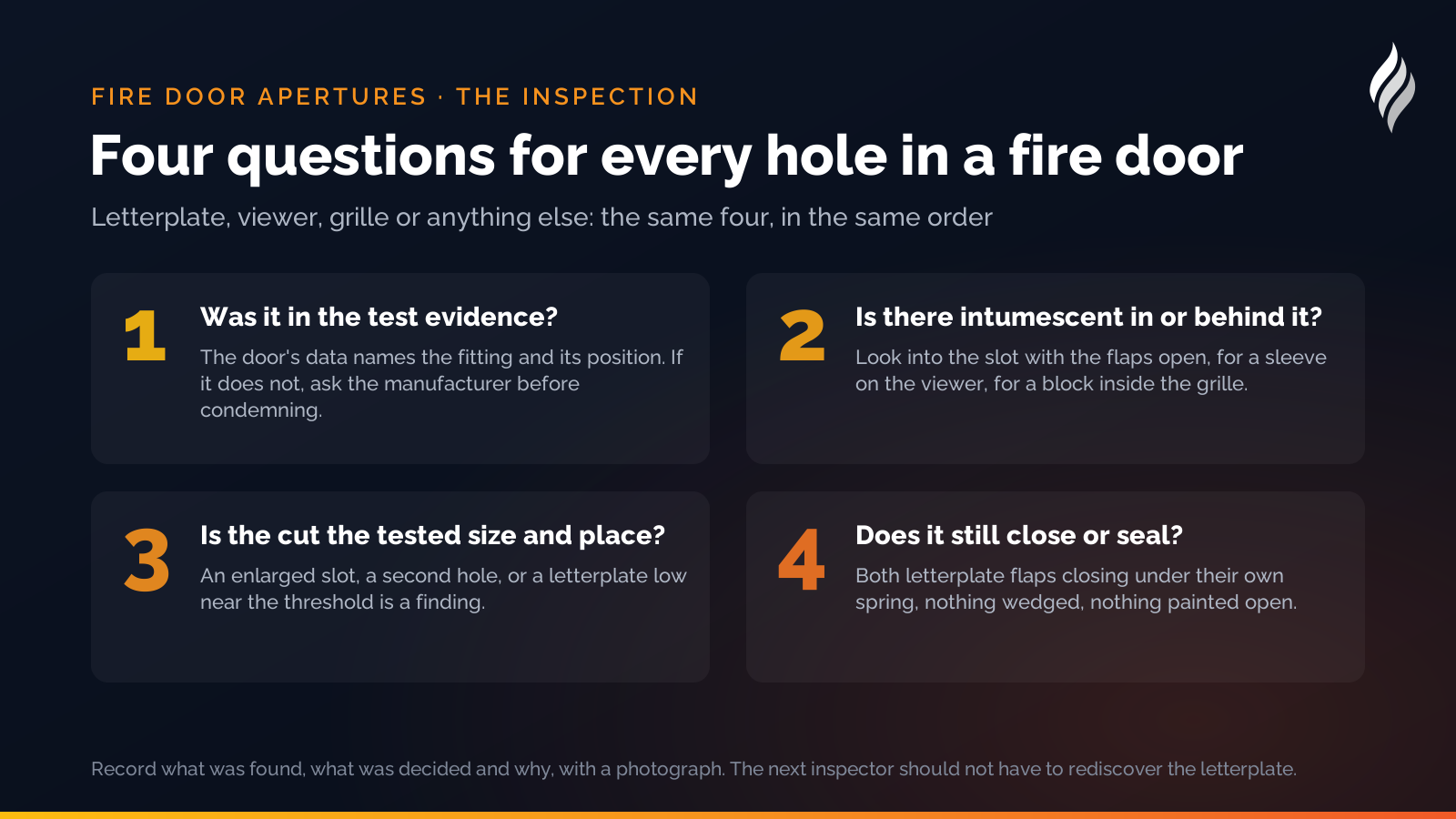
- Confirm the evidence. Sometimes the fitting is in the manufacturer's data after all, or the manufacturer will confirm in writing that it is acceptable for that door. Ask before condemning.
- Replace the fitting with a tested one. For letterplates, viewers and grilles there is usually a fire-rated equivalent that fits the existing cut, and the manufacturer of the fitting will say which door constructions it has been tested in.
- Blank the aperture with a tested plate. Where the fitting is no longer wanted, a blanking plate tested for the purpose closes the hole.
- Replace the leaf. For a cat flap, an enlarged cut or a hole nothing tested will fill, the leaf goes. Our guide to repairing or replacing a fire door covers the wider choice.
Whatever is done, the record should say what was found, what was decided and why, with a photograph of the aperture. The next inspector should not have to rediscover the letterplate.
Where this bites hardest
Flat entrance doors in blocks of flats are where apertures and the law meet. Under Regulation 10 the Responsible Person in a building over 11 metres checks flat entrance doors at least annually, and residents are responsible for not altering their doors. A resident who fits a cat flap or swaps a letterplate has altered a fire door, and the information duty under Regulation 10 is the place to tell residents so before it happens. Our guide to flat entrance fire doors and our article on HMO fire door duties cover the two settings where bedroom and entrance doors carry the most fittings.
How DoorTRACE helps
The DoorTRACE checklists ask about the door's apertures as part of every inspection, and the engineer photographs what is there, so a changed letterplate or a new viewer shows up against the last visit rather than being missed. A defect raised against an aperture carries its photograph and its remedial work through to sign-off, and the door's full history is on its record for the next visit. See the platform, the fire door inspection app the engineer uses on site, or our fire door inspection software page for the whole picture. The free inspection checklist PDF includes the aperture checks, and if you manage blocks or HMOs, get in touch.
After the survey: building a fire door remediation plan
The survey is the easy part. A 300-door building produces a list of defects longer than anyone's budget. Here is how to turn it into a plan the board will sign, the fire officer will accept and the engineers can work from.
Building Notes: your statement on every building report
A customer surveying a heritage church needed a statement on the building report that applied to every door in it. Building Notes is the result: formatted text written once per building, printed on every report.
Fire doors in nurseries and early years settings
A nursery's occupants cannot evacuate themselves, and its doors are opened a hundred times a day by people carrying children. Here is how the Fire Safety Order applies, where the doors usually go wrong, and what to check.