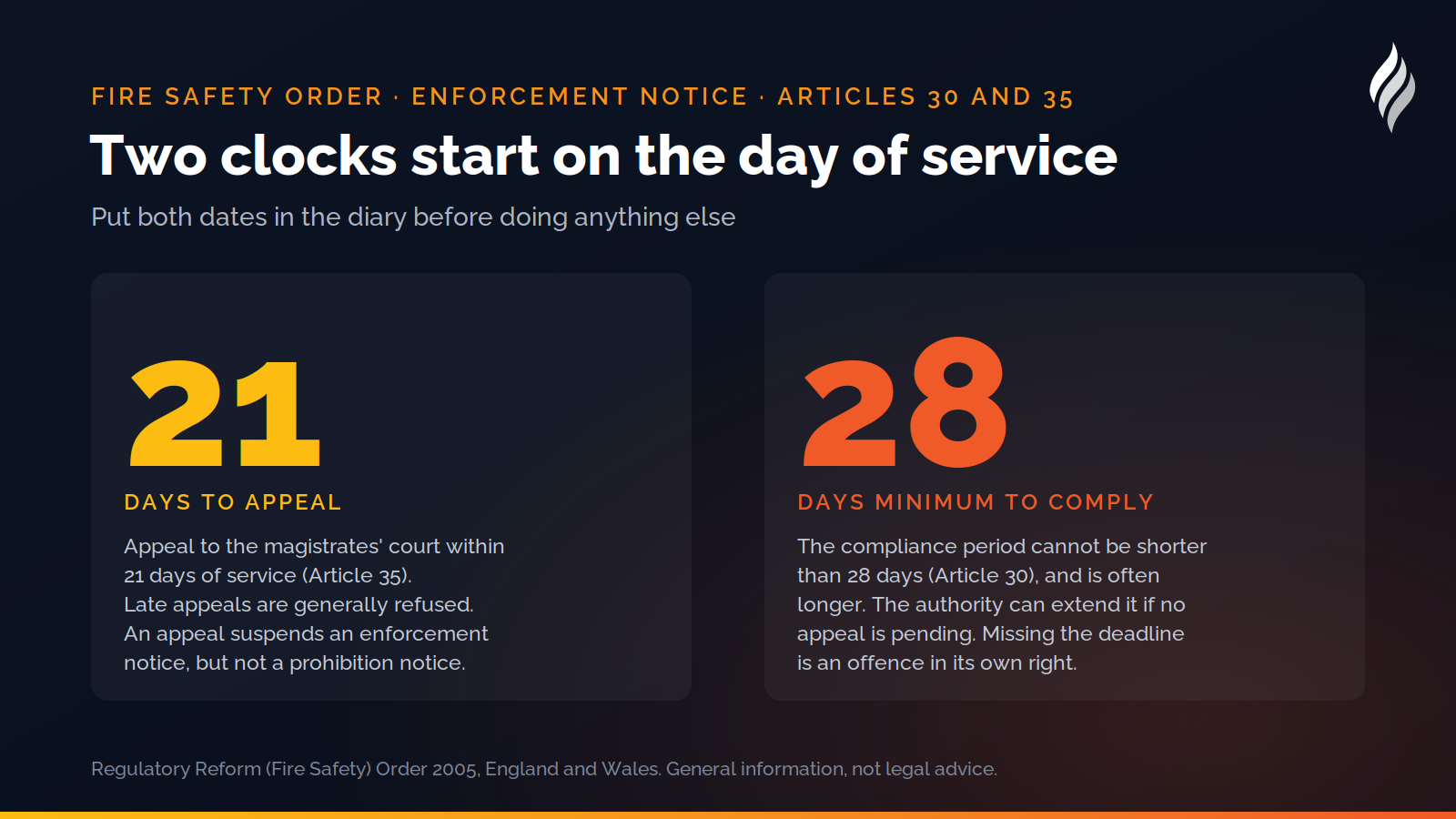
An enforcement notice from the fire and rescue service is not the end of the world, but it is the start of a clock. Two clocks, in fact: 21 days to appeal if you think the notice is wrong, and at least 28 days to put right whatever it says is wrong. In the year to March 2026, English fire and rescue services served 1,896 enforcement notices and 1,224 prohibition notices, and completed 33 prosecutions. Nearly every prosecution we have covered in our Q2 and Q3 roundups began with a notice that was not acted on.
This guide walks through what to do from the day the notice arrives: reading it properly, deciding whether to appeal, planning the works, dealing with the inspecting officer, and building the evidence that closes the notice out. It covers England and Wales under the Regulatory Reform (Fire Safety) Order 2005. It is general information, not legal advice; a notice is exactly the moment to take proper advice.
First, work out which notice you have
The Fire Safety Order gives an enforcing authority three statutory notices, and they behave differently.
- Enforcement notice (Article 30). The authority believes you have failed to comply with the Order, and the failure is serious enough that it needs to be put right formally. The notice states the failures and requires you to remedy them within a period of not less than 28 days from service. It may include directions on the measures the authority considers necessary, and those can offer a choice between different ways of fixing the problem.
- Prohibition notice (Article 31). The risk is judged so serious that use of the premises, or part of them, must be restricted or stopped, immediately or from a stated date. This is the notice that empties a floor of a hotel or closes the rooms above a takeaway. Breaching it is its own offence, and the courts have sent people to prison, suspended, for doing so.
- Alterations notice (Article 29). Not a finding of a breach. It tells you the premises are high risk enough that you must notify the authority before making changes that would increase the risk.
Most fire door problems arrive as enforcement notices: doors that do not close, missing seals, damaged leaves, doors wedged open, a corridor door replaced with something that is not a fire door at all. A prohibition notice is more likely where those doors protect the only escape route from sleeping accommodation. The rest of this guide is about the enforcement notice, with a note on prohibitions where they differ.
The two deadlines
Day 21: the appeal window closes. Article 35 gives you 21 days from the day the notice is served to appeal to the magistrates' court. Late appeals are generally not accepted. An appeal against an enforcement or alterations notice suspends it until the appeal is decided or withdrawn; an appeal against a prohibition notice does not suspend it unless the court directs. The court can cancel the notice, affirm it as written, or affirm it with changes.
Day 28 at the earliest: the compliance deadline. The authority sets the period, and by law it cannot be shorter than 28 days. It can be longer, and for structural work it often is. If no appeal is pending, the authority can extend the period, and can withdraw the notice altogether. Failing to comply with a notice is a specific offence, separate from any offence for the underlying breach.
Those two dates should go in a diary on day one. The single most common way an enforcement notice turns into a prosecution is a Responsible Person who spends the first three weeks deciding how to react, then discovers that ordering doorsets, booking an installer and getting the work certified takes longer than the days that are left.
Days 1 to 3: read it, record it, tell people
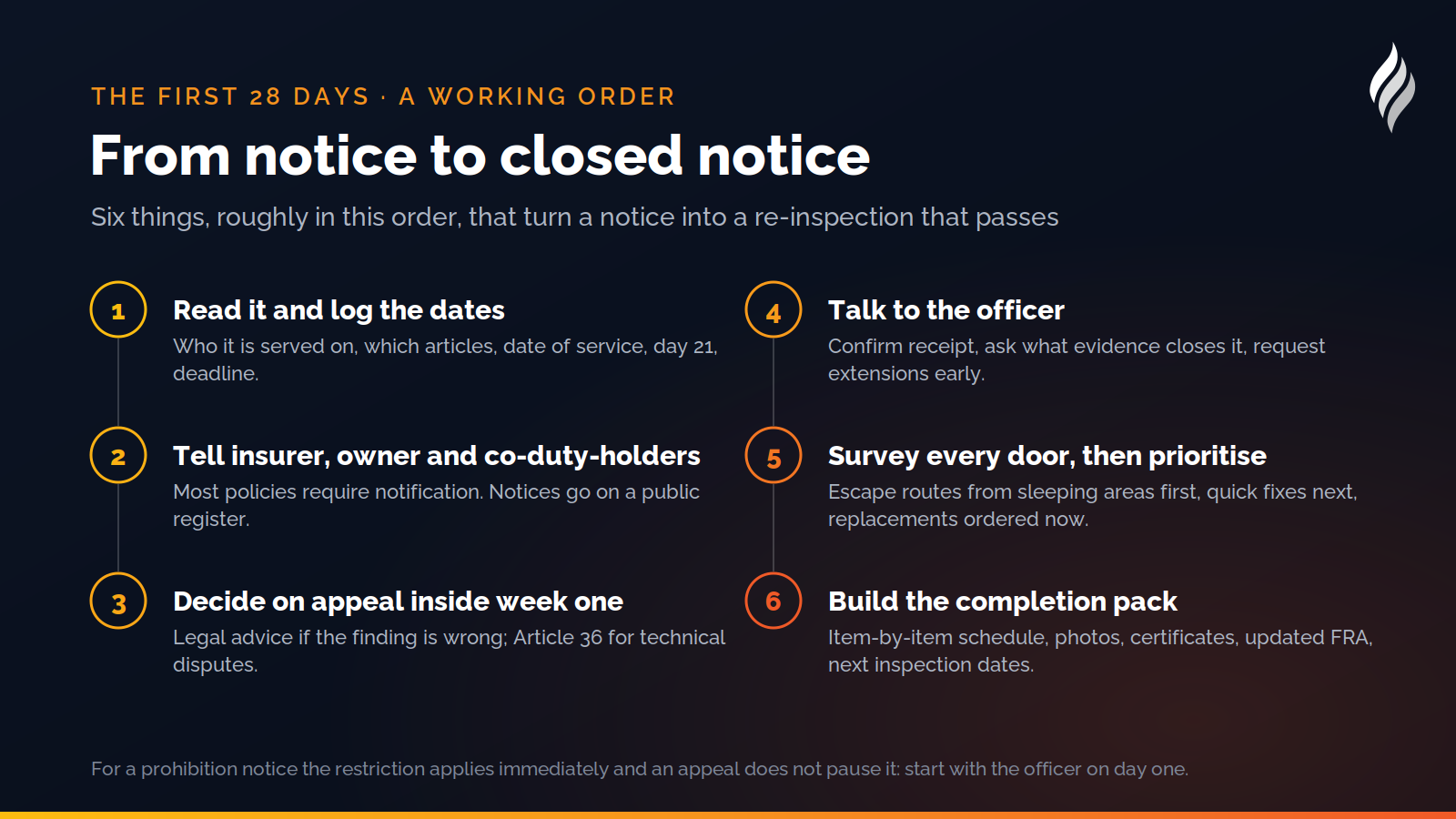
Start by reading the notice as a document, not as an insult. It should identify the premises, the Responsible Person it is served on, the articles of the Order the authority believes you have breached, the failures found, the date of service, the compliance period, and the right of appeal. Check every one of those. A notice served on the wrong person, or one that cites the wrong premises, is a real problem for the authority, and a reason to speak to a lawyer rather than to ignore it.
Then do three practical things:
- Log the dates. Date of service, day 21 and the compliance deadline. Put them where the people who have to act on them will see them.
- Tell the people who need to know. The board or owner, your insurer (most policies require notification of enforcement action), any managing agent or freeholder who shares responsibility, and if the building is a higher-risk building, the Accountable Person. Notices go on a public register, so others may hear about it anyway.
- Collect what you already have. The last fire risk assessment, the fire door register, inspection records, any works orders in progress. What you can show already done is the starting point for the conversation with the officer.
Days 3 to 10: decide whether to appeal, and talk to the officer
Very few notices are appealed, and most of those are about the timescale or a specific required measure rather than the finding itself. If you believe the officer has misunderstood the building, the notice cites a breach that is not there, or the compliance period is impossible for the work required, take legal advice inside the first week, because the 21 days will not wait.
Where the disagreement is technical rather than legal, for example whether a particular door needs replacing or can be repaired, the Order provides for a determination by the Secretary of State under Article 36. The enforcement guidance MHCLG updated in July 2026 sets out how that route works, and it is worth knowing it exists before an argument with an officer hardens into a court date.
For everyone else, the right move is a conversation. Fire and rescue services say the same thing in almost every prosecution press release: they would rather work with a Responsible Person who engages than prosecute one who does not. Contact the officer named on the notice, confirm you have received it, and ask what evidence of completion they will want to see. If the deadline is unrealistic for the works required, say so now, with a programme that shows why, and ask for an extension in writing. Authorities can extend the period if no appeal is pending, and they are far more likely to do so for someone who asked in week two than someone who asked the day before it expired.
Days 10 to 28: fix it, and fix it in the right order
Treat the notice as a symptom, not a checklist. If the officer found four fire doors that did not close, the odds are that others in the building are in the same state and were simply not inspected that day. A full survey of every fire door before ordering any work costs a few days and prevents the second notice.
Then prioritise:
- Anything that protects an escape route from sleeping accommodation comes first. Flat entrance doors, doors onto the stair, doors on the only way out from bedrooms.
- Quick fixes next. Adjusting a closer, replacing a damaged seal, removing a wedge and putting a sign up, refitting a dropped hinge. Our guide to common defects covers most of what an officer will have listed.
- Replacements last, but ordered first. A doorset that needs replacing has a lead time; order it in the first week so it arrives inside the period, and tell the officer the date.
For every door, keep a before and after record: the defect, the fix, who did it, when, and a photograph. Our guide on repairing or replacing a fire door helps with the judgement call, and whoever does the work should be competent for it. The BS 8214:2026 code of practice is the reference for installation.
Closing it out: the evidence that ends the notice
An enforcement notice is closed when the authority is satisfied the failures have been remedied. That usually means a re-inspection, and what the officer wants to see is proof, not assurance. Prepare a completion pack before the deadline:
- A schedule of every item in the notice, with the action taken and the date.
- The door-by-door record: photographs, installer or maintainer details, certification for any new doorsets.
- The updated fire risk assessment, reviewed to reflect the works and, ideally, to explain how the failures arose and what now stops them recurring.
- The inspection regime going forward, with the next dates already set.
The last item is the one that separates a closed notice from a repeat visit. In the Brighton case in our Q3 roundup, the kitchen fire door the officers found wedged open in February 2023 was still wedged open on visits through December of that year. The notice was not the problem; the absence of anything that would have caught the door being wedged again was.
If it is a prohibition notice
Everything above applies, with three differences. The restriction takes effect when the notice says it does, usually immediately, and appealing does not pause it. Using the restricted part of the premises anyway is the offence that produced this quarter's suspended prison sentence in Bishop's Stortford. And the way out is not a compliance period but satisfying the authority that the risk has been removed, so the conversation with the officer starts on day one, not day three.
This guide is general information about the Fire Safety Order's enforcement provisions, not legal advice. If you have been served with any statutory notice, take advice from a suitably qualified professional.
How DoorTRACE helps
The completion pack above is what DoorTRACE produces as a matter of course: a fire door register for the building, an inspection record for every door, defects logged with photographs and closed with post-remedial evidence, and reports that show an officer the whole story on one screen. It is also the inspection regime that stops the next notice arriving. See how fire door inspection software produces that pack, or book a demo.
After the survey: building a fire door remediation plan
The survey is the easy part. A 300-door building produces a list of defects longer than anyone's budget. Here is how to turn it into a plan the board will sign, the fire officer will accept and the engineers can work from.
Building Notes: your statement on every building report
A customer surveying a heritage church needed a statement on the building report that applied to every door in it. Building Notes is the result: formatted text written once per building, printed on every report.
Fire doors in nurseries and early years settings
A nursery's occupants cannot evacuate themselves, and its doors are opened a hundred times a day by people carrying children. Here is how the Fire Safety Order applies, where the doors usually go wrong, and what to check.