Fire door failings put two property managers in front of a Crown Court judge this quarter, and they did not leave with a warning. Between April and June 2026, courts and councils in England handed down suspended prison sentences, community orders and well over £100,000 in fines, costs and penalties for fire safety breaches, with defective fire doors appearing in case after case. This is our first quarterly enforcement roundup: what happened, who was held to account, and what it tells anyone with fire doors in their building.
Below are the quarter's stand-out cases, the numbers behind them, and the wider pattern they point to. As with all enforcement content, this is general information, not legal advice.
Windsor: inadequate fire doors and suspended sentences
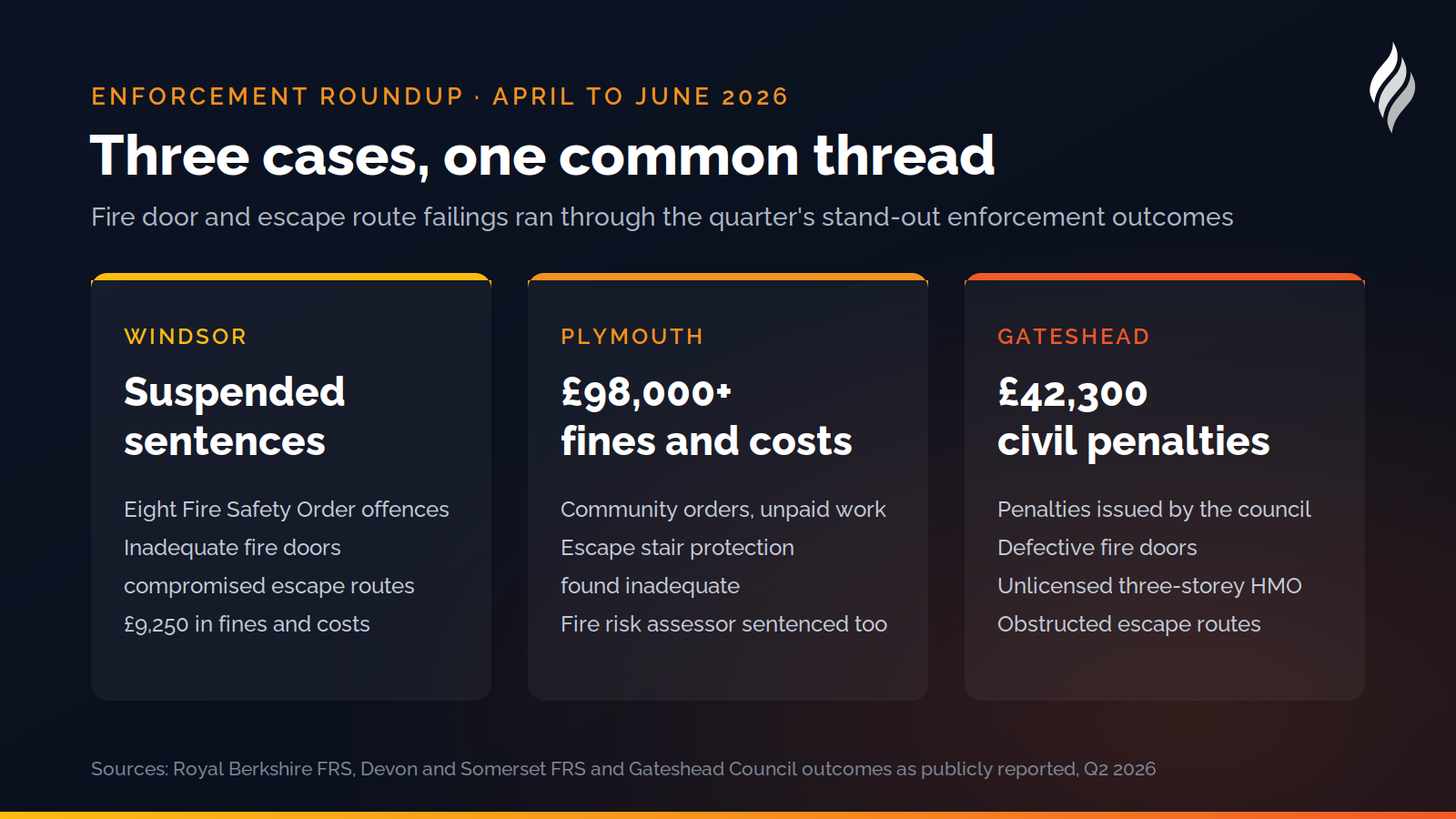
The clearest fire door case of the quarter came out of Reading Crown Court on 22 May. Two managers of a mixed commercial and residential property on St Leonards Road in Windsor pleaded guilty to eight offences under the Fire Safety Order following a prosecution by Royal Berkshire Fire and Rescue Service.
Investigators found no working fire detection covering the commercial and residential parts of the building, insufficient emergency lighting, and fire doors so inadequate they would have compromised the means of escape in a fire. Both defendants received 14-week custodial sentences, suspended, and the fines, costs and surcharge came to £9,250 between them.
The lesson is blunt: courts now treat a defective fire door not as a paperwork slip but as a direct threat to people's escape routes, and sentencing reflects that.
Plymouth: four years of investigation, three defendants sentenced
On 22 June, Plymouth Crown Court sentenced three parties over failings at Latitude 52, a high-rise residential block, after a four-year investigation by Devon and Somerset Fire and Rescue Service. A ground-floor smoke ventilation system had been removed to make room for a new flat, fire-resisting construction protecting an escape staircase was inadequate, and a mechanical ventilation system had gone unmaintained, in a building that also had a combustible external wall system. Prohibition notices were served during the investigation and residents were protected by a waking watch while the risks were addressed.
The director behind the building received an 18-month community order with 240 hours of unpaid work and costs of almost £35,000. His management company was fined £12,000 plus £18,000 in costs. The fire risk assessor who signed the building off was sentenced too: a 12-month community order, 120 hours of unpaid work and £34,000 in costs. Across the three defendants, fines and costs came to more than £98,000.
Two things stand out. Passive fire protection, meaning the walls, doors and compartmentation that hold a fire back, is now prosecuted as seriously as alarms and extinguishers. And assessors themselves are in the frame: signing off a complex building you do not fully understand carries personal consequences.
Gateshead: £42,300 in civil penalties for one HMO
Not every enforcement action goes through a courtroom. In June, Gateshead Council reported financial penalties totalling £42,300 issued to the landlord of an unlicensed three-storey HMO housing seven people. Among the failings: defective fire doors, a faulty fire alarm, no emergency lighting, obstructed escape routes, and bedroom doors that needed a key to open from the inside.
Civil penalties under Housing Act powers let councils act without bringing a prosecution, and they are clearly willing to use them. For HMO landlords the message is the same either way: fire door defects sit near the top of the list every time a council inspects.
Reported this quarter: a £94,000 care home fine
One more case dominated the fire safety press in April, although sentencing fell on 31 March, a day before the quarter began. The operator of a Dorset care home was fined £70,000 with £24,000 in costs and surcharge after pleading guilty to a Fire Safety Order offence, following the death of a vulnerable resident who suffered fatal burns in the home's designated smoking area in 2023. Care settings remain a heavy focus for fire and rescue authorities, and the sums involved dwarf those in smaller residential cases.
The bigger picture: enforcement is rising
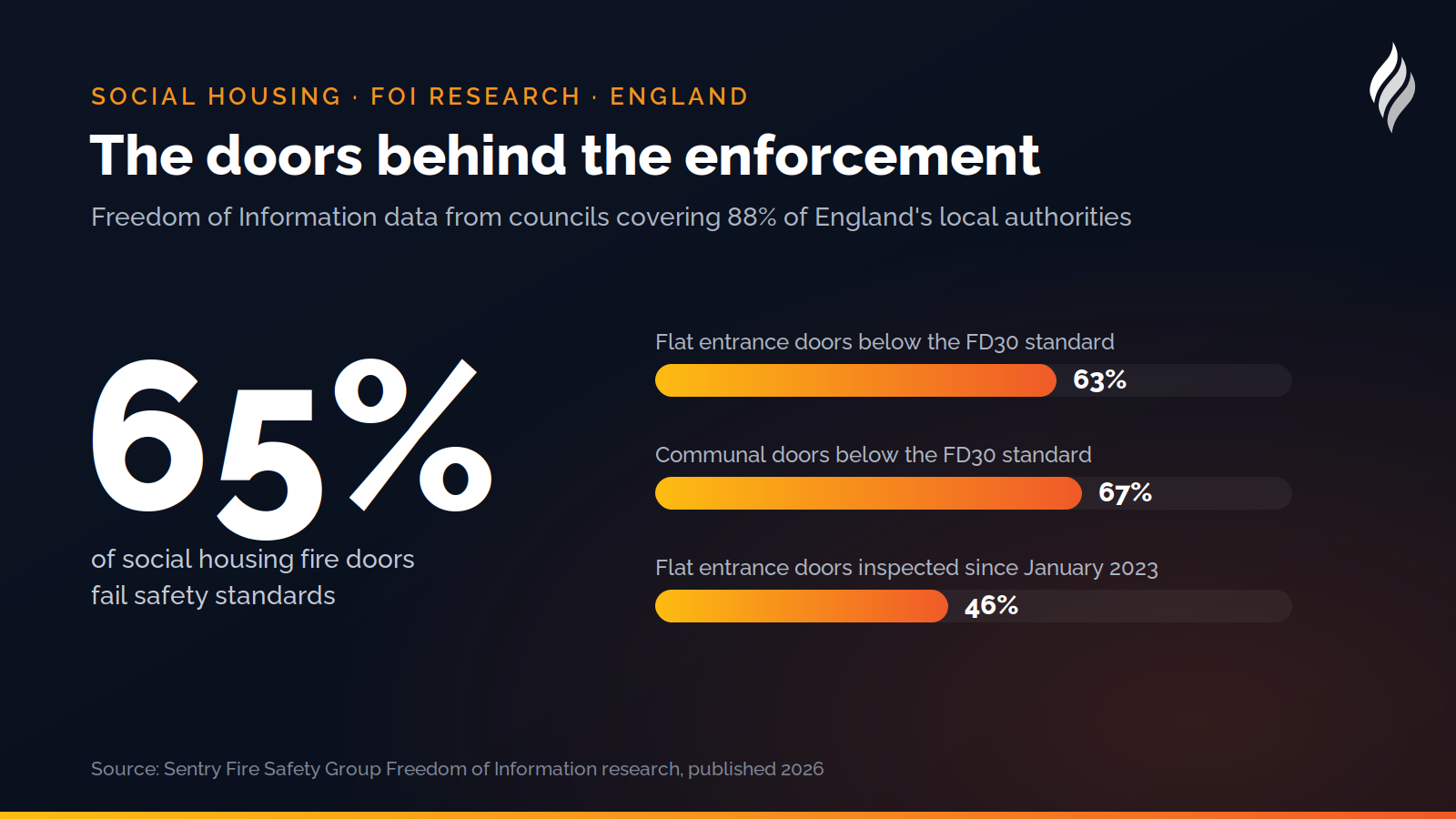
None of this is happening in isolation. Research published this year by Sentry Fire Safety Group, based on Freedom of Information responses from councils covering 88% of England's local authorities, found that around 65% of social housing fire doors fail safety standards: 63% of flat entrance doors and 67% of communal doors did not meet the FD30 standard, and only 46% of flat entrance doors had been inspected since Regulation 10 checks became mandatory in January 2023.
At the same time, one prominent fire safety lawyer has described formal enforcement under the Fire Safety Order as being at its highest level in at least five years, a trend we looked at when updated enforcement guidance arrived in July. Put those two facts together and this quarter's cases look less like bad luck and more like a pattern taking shape: a large stock of failing doors, and regulators increasingly willing to act on them.
Since the quarter closed
July has already produced a fire door case of its own. On 16 July, the operator of a guest house near Shepton Mallet was fined £26,000 with £7,700 in costs and surcharge at Taunton Magistrates' Court for four Fire Safety Order offences, including defective fire doors, a fire alarm carrying nine faults and no fire risk assessment at all. Prohibition notices had already stopped the premises being used for sleeping. We will cover it fully in the Q3 roundup.
What Responsible Persons should take from Q2
The cases above involve different building types, different enforcers and different legal routes, and fire doors run through all of them. If you are the Responsible Person, the practical response is the one we set out in our guide to the penalties for fire door non-compliance: know your doors, inspect them on a schedule, fix the common defects quickly, and keep records that prove all of it. Every case in this roundup started with a problem someone could have found and fixed first.
This roundup is general information about publicly reported enforcement outcomes, not legal advice. If you are facing enforcement action, take advice from a suitably qualified professional.
How DoorTRACE helps
DoorTRACE gives Responsible Persons a live, evidenced record of every fire door: what was inspected, what was found, what was fixed and when. Inspection schedules, defect tracking and audit-ready reports mean that if an inspector calls, your evidence is already in order. See the platform or book a demo to run it on your own buildings.
Approved Document B: the second staircase era starts today
The amendments to Approved Document B come into force today: more than one common stair in new blocks of flats with a storey 18m or more, evacuation shafts to support evacuation lifts, and new escape guidance. What changes, who it touches, and the fire door angle.
Remedial work is now free to record on DoorTRACE
Only inspections are charged on Pay-As-You-Go from now on. The form that closes out remedial work joins registrations and reports on the free list, so the cost of a door for the year is known before it starts.
Fire doors in warehouses and industrial units
An open warehouse floor resists traditional compartmentation, so its fire doors concentrate around the edges and take the hardest knocks in any sector. Where the doors are, the fork-lift problem, and a check regime for a hard-wearing site.