A warehouse is a strange building for fire doors: a vast open floor with almost none, ringed by edges that concentrate more fire door duty per doorway than almost anywhere else. High fire loads, machinery traffic that batters doors daily, and openings that are not doors at all in the ordinary sense. The Regulatory Reform (Fire Safety) Order 2005 applies to industrial premises like any workplace, with a Responsible Person carrying the duties, but how those duties land on an industrial site is its own story.
This guide covers where the fire doors actually sit when the floor is one big compartment, the sector's signature failure, the shutters and curtains that do a fire door's job on oversized openings, the insurance dimension, and a check regime that survives machinery traffic.
Where the doors sit on an open floor
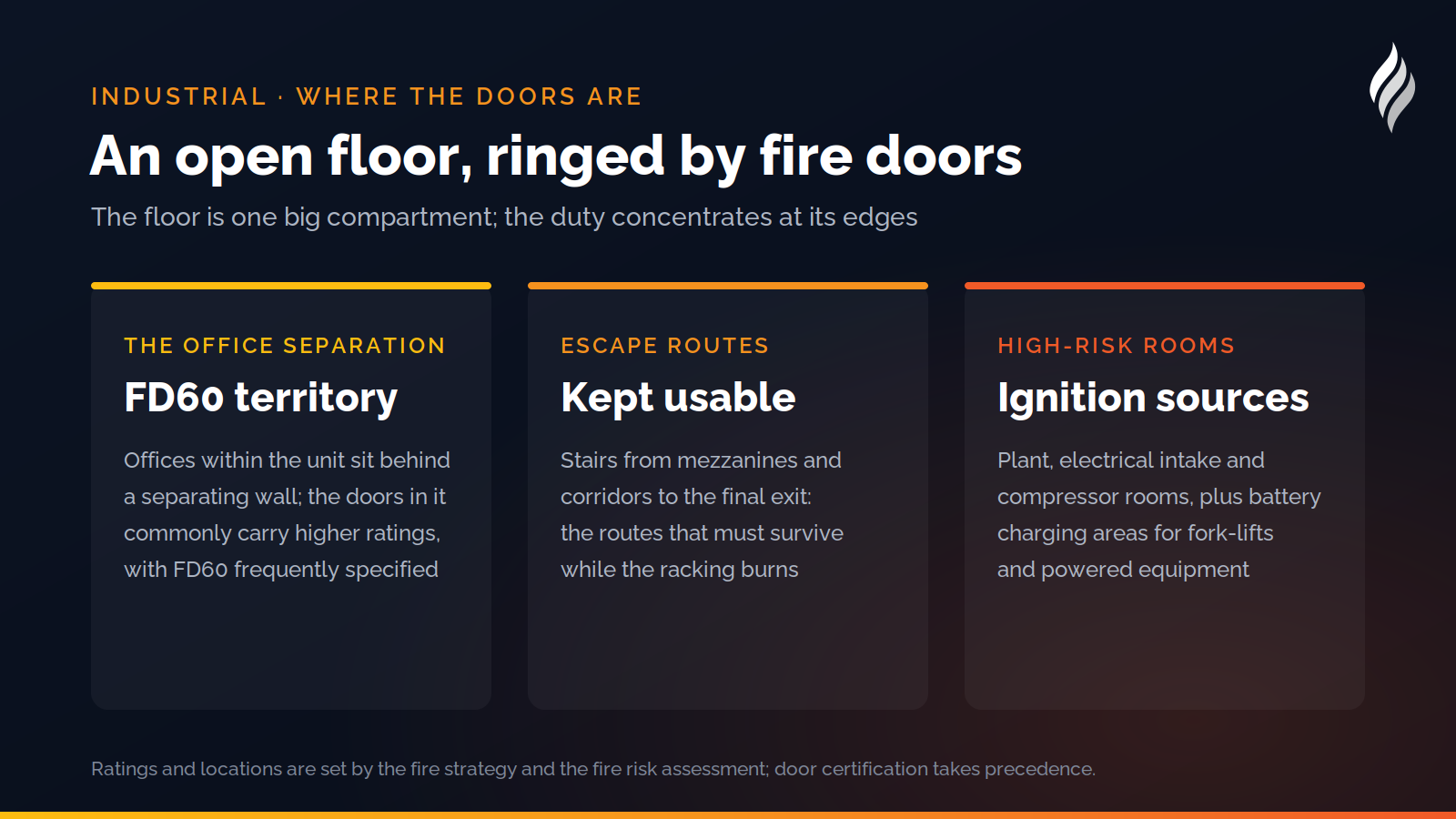
Traditional compartmentation is hard on a wide, open warehouse floor: the space is the point of the building. So the fire doors concentrate where the open floor meets everything else:
- The office block within the unit. Most industrial units carry offices, and the separation between the two carries weight because building regulations treat storage and office space as different purpose groups. The doors in that separating wall commonly carry a higher rating, with FD60 frequently specified, subject as always to the fire strategy and the fire risk assessment.
- Protected escape routes. Stairs from mezzanines, corridors from the far end of the floor to a final exit, and the doors that keep those routes usable while the racking burns.
- High-risk rooms. Plant rooms, electrical intake, compressor rooms, and increasingly the battery charging areas serving fork-lifts and other equipment, a risk with a family resemblance to the e-bike problem covered in lithium-ion batteries and fire doors.
- Staff welfare areas. Canteens, locker rooms and toilets off the main floor, with kitchens bringing their own fire load.
Mezzanines and high racking add the vertical dimension: fire spreads upward fast in a warehouse, which raises the value of every compartment line that holds, and puts weight on keeping escape routes from upper levels protected. Our retail guide covered stock pressing against doors; in a warehouse the same failure happens at pallet scale.
The fork-lift problem
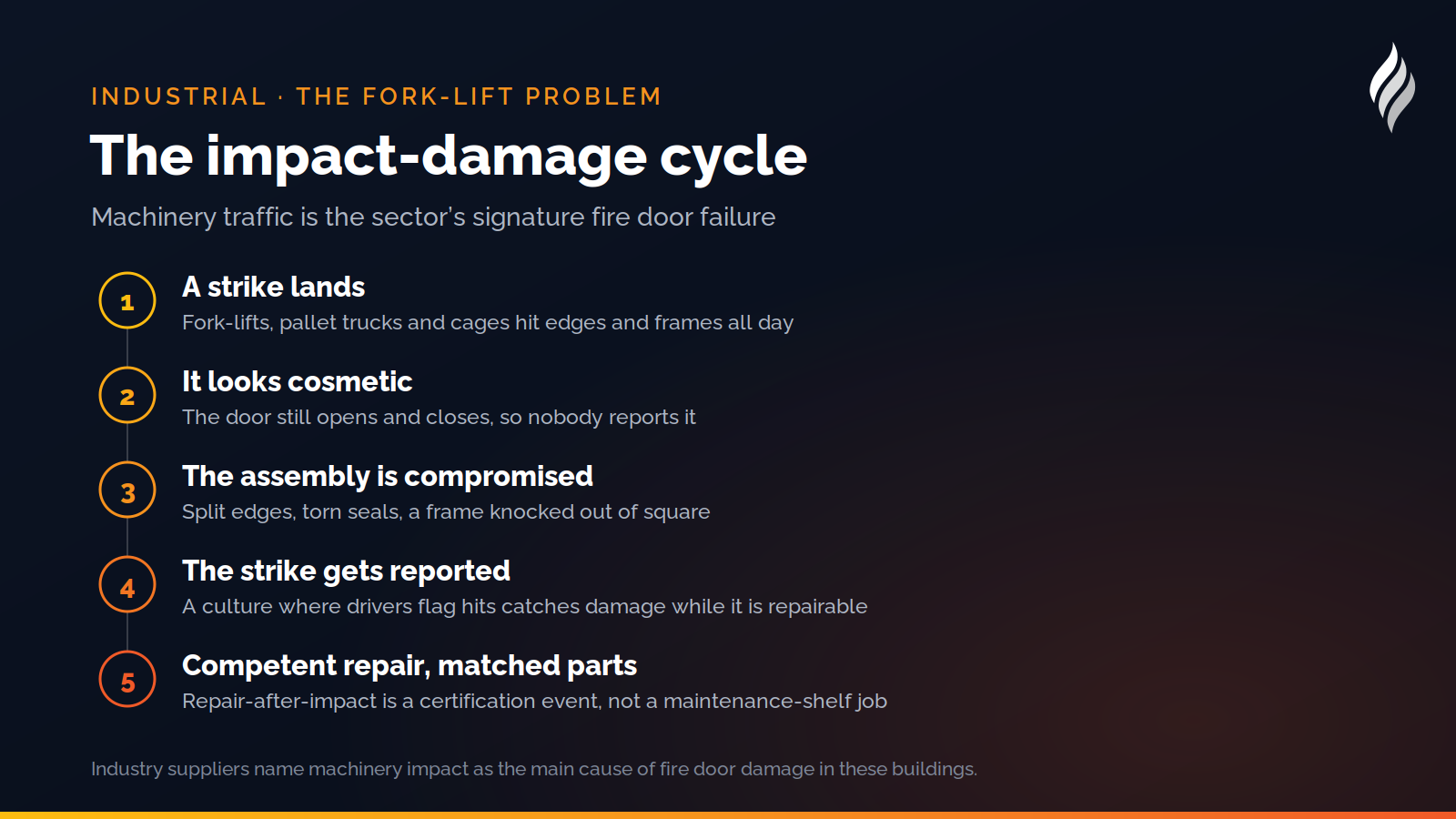
Every sector damages its fire doors in a characteristic way, and industrial's is blunt: machinery hits them. Fork-lifts, pallet trucks and roll cages strike door edges and frames all day, and industry suppliers are frank that this traffic is the main cause of fire door damage in these buildings. The dangerous part is how survivable the damage looks. A door that took a fork impact and still opens and closes reads as fine from a distance, while the leaf is split at the edge, the frame is knocked out of square, or the seals are torn where the impact landed, and any of those can end the door's ability to hold back fire and smoke.
Three habits blunt the problem. Protect the doors that take traffic: bollards, guards and protection plates where the fire strategy and the door's certification allow them. Report every strike, not just the ones that leave a door visibly hanging: a culture where a driver flags a hit costs minutes and catches damage while it is repairable. And treat repair-after-impact as a certification event, with compatible, matched components and competent hands, because a warehouse door patched from the maintenance shelf is exactly how a tested assembly quietly stops being one. What impact damage looks like up close is in common fire door defects.
Doors that are not doors
Industrial buildings run on openings too big for a door leaf: loading bays, conveyor penetrations, openings between production and storage. Fire-rated roller shutters and fire curtains do the compartment line's job there, typically linked to the fire alarm so they close automatically on activation. They are part of the same legal picture, fire safety measures that must be maintained in efficient working order, and they earn a specific place in the check regime: an alarm-linked shutter that has never been drop-tested is a compartment line running on faith. Specification and testing of these systems sit with specialists, but the Responsible Person owns making sure the testing happens and the results are recorded.
The insurance dimension
In most sectors fire doors are discussed as life safety. In industrial buildings they are also property and continuity protection, and insurers know it: a fire that takes the whole unit takes the stock, the plant and the trading period with it. Insurers commonly take an active interest in compartmentation, in whether shutters are alarm-linked, and in the maintenance evidence behind all of it. A documented fire door regime is not just compliance; at renewal it is part of the risk story your premium is priced on.
A check regime for a hard site
The fire risk assessment sets the inspection frequency, and on an industrial site the honest input to that assessment is traffic: doors in machinery lanes take more damage in a month than an office door takes in a year. A workable pattern is professional inspection at the assessed frequency by a competent inspector, frequent walk-throughs of the high-traffic doors with the five-step check, strike reporting in between, and shutter drop-tests on their own schedule, all recorded. Our inspection frequency guide covers how the assessment translates into a calendar, and the free printable checklist works as well beside a racking aisle as in a corridor.
How DoorTRACE helps
Industrial sites are where paper records go to die, because the doors take too much traffic for a binder to keep up. DoorTRACE puts a QR plaque on every door and shutter, logs checks and strike reports from a phone on the floor, and tracks defects with photographs through to competent repair, building the maintenance evidence the assessor and the insurer both ask for. See the platform overview, our industrial sector page, or talk to us.
Approved Document B: the second staircase era starts today
The amendments to Approved Document B come into force today: more than one common stair in new blocks of flats with a storey 18m or more, evacuation shafts to support evacuation lifts, and new escape guidance. What changes, who it touches, and the fire door angle.
Remedial work is now free to record on DoorTRACE
Only inspections are charged on Pay-As-You-Go from now on. The form that closes out remedial work joins registrations and reports on the free list, so the cost of a door for the year is known before it starts.
After Fire Door Safety Week: the year-round programme
Day five of Fire Door Safety Week, and the campaign ends this afternoon. The doors stay. Here is how to convert a week of attention into a programme that runs the other 51 weeks: rhythm, ownership, a live reporting route and evidence that accumulates.