Fire Door Safety Week 2026 ends this afternoon. If you followed the five-day plan, today is report-back day: findings published, quick wins fixed, remedials booked. That close-out is covered there, so this piece asks the harder question, the one that decides whether the week meant anything: what happens for the other 51?
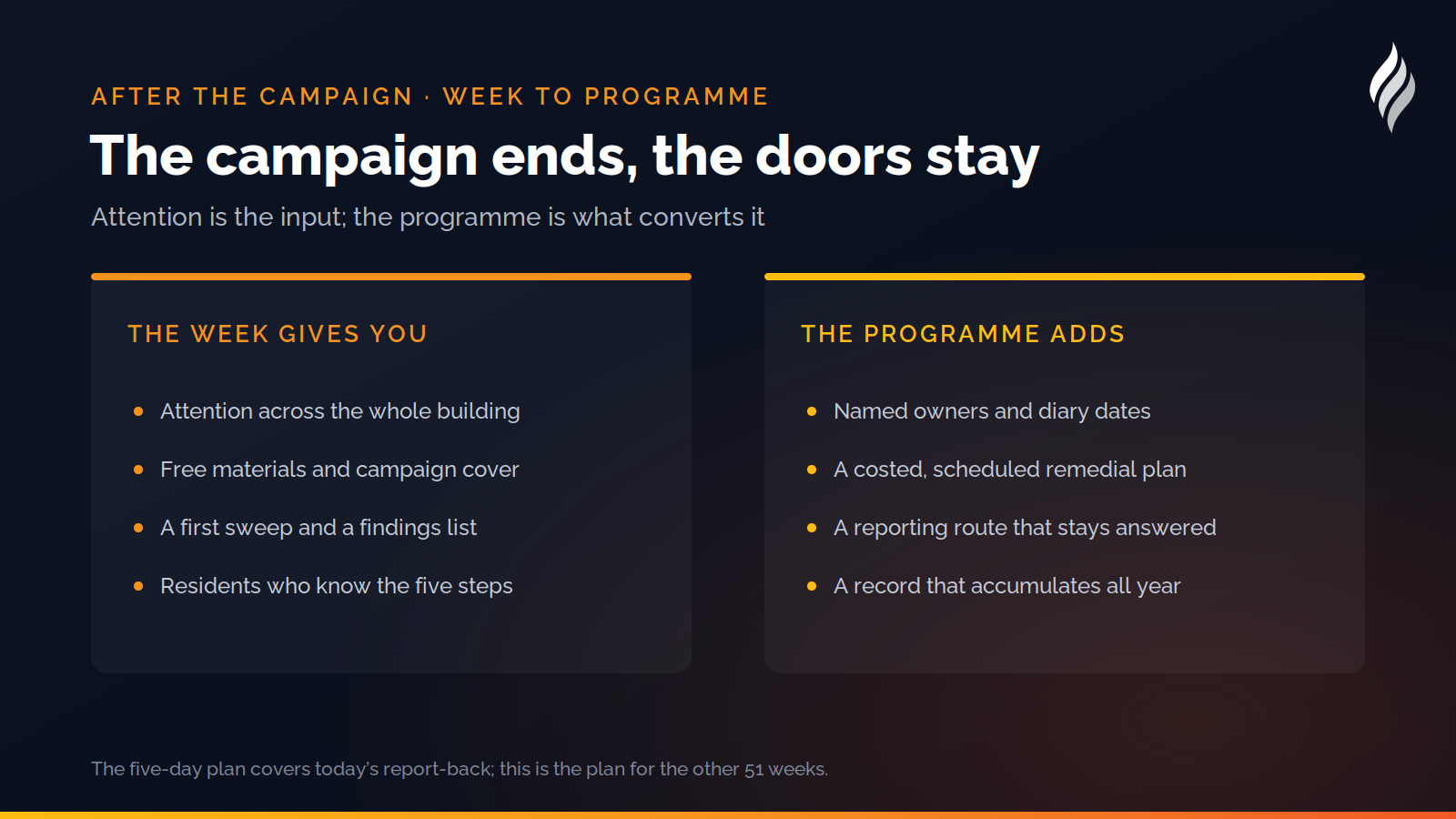
A campaign week produces attention. A programme is what converts attention into a building that stays compliant in March, when there is no banner on the notice board and no national campaign giving anyone cover. The good news is that a programme is not a bigger version of the week; it is a small set of recurring habits with names and dates attached.
The 12-month rhythm
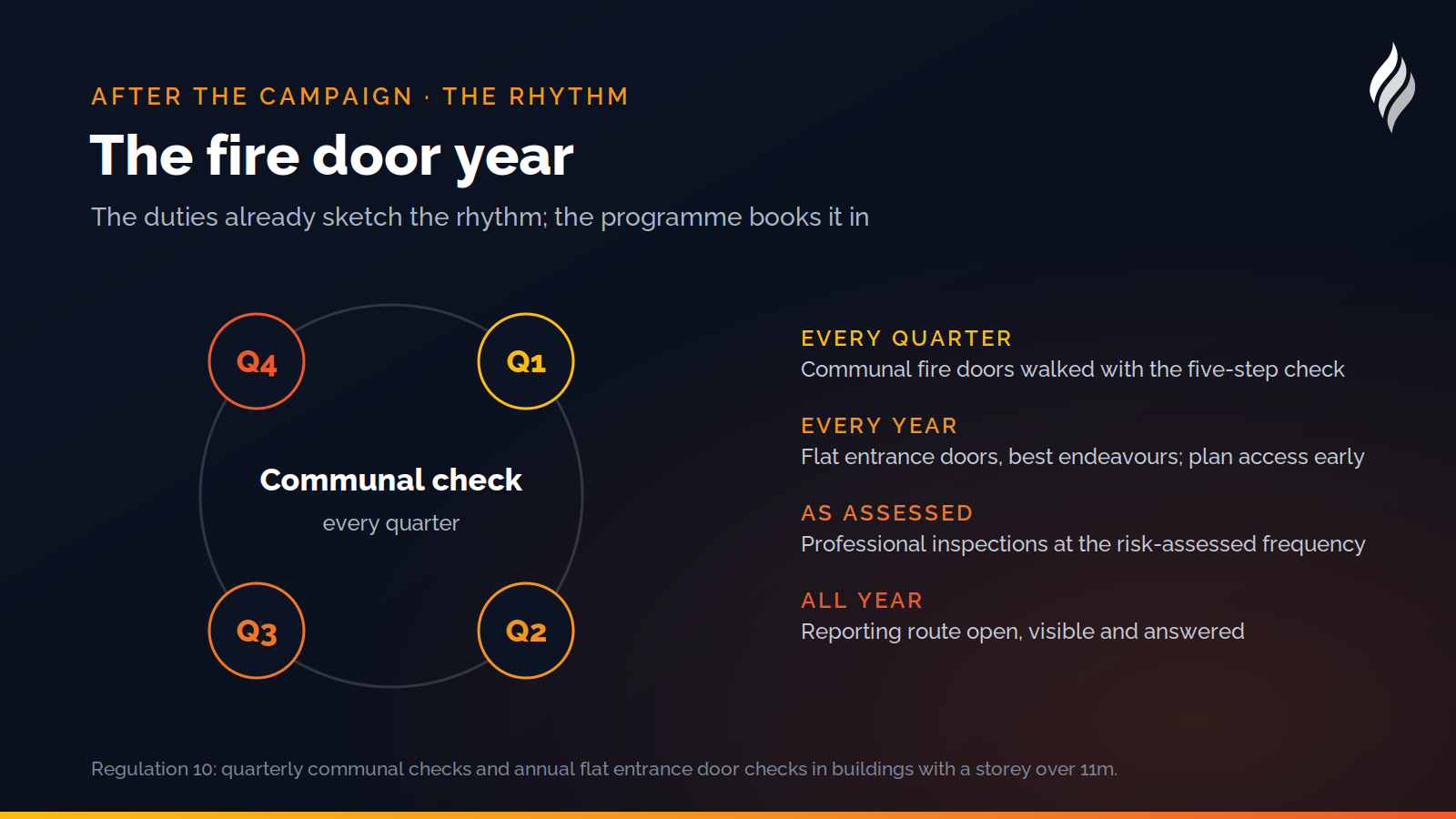
The legal duties already sketch the rhythm; the programme just makes it explicit and books it in:
- Quarterly: communal fire door checks. A legal duty under Regulation 10 in buildings with a storey over 11 metres, and sound practice in any multi-occupied building below that height. Four fixed dates a year, walked with the five-step check.
- Annually: flat entrance doors. The best-endeavours annual check where Regulation 10 applies, planned around access, which is the hard part: start arranging it months out, not weeks.
- At the assessed frequency: professional inspections. The fire risk assessment sets how often each door type needs a competent inspection; our inspection frequency guide covers the common patterns. Book next year's visits before this year's invoice is filed.
- Continuously: the reporting route. Faults do not wait for quarter-end. The route residents and staff learned this week needs to stay open, visible and answered all year.
One rhythm note from experience: attach every recurring task to a named owner and a diary date. "We check quarterly" is a policy; "Priya walks Block A on the first Tuesday of January, April, July and October" is a programme. Where the week ran on enthusiasm, the year runs on the calendar. The seasons bring their own patterns too: summer is propped-open-door season, winter building movement shifts gaps that were fine in June, and December's deliveries pile stock where it should not be, so the quarterly walks land differently each time even when the checklist is identical.
Turn the findings into a remedial plan
The sweep's findings need a second life beyond today's report-back: a remedial plan with money and dates attached. Triage what was found by severity, cost the works, and spread the non-urgent remedials across the coming quarters instead of leaving them as one large lump that never gets budget. A plan that says "closer adjustments and seal replacements in Q4, the two doubtful doors surveyed in Q1, replacements budgeted for the spring" is a plan that survives contact with a finance meeting. It also gives the quarterly checks something to verify: each walk confirms the last quarter's works actually happened and held. Anything on the list involving repair-or-replace judgement stays with a competent professional, but the scheduling and the budget line are yours.
Keep the reporting route alive
The most perishable thing the week created is the reporting habit. Residents and staff who learned the five-step check and reported their first fault will keep reporting for exactly as long as reporting visibly works. That means three things stay in place after today: the signage saying how to report, a route that lands somewhere monitored, and fixes that happen where people can see them. A fault reported in October and fixed in October teaches the building that the system is real; a fault that vanishes into silence undoes the whole week. The fire door awareness gap is what grows back when the route goes quiet.
Training as a cycle, not an event
The week's briefings and walk-alongs decay the same way: people leave, new starters arrive, memories fade. Fold fire door awareness into induction for anyone whose role touches the building, and run a short refresher annually, for which the one-hour training session we published last week is designed. The aim is modest and specific: everyone who works in the building can run the five steps and knows where reports go.
Evidence is the spine
Everything above produces records, and the records are the programme's real output. Checks logged with passes as well as faults, photographs against every defect, repairs traced to completion, inspection reports filed against the doors they cover: over a year this accumulates into the thing the fire risk assessor, the fire officer and the insurer actually ask for, a fire door register with a living history behind it. It is also what makes next September a stocktake instead of a fresh start: Fire Door Safety Week 2027 lands, you pull the year's record, and the week becomes a review of a working system rather than the annual rediscovery of the same faults. The case for keeping that record digital rather than in a lever-arch file is made in paper vs digital fire door records.
Book next year now
The last five minutes of the campaign are the cheapest planning you will do all year: put Fire Door Safety Week 2027 in the calendar, provisionally diary next September's walk-through, and note what you would do differently. The Responsible Person who books the next campaign before this one ends has quietly made the strongest possible statement that this was a programme starting, not a week passing.
How DoorTRACE helps
A year-round programme is mostly a scheduling and evidence problem, which is what DoorTRACE is for: recurring checks against every door, faults captured as defects with photographs and tracked to completion, and the year's history building into a register you can hand to an assessor in minutes. The week gave you momentum; see the platform overview or talk to us about keeping it.
Approved Document B: the second staircase era starts today
The amendments to Approved Document B come into force today: more than one common stair in new blocks of flats with a storey 18m or more, evacuation shafts to support evacuation lifts, and new escape guidance. What changes, who it touches, and the fire door angle.
Remedial work is now free to record on DoorTRACE
Only inspections are charged on Pay-As-You-Go from now on. The form that closes out remedial work joins registrations and reports on the free list, so the cost of a door for the year is known before it starts.
Fire doors in warehouses and industrial units
An open warehouse floor resists traditional compartmentation, so its fire doors concentrate around the edges and take the hardest knocks in any sector. Where the doors are, the fork-lift problem, and a check regime for a hard-wearing site.