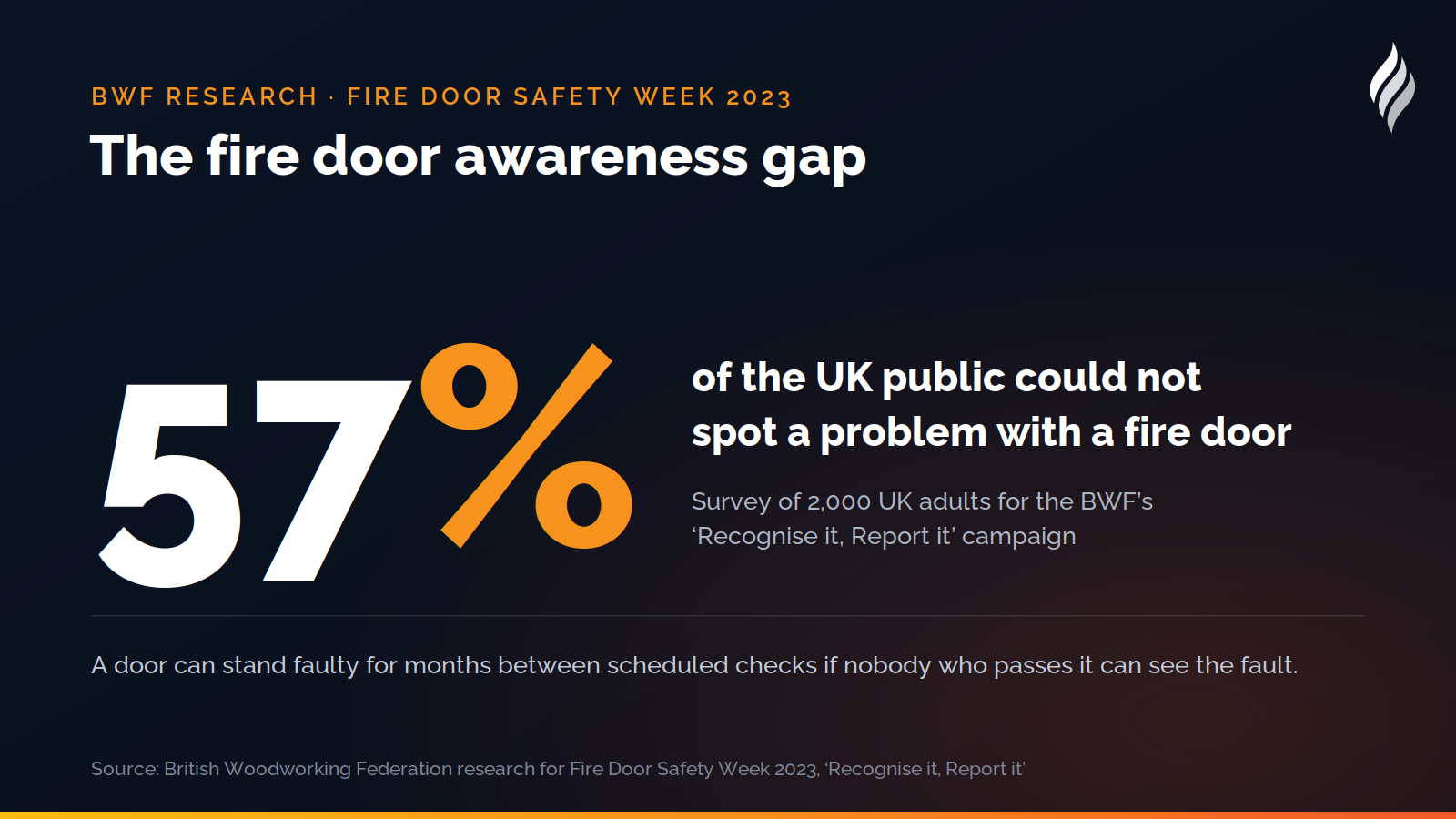
Every faulty fire door in a building is walked past dozens of times a day. The uncomfortable finding from the British Woodworking Federation's research is that most of the people walking past would not recognise the fault if they looked straight at it. Research conducted in 2023 for the BWF's Fire Door Safety Week campaign 'Recognise it, Report it' found that 57% of the UK public could not spot a problem with a fire door, and earlier research in 2022 found that a third of the British public would not report a problem with a fire door.
For anyone responsible for a building, those two numbers describe a blind spot in the compliance system. This article looks at what the research found, why the gap persists, and what building owners and managers can practically do about it, with The British Woodworking Federation's Fire Door Safety Week 2026 running from 21 to 25 September.
What the research found
The BWF's 2023 study surveyed 2,000 UK adults for the 'Recognise it, Report it' campaign. Awareness of what fire doors are for came out reasonably high. The ability to act on that awareness did not: more than half of respondents could not identify a faulty fire door when it counted.
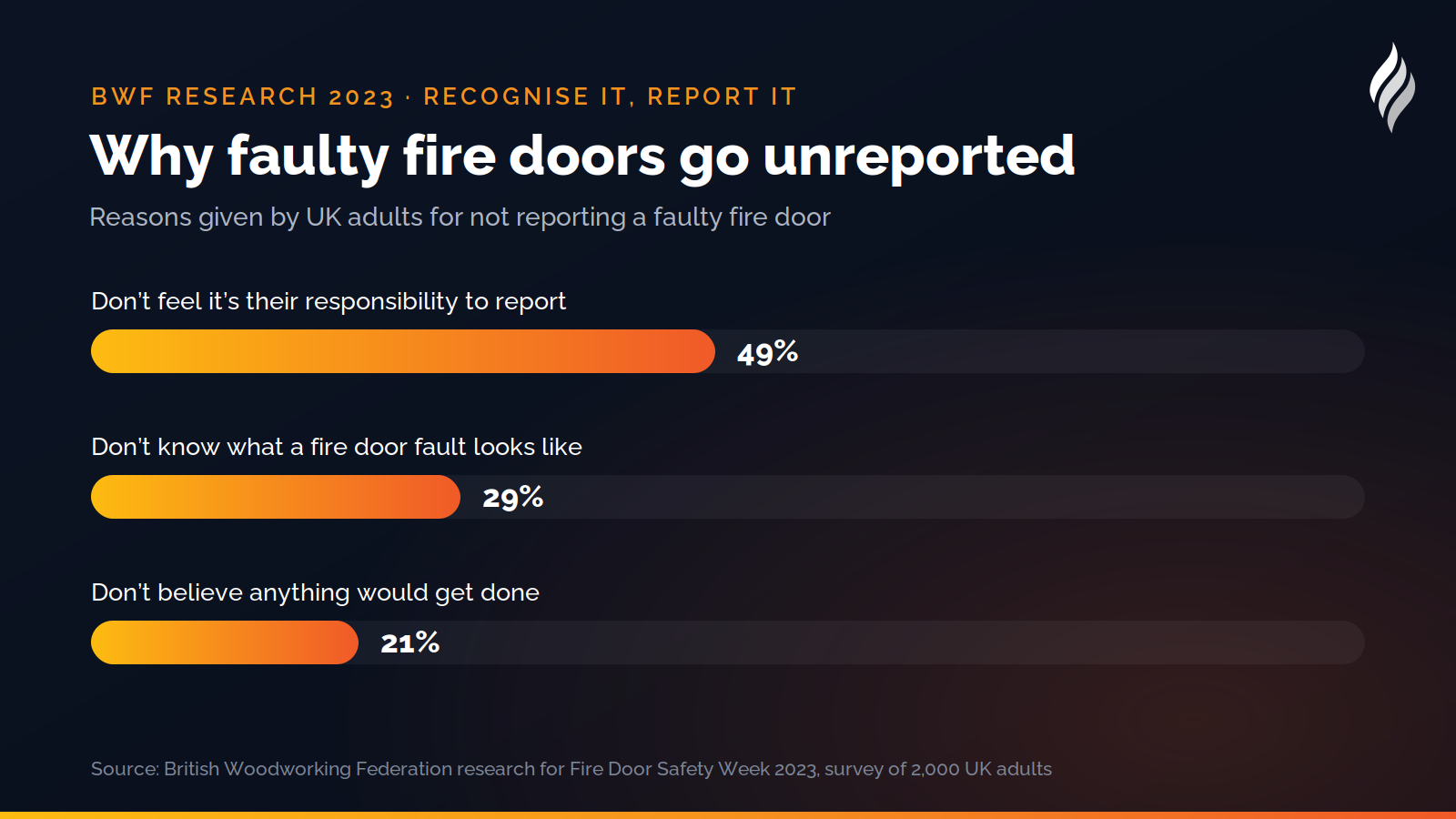
The reasons people gave for staying silent are just as telling. In the same study, 29% said they would not report a faulty fire door because they lacked the knowledge to judge what a fault looks like, 21% said they would not report because they did not believe anything would get done, and almost half, 49%, did not feel it was their responsibility to report at all.
A fire door regime that relies on quarterly or annual checks alone has a simple exposure here: a door can be damaged the day after a check and stand faulty for months before the next one. The people who could close that window are the residents and staff who pass the door daily, and the research says most of them cannot, or will not.
The reporting problem
The 2022 research put a number on the second half of the problem: a third of the British public would not report a fire door fault. The 2023 follow-up dug into where guidance comes from, and found the workplace well ahead of the home. Some 38% of respondents said their employer had given them guidance on identifying faulty fire doors, against only 26% who had received anything similar from their landlord.
That gap should give housing providers pause. The buildings where fire doors carry the greatest life safety load, blocks of flats with sleeping residents, are exactly where guidance is least likely to have been given. It also runs against the direction of the law: the resident information duty under Regulation 10 of the Fire Safety (England) Regulations 2022 applies to all multi-occupied residential buildings regardless of height, and fire door information is on the list of what residents must be given. Our guide to Regulation 10 resident information covers that duty in full.
Fire doors are smoke doors first
One more finding from the 2023 study explains a lot of the quiet neglect. Asked what a fire door does, more respondents said it stops the spread of fire (46%) than the spread of smoke (32%). Smoke inhalation, not burns, is the leading cause of death in fires, and holding back smoke is the job a closed fire door does best. Someone who believes a fire door is only about flames will underrate the harm in a door propped open for airflow on a warm day, a habit we looked at in our piece on propped open fire doors in summer. Understanding the smoke role is what turns a wedged door from a convenience into something worth acting on.
Closing the gap in your buildings
The encouraging part of the research is that the gap is a knowledge gap, not an apathy gap. In the 2023 study a large majority said they would report a faulty or propped open fire door in future. People are willing; they need two things from the building's management to follow through.
The first is the ability to recognise a fault. That is a teaching job, and the material already exists: the BWF's five-step check was built precisely so an untrained person can spot the common faults in about two minutes. Our walkthrough of the five-step check and what a professional inspection adds is written to be shared with staff and residents, and the full toolkit is free at firedoorsafetyweek.co.uk. Fire Door Safety Week, running 21 to 25 September this year, is the natural hook for that conversation; our guide to Fire Door Safety Week 2026 covers the campaign.
The second is a reporting route people trust. The 21% who stay silent because nothing gets done are describing a feedback failure, not a fire safety attitude. If a report disappears into a mailbox and the wedge is still there a month later, the building has taught its occupants not to bother. A visible route, a fast acknowledgement, and evidence that reported faults get fixed are what convert willingness into reports.
How DoorTRACE helps
DoorTRACE puts a reporting route on the door itself. Every door gets a QR plaque linking to its public door page, so a resident or staff member who spots a wedge, a gap or a broken closer can report it from their phone in the moment they see it. Reports land against the door's record alongside its check and inspection history, so nothing disappears and the fix is documented. See the full picture on our platform overview, or talk to us about getting your buildings ready before Fire Door Safety Week.
Approved Document B: the second staircase era starts today
The amendments to Approved Document B come into force today: more than one common stair in new blocks of flats with a storey 18m or more, evacuation shafts to support evacuation lifts, and new escape guidance. What changes, who it touches, and the fire door angle.
Remedial work is now free to record on DoorTRACE
Only inspections are charged on Pay-As-You-Go from now on. The form that closes out remedial work joins registrations and reports on the free list, so the cost of a door for the year is known before it starts.
Fire doors in warehouses and industrial units
An open warehouse floor resists traditional compartmentation, so its fire doors concentrate around the edges and take the hardest knocks in any sector. Where the doors are, the fork-lift problem, and a check regime for a hard-wearing site.