Every September, one national campaign puts fire doors in front of people who spend the rest of the year walking past them. The British Woodworking Federation's Fire Door Safety Week returns from 21 to 25 September 2026, and the weeks before it are the right time to decide how your buildings will take part.
This guide covers what the campaign is, why it exists, who it is for, and the practical ways to get involved between now and September.
What Fire Door Safety Week is
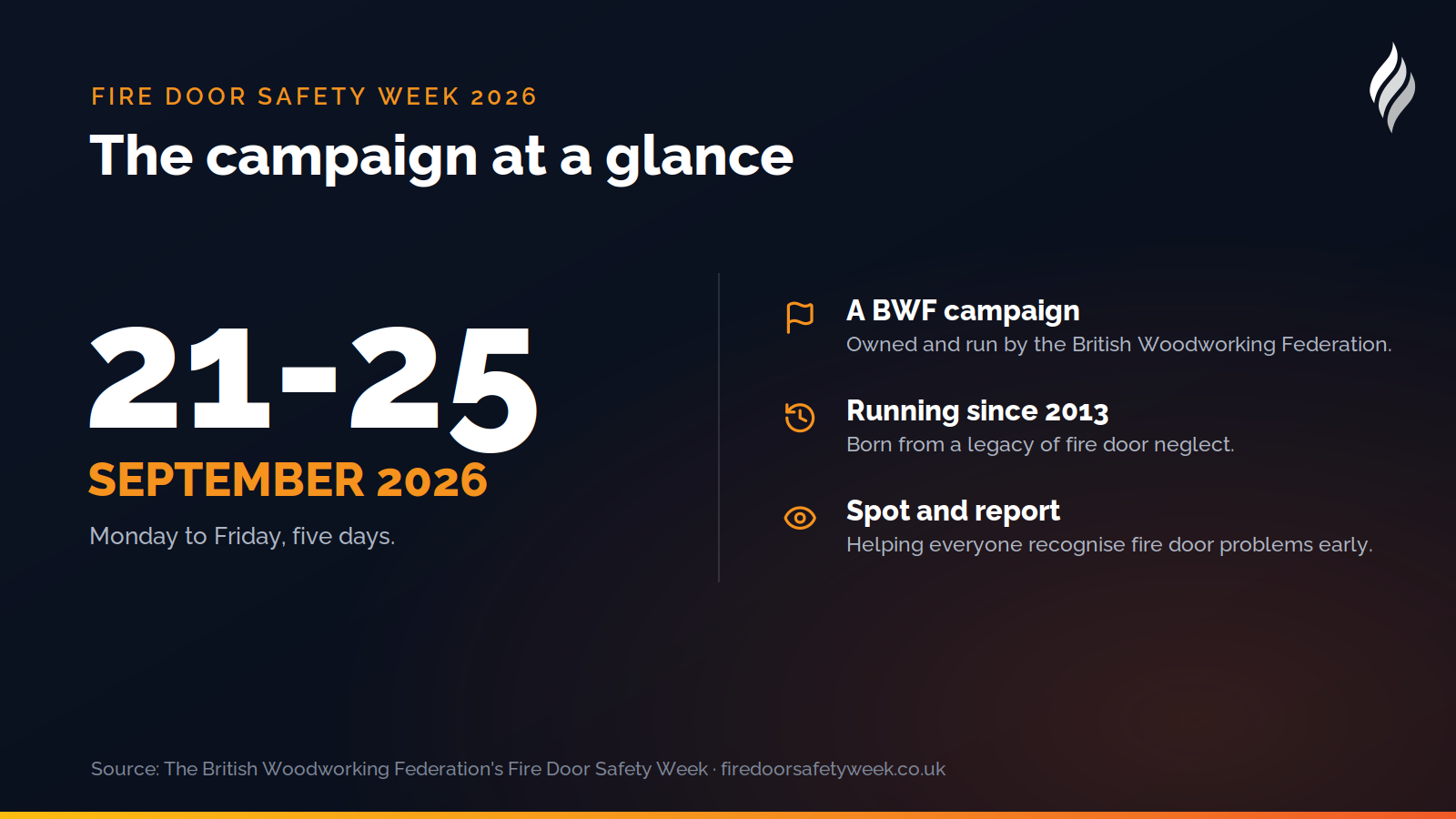
Fire Door Safety Week is an annual awareness campaign owned and run by the British Woodworking Federation (BWF) and supported by the BWF Fire Door Alliance. It launched in 2013 in response to a legacy of fire door neglect: doors wedged open, damage left unrepaired, and a public that mostly had no idea what a fire door does.
The aim is straightforward. Fire doors hold back fire and smoke, protect escape routes, and buy time for people to get out and for crews to get in. They can only do that if they are in working order, and problems get fixed sooner when more people can recognise and report them. The campaign gives everyone, from building owners to residents, the knowledge to play their part.
The 2026 campaign runs from Monday 21 to Friday 25 September. Full details are on the Fire Door Safety Week website.
Why the campaign exists
Awareness is the weak link in fire door safety. Research by the BWF for its 2023 Fire Door Safety Week campaign found that over half of the UK public (57%) could not spot a problem with a fire door, and its 2022 campaign research found that a third of people would not report one. A fault nobody recognises never gets reported, and a fault never reported never gets fixed.
That is why the campaign speaks to everyone rather than just the trade. A caretaker who knows what a broken closer looks like, or a resident who understands that a propped-open corridor door is a problem, extends the reach of every formal inspection during the months between visits.
Who should take part
The campaign is for anyone with a stake in a building: Responsible Persons under the Fire Safety Order, housing providers, facilities and estates teams, landlords, and the inspectors and engineers who look after fire doors professionally. The issues it highlights are not limited to high-rise residential blocks either. Fire doors do the same life-safety job in schools, care homes, offices and every other occupied building type, so the week is an open invitation to put them on the agenda wherever you are responsible for them.
The five things everyone can check
The campaign's public toolkit centres on a five-step fire door check that anyone can carry out. The five steps cover certification, apertures, gaps and seals, closers, and operation. It is designed for building users, not professionals, and it does a specific job: catching visible problems between formal inspections.
It is worth being clear about what the five-step check is not. It does not replace inspection by a competent person, and the campaign does not claim it does. The two work together: everyday eyes catch obvious faults early, and routine professional inspection confirms that the whole assembly still performs as certified. If you want the fuller picture of what a professional looks at, our free 41-point inspection checklist sets out every item.
What happens during the week
Across the five days, supporters run door checks in their buildings, put up campaign posters, hold toolbox talks and training sessions, share the BWF's films and resources with residents and staff, and post their activity on social media. The BWF publishes new research and guidance to anchor the week, and the trade press covers it heavily, which makes it the one week of the year when a fire door message lands with people who normally tune it out.
One point of etiquette from the campaign's own guidance: if you host an event during the week, make clear it is run in support of the campaign and independently of the British Woodworking Federation.
How to take part
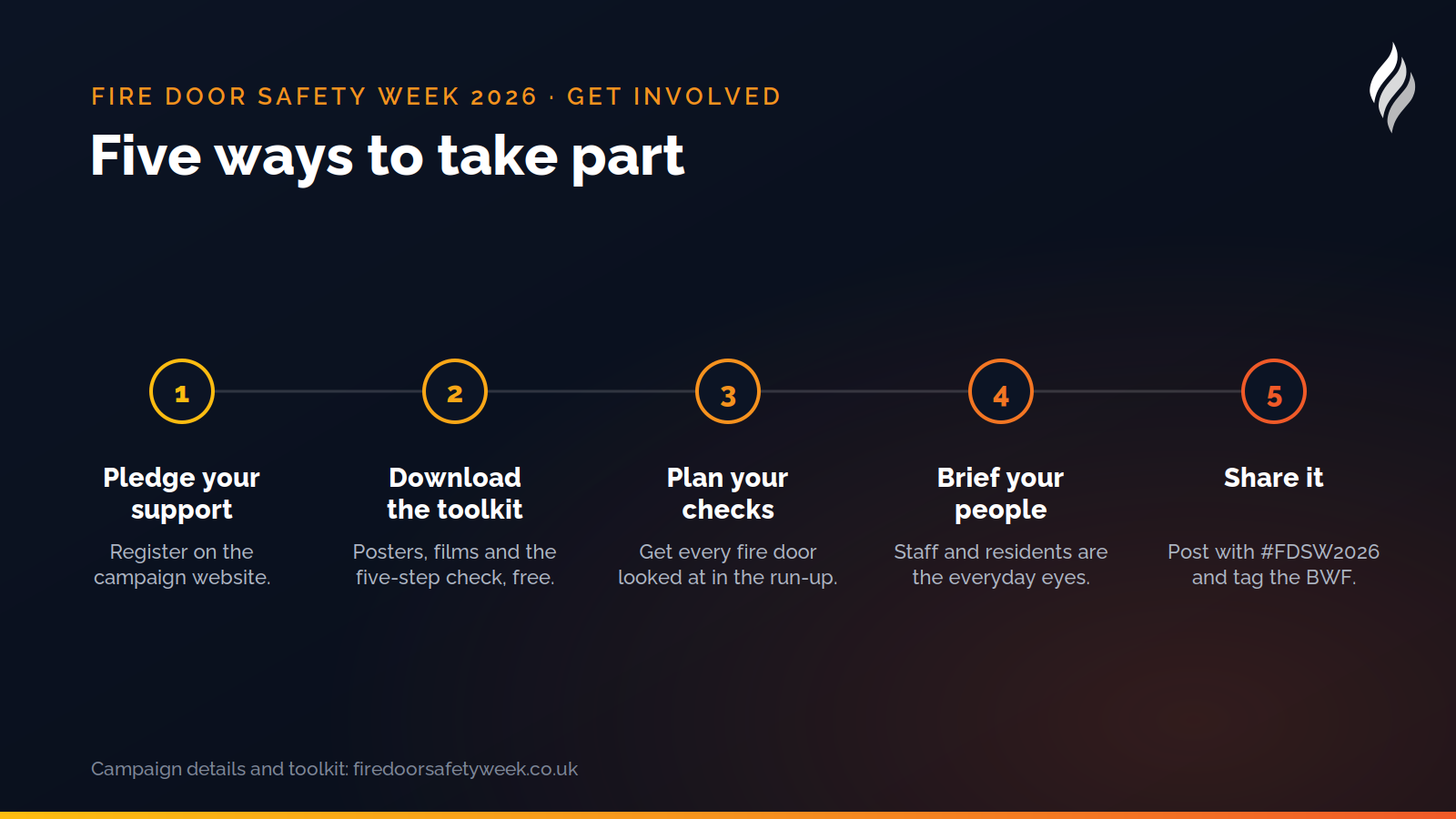
Taking part can be as light or as involved as suits your organisation. The campaign asks supporters to register on the Fire Door Safety Week website, use the free toolkit of posters, films and check guides, and share activity on social media using the #FDSW2026 hashtag, tagging the British Woodworking Federation and crediting the campaign by its full name.
Make the run-up count
Seven weeks is enough time to do the unglamorous work that makes the week itself easy. Book any overdue inspections now, close out open defects, and make sure your records would stand scrutiny if the week prompts a resident, a client or a regulator to ask questions. If your fire door records are still on paper, the run-up is also a natural moment to move them into a digital register so that every door, inspection and defect sits in one place before the spotlight arrives.
We will be publishing a series of Fire Door Safety Week articles between now and September, covering the five-step check in depth, resident engagement, staff training and more, so keep an eye on our news page.
How DoorTRACE helps
DoorTRACE gives you the register, inspection records and defect tracking to walk into Fire Door Safety Week with your evidence in order. Every door carries its full history, every inspection is logged against a BS 8214 aligned checklist, and reports are ready for anyone who asks. See the platform, or talk to us before September.
Approved Document B: the second staircase era starts today
The amendments to Approved Document B come into force today: more than one common stair in new blocks of flats with a storey 18m or more, evacuation shafts to support evacuation lifts, and new escape guidance. What changes, who it touches, and the fire door angle.
Remedial work is now free to record on DoorTRACE
Only inspections are charged on Pay-As-You-Go from now on. The form that closes out remedial work joins registrations and reports on the free list, so the cost of a door for the year is known before it starts.
Fire doors in warehouses and industrial units
An open warehouse floor resists traditional compartmentation, so its fire doors concentrate around the edges and take the hardest knocks in any sector. Where the doors are, the fork-lift problem, and a check regime for a hard-wearing site.