The British Woodworking Federation's Fire Door Safety Week returns from 21 to 25 September 2026, and the campaign's most enduring tool is also its simplest: a five-step fire door check that anyone can run in about two minutes, with nothing more than their eyes, their phone and a £1 coin. It was designed so that residents, staff and building users can spot the most common fire door problems and report them, rather than walking past them every day without a second glance.
This guide walks through each of the five steps, explains what the check is genuinely good at, and then covers the other half of the story: what a professional inspection by a competent person adds, and why a building needs both.
Where the five-step check comes from
Fire Door Safety Week was launched by the British Woodworking Federation in 2013 in response to a long record of fire door neglect, and the five-step check has been at the heart of its toolkit ever since. The thinking behind it is straightforward: a fire door only protects people if someone notices when it stops working, and the people best placed to notice are the ones who use the door every day.
The check is deliberately non-technical. It asks no one to measure fire resistance, judge certification data or assess installation quality. It asks them to look, and to report what looks wrong to whoever is responsible for the building. The full toolkit, including a printable version of the check, is free at firedoorsafetyweek.co.uk.
The five steps
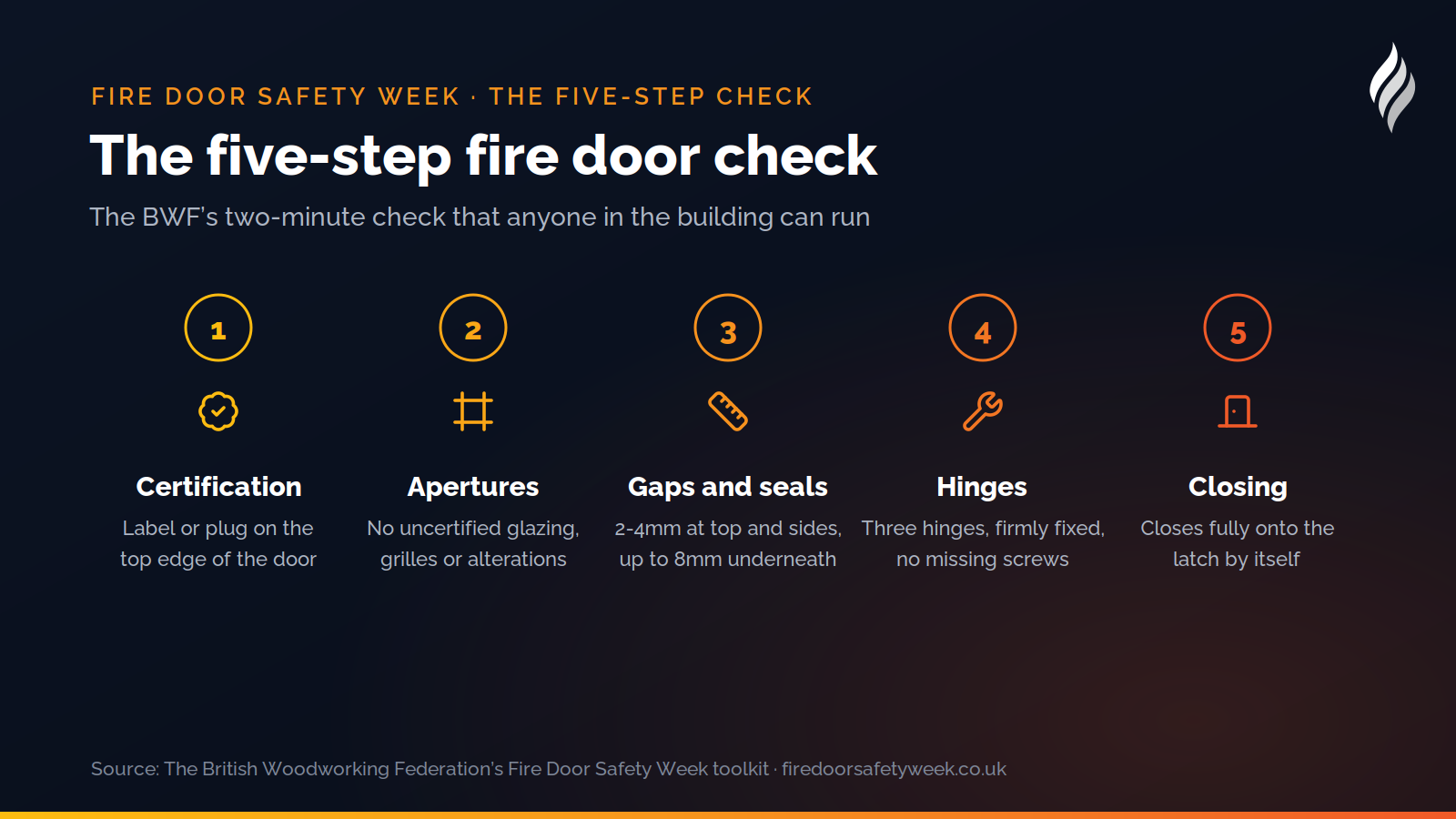
1. Check for certification. Look for a label or plug on the top edge of the door, or occasionally on the side. This is the evidence that the door is a certified fire door rather than an ordinary door in a fire door's position. A mirror, or the selfie camera on a phone, makes the top edge easy to see. No label does not automatically mean no fire door, but it does mean nobody can tell from looking, and that is worth reporting. Our guide to spotting a certified fire door covers the main schemes and what their markings look like.
2. Check the apertures. Look for alterations: glazing panels, air transfer grilles, letterplates or holes that look like they were cut after the door was made. Uncertified modifications can void the door's certification entirely, because the door is only proven to resist fire as the complete assembly that was tested.
3. Check the gaps and seals. The gap between the door and the frame should be consistent around the top and sides, commonly 2mm to 4mm, with up to 8mm allowed under the door. A £1 coin is roughly 3mm thick, which makes a handy gauge. Then look at the intumescent seals around the door or frame: they should be continuous and undamaged. If the gaps are wider, or daylight shows under the door, fire and smoke have a path through. We cover the detail in our guides to fire door gaps and intumescent and smoke seals.
4. Check the hinges. Three hinges, firmly fixed, with no missing or broken screws and no visible wear or metal leaking from the knuckles. Hinges carry the full weight of a heavy fire door through thousands of cycles, and loose or damaged hinges are one of the most common faults found in the field.
5. Check the door closes properly. Open the door about halfway, let go, and watch. It should close fully onto the latch under its own power, without sticking on the floor or the frame. A fire door that is wedged open, or that will not close on its own, offers no protection at all. Self-closing devices have their own failure patterns, which we cover in our guide to self-closers and hold-open devices.
What the check is good at
The five-step check earns its place because it catches the faults that are both common and visible: wedged doors, broken closers, missing seals, obvious gaps, damaged hinges, glazing that looks improvised. These account for a large share of real-world fire door failures, and every one of them can be spotted by an untrained person in under two minutes.
It also builds a reporting culture. The BWF's research has repeatedly found that the public struggles to recognise fire door faults and often does not report the ones they do notice. A workforce or resident group that knows the five steps is far more likely to flag a problem in week one than to leave it for the next scheduled visit months later.
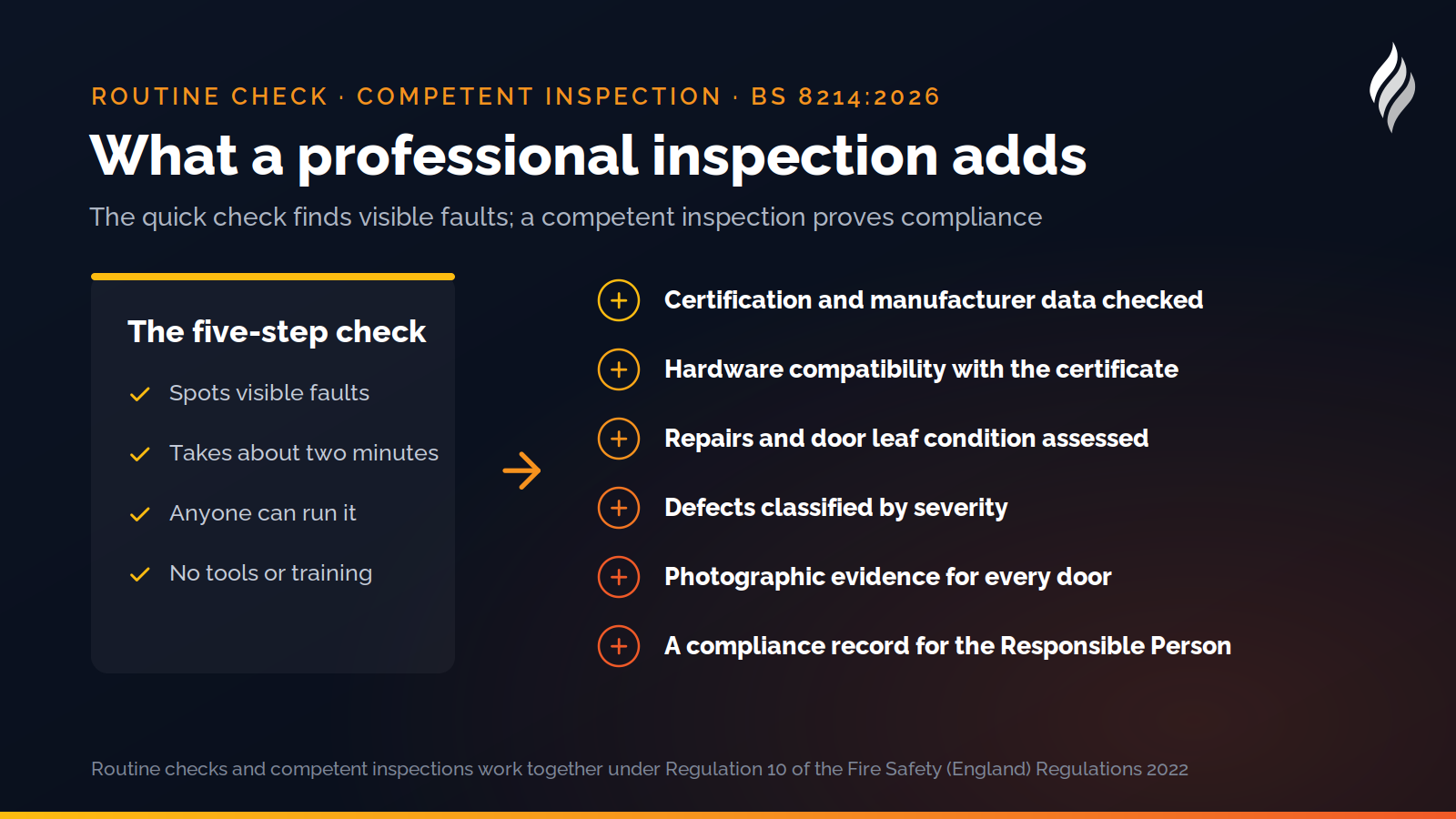
What the check cannot do is confirm that a door is compliant. Passing all five steps means no visible problems were found by a layperson. That is valuable, but it is not the same thing as a competent person confirming the door will perform as certified.
What a professional inspection adds
A professional inspection differs from the five-step check in depth, in competence and in what it produces at the end.
On depth, an inspector examines the whole doorset as an assembly: the door leaf's condition and any repairs, the frame and its fixing to the structure, glazing systems and their beads and seals, the compatibility of every piece of hardware with the door's certification, threshold details, signage, and the condition of the surrounding wall where it can be seen. Guidance such as BS 8214:2026 sets out how timber and other fire door assemblies should be installed and maintained, and a competent inspector works against that detail rather than against a five-item list.
On competence, the inspector can judge the things a checklist cannot: whether a gap that measures fine is actually consistent under load, whether a repair was carried out with the right materials, whether a closer is adjusted to overcome the latch, and whether a defect makes the door fail or merely needs monitoring. Our article on what makes a fire door inspector competent covers the qualifications and schemes in this space.
On output, a professional inspection produces a record: door by door findings, photographic evidence, defects classified by severity, and remedial recommendations that a contractor can price and action. That record is what the Responsible Person relies on to demonstrate compliance, and it is what an enforcing authority will ask to see. A passed five-step check produces a reassured resident; a passed inspection produces evidence. We have a full walkthrough of what happens during a fire door inspection and how the two levels of scrutiny compare side by side.
Using both through the year
The two levels are designed to work together, and the law reflects that. Under Regulation 10 of the Fire Safety (England) Regulations 2022, buildings with a storey over 11 metres need communal fire doors checked at least quarterly and flat entrance doors checked at least annually on a best endeavours basis. Those routine checks sit naturally at the five-step level, carried out by trained staff. Periodic professional inspections then sit above them, at a frequency driven by the building's risk profile and fire risk assessment.
Fire Door Safety Week is the ideal moment to put the first layer in place. Teaching residents and non-specialist staff the five steps costs an afternoon, and it turns every pair of eyes in the building into an early warning system. If you are planning activity for the week, our guides to Fire Door Safety Week 2026 and preparing your buildings for the week are a good starting point, and our free fire door inspection checklist gives your team a printable companion to the five steps.
How DoorTRACE helps
DoorTRACE gives both layers a home. Routine checks and professional inspections are recorded against the same door history, so a fault reported during a five-step check and a defect logged by an inspector end up in one timeline with photos, dates and outcomes. Every door gets a QR plaque, so reporting a problem takes seconds rather than an email hunt. See how it fits together on our platform overview, or get in touch to see it on your own buildings before Fire Door Safety Week begins.
Approved Document B: the second staircase era starts today
The amendments to Approved Document B come into force today: more than one common stair in new blocks of flats with a storey 18m or more, evacuation shafts to support evacuation lifts, and new escape guidance. What changes, who it touches, and the fire door angle.
Remedial work is now free to record on DoorTRACE
Only inspections are charged on Pay-As-You-Go from now on. The form that closes out remedial work joins registrations and reports on the free list, so the cost of a door for the year is known before it starts.
Fire doors in warehouses and industrial units
An open warehouse floor resists traditional compartmentation, so its fire doors concentrate around the edges and take the hardest knocks in any sector. Where the doors are, the fork-lift problem, and a check regime for a hard-wearing site.