Fire Door Safety Week 2026 runs from 21 to 25 September, which leaves a little under six weeks from today. That is exactly enough time to walk into the week with your fire doors inspected, your defects closed and your records ready to show, rather than spending the five days hoping nobody asks a question you cannot answer.
Here is a week-by-week run-up plan, built for Responsible Persons, facilities teams and housing providers. If you are new to the campaign itself, start with our guide to what Fire Door Safety Week is.
Why prepare at all
The week concentrates attention. Residents see posters and films, boards and clients ask how compliant the portfolio is, the trade press runs stories, and fire door problems that have sat quietly for months suddenly get noticed. That attention lands very differently depending on whether your evidence is in order. The run-up is when you decide which version of the week you get.
One effect worth planning for specifically: the campaign teaches people to report faults, so expect more fire door reports from residents and staff during and after the week. That is the campaign working as intended, and it is a good thing if you have a route to receive, log and act on those reports. It is an uncomfortable thing if reports arrive into an inbox nobody owns. Decide now where a resident's "this door does not close" goes and who picks it up.
Weeks six and five: know what you have
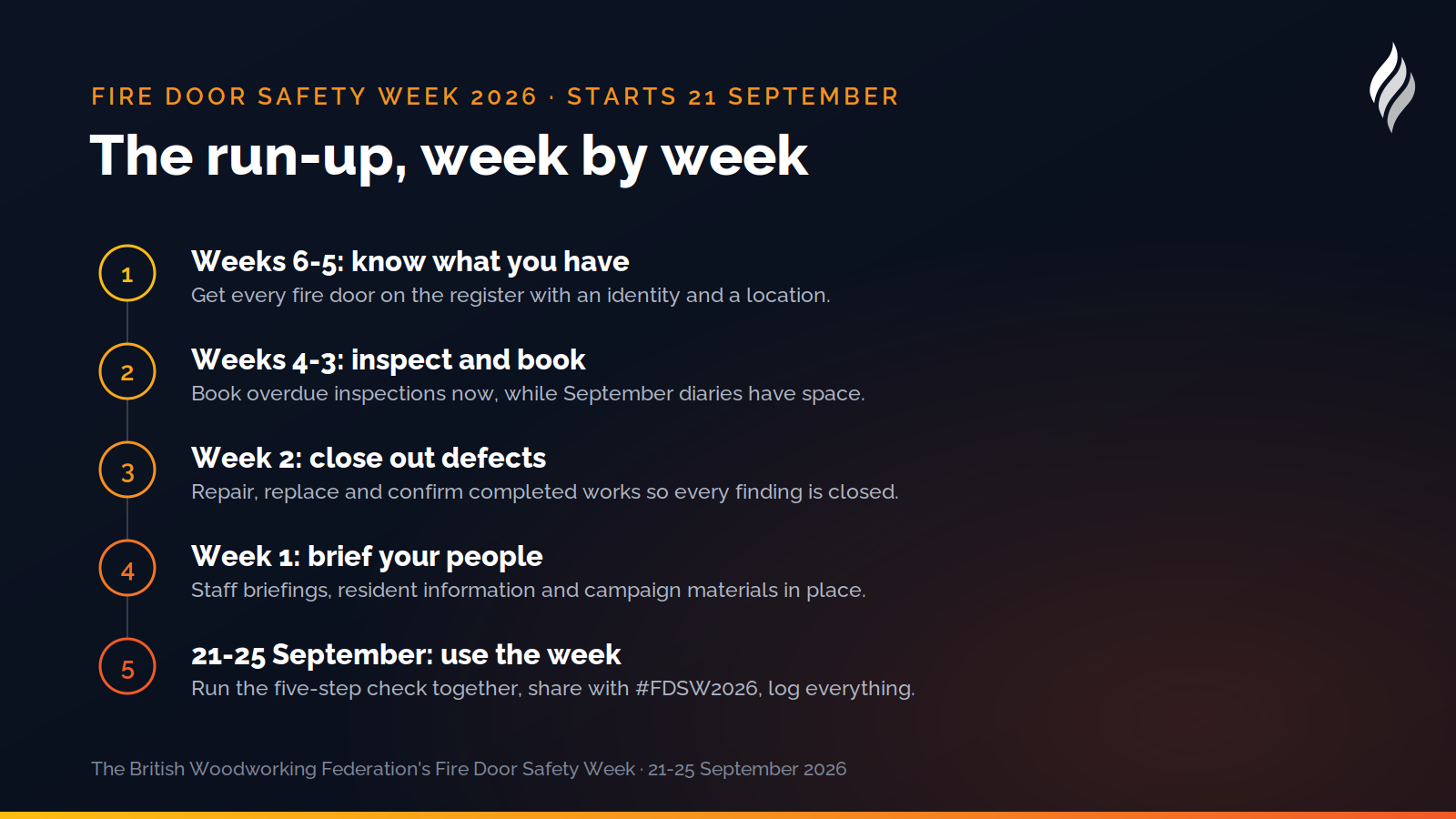
Everything starts with the register. List every fire door you are responsible for, with a unique identity and a location. Doors that are not on a fire door register are doors nobody is managing, and portfolios that skip this step spend the later weeks discovering doors instead of fixing them. If your register lives across three spreadsheets and a filing cabinet, consolidating it is the single highest-value job of the whole run-up.
Weeks four and three: inspect and book
With the register straight, get inspections moving. Anything overdue against your inspection frequency gets booked now, while inspector diaries still have September space; demand tightens as the week approaches. Use a competent inspector, and if you want to know what to expect on the day, our guide to what happens during a fire door inspection walks through it.
Week two: close the loop on defects
Inspections generate findings, and findings left open are worse than no findings at all: they are documented knowledge of a problem. Week two is for remediation: fix the common defects, replace what cannot be repaired, and make sure completed works are confirmed and recorded so each defect is properly closed rather than just quietly forgotten. A defect log with open items and no dates is exactly the document you do not want to be holding in late September.
Week one: brief and equip your people
The final week before the campaign is about people. Brief caretakers, cleaners, concierge and site staff on what a failing fire door looks like and how to report one. Give residents the fire door information they are entitled to, which in multi-occupied residential buildings is a legal duty at any height, not a courtesy. Print what you need: the campaign's free toolkit covers posters and films, and our free 41-point inspection checklist gives your team something concrete to hold.
During the week itself
Then use the five days. Walk the buildings with staff and run the campaign's five-step check together, share what you are doing with #FDSW2026, and log everything you find. Activity during the week is worth double: it engages people while the national spotlight is on, and it leaves dated evidence behind.
Starting behind? Triage, do not panic
If reading this list makes clear you are further back than six weeks of work, do not try to do everything. Triage by risk: sleeping accommodation before offices, escape routes before cupboards, doors with known faults before doors with none. Getting the highest-risk doors inspected and their defects closed is worth more than a thin pass over everything, and an honest, dated plan for the remainder is itself good evidence of a Responsible Person taking the duty seriously. What you want to avoid is arriving in September with neither the work done nor a record of a plan.
Walk in ready
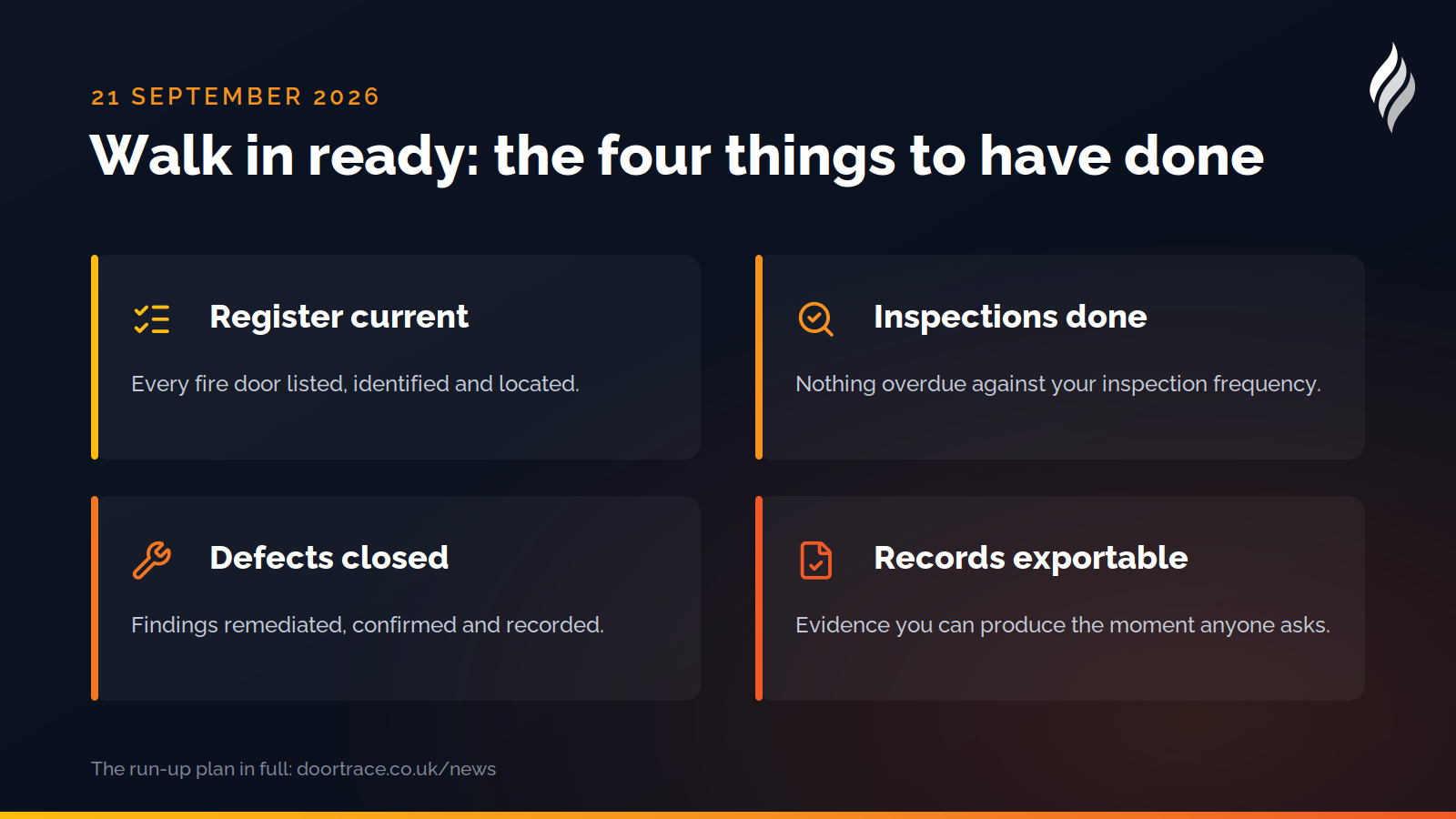
By 21 September the picture should be simple: register current, inspections done, defects closed, and records you can export and hand over the moment anyone asks. If assembling that evidence still means chasing paper, the run-up is also the natural moment to go digital, so the week's questions get answered in minutes rather than days.
How DoorTRACE helps
DoorTRACE is the run-up plan in software: a live register of every door, inspections logged against a recognised checklist, defect tracking from finding to confirmed fix, and reports ready for whoever asks in September. See the platform or talk to us while there is still time to be ready.
Approved Document B: the second staircase era starts today
The amendments to Approved Document B come into force today: more than one common stair in new blocks of flats with a storey 18m or more, evacuation shafts to support evacuation lifts, and new escape guidance. What changes, who it touches, and the fire door angle.
Remedial work is now free to record on DoorTRACE
Only inspections are charged on Pay-As-You-Go from now on. The form that closes out remedial work joins registrations and reports on the free list, so the cost of a door for the year is known before it starts.
Fire doors in warehouses and industrial units
An open warehouse floor resists traditional compartmentation, so its fire doors concentrate around the edges and take the hardest knocks in any sector. Where the doors are, the fork-lift problem, and a check regime for a hard-wearing site.