The British Woodworking Federation's Fire Door Safety Week is running right now, from 21 to 25 September, and the difference between a week that changes something and a week of reposted graphics is a plan. This one takes five days, uses the campaign's free materials, and ends on Friday with faults logged, quick wins fixed and evidence on record.
The days are numbered rather than dated on purpose. The week starts today, so Day 1 is this morning's job; if you are picking this up later in the week, start at Day 1 anyway and let the plan spill into next week. The doors do not know what day it is, and every step here is worth doing whether or not the campaign banner is still up.
The shape of the week
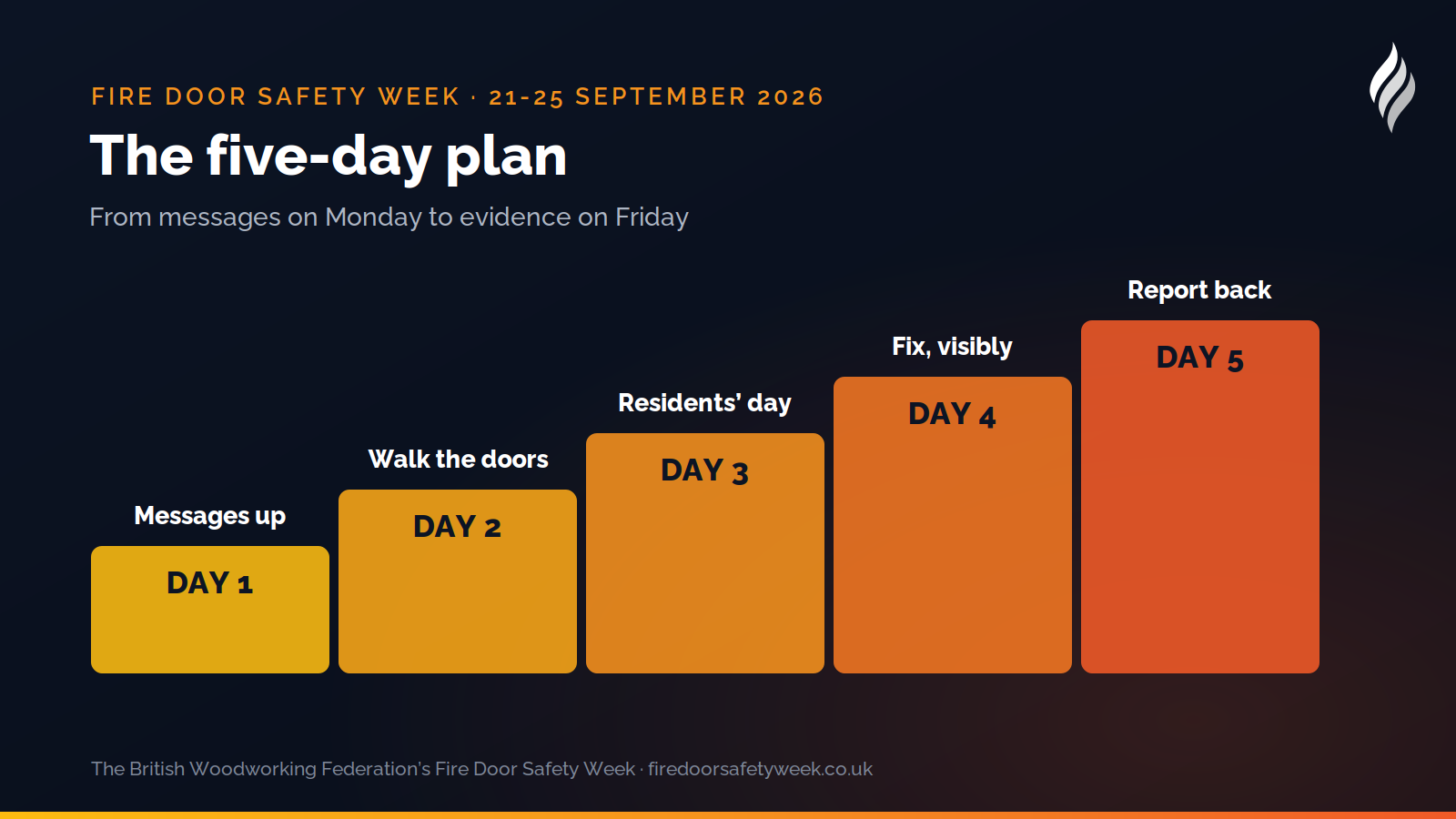
The plan moves from words to evidence: put the messages up, walk the doors, bring residents in, fix what you found, then report back and lock the routine in. Each day builds on the one before, and none of them needs more than a few focused hours.
Day 1: put the messages up
Start with communication, because everything later in the week works better once people know why it is happening. Print the posters and checklists from the free toolkit at firedoorsafetyweek.co.uk and put them where people pause: notice boards, lift lobbies, staff rooms, resident portals. Make sure the three Regulation 10 messages go with them: keep fire doors shut, never tamper with self-closers, report faults straight away. Tell your own staff the week is on and what is coming; if they have had the one-hour training session, this is their reminder, and if not, Day 2 doubles as the walk-along.
Day 2: walk the doors
Sweep the communal fire doors with the five-step check: certification, apertures, gaps and seals, hinges, closing. Log every door you look at, not just the faulty ones; "checked and fine" is evidence too. Photograph every fault. Close every wedge you find as you go. Depending on the size of the estate this is a morning or a couple of days, and it does not need to be exhaustive to be valuable: a full sweep of one building beats a sample of five.
Day 3: residents' day
Spend a day on the people who live with the doors. A short walk-along teaching a few residents the five-step check, a demonstration of the reporting route, a piece in the newsletter or portal carrying the Regulation 10 messages. We published a full playbook for this in getting residents involved, and the case for bothering is in the fire door awareness gap: most people cannot spot a faulty fire door until someone shows them.
Day 4: fix what you found, visibly
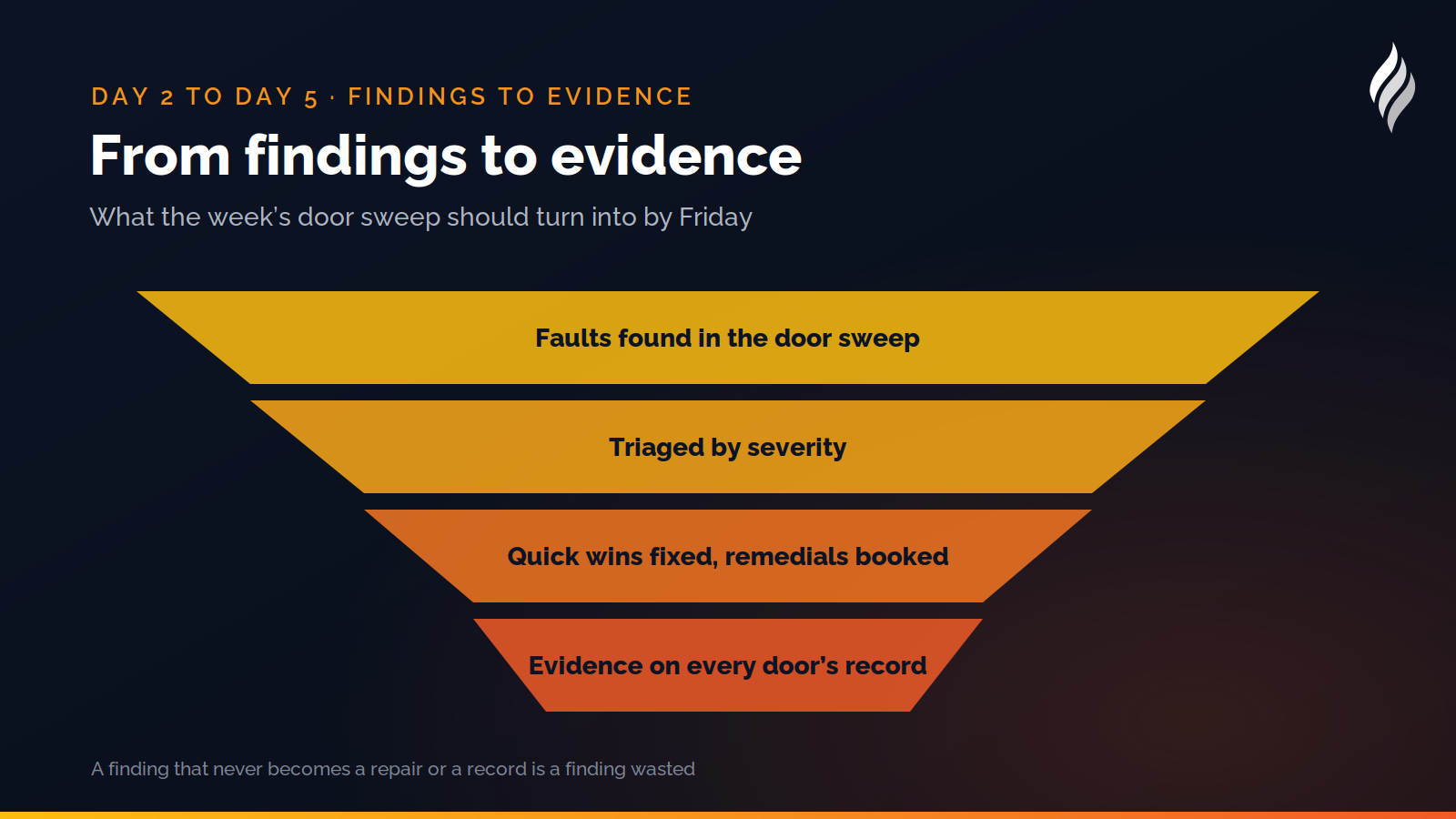
Triage Day 2's findings by severity. Fix the quick wins today where you safely can: wedges removed, signage replaced, a closer adjusted by someone competent to do it. Book contractors for the rest, and refer anything needing judgement, certification questions, repairs, doors that may be beyond repair, to a competent inspector rather than guessing. Do the visible fixes loudly: a resident who reported a fault on Wednesday and sees it fixed on Thursday has just learned that reporting works.
Day 5: report back and lock it in
Close the week by publishing what happened: doors checked, faults found, faults fixed, remedials booked. Put it on the notice board next to the campaign poster. Then convert the week's momentum into routine: schedule the professional inspections the sweep showed you need, set the date for the next quarterly checks, and book next year's Fire Door Safety Week into the calendar now. The findings themselves should end the week somewhere permanent; a fire door inspection report or door-by-door record, not a spreadsheet nobody will reopen.
Only got one day left?
If the week has nearly gone and you can spare a single day, compress the plan to its spine: put the three Regulation 10 messages up in the morning, sweep the communal doors of your highest-risk building with the five-step check before lunch, close every wedge as you find it, and spend the afternoon logging the faults, fixing the trivial ones and booking the rest. That single day produces the two things that outlast the campaign, a record of what was found and remedials in motion, and Day 3's resident engagement can run any week of the year. A compressed week is a start, not a substitute: put the full version in the diary for next September.
After Friday
The campaign ends; the doors stay. The test of the week is what still exists in October: a reporting route people have used, staff and residents who know the five steps, a door register with this week's evidence in it, and remedial works moving. If you are reading this before next year's campaign, our guides to preparing for Fire Door Safety Week and Fire Door Safety Week 2026 cover the ground this plan assumes.
How DoorTRACE helps
DoorTRACE is built for exactly this week. The Day 2 sweep goes straight into each door's record with photos, defects are triaged and tracked through to completion, resident and staff reports arrive by QR scan, and the Day 5 report-back is generated from the data instead of assembled by hand. By Friday you have the evidence trail, not a pile of notes. See the platform overview, or talk to us and next year's week runs itself.
Approved Document B: the second staircase era starts today
The amendments to Approved Document B come into force today: more than one common stair in new blocks of flats with a storey 18m or more, evacuation shafts to support evacuation lifts, and new escape guidance. What changes, who it touches, and the fire door angle.
Remedial work is now free to record on DoorTRACE
Only inspections are charged on Pay-As-You-Go from now on. The form that closes out remedial work joins registrations and reports on the free list, so the cost of a door for the year is known before it starts.
Fire doors in warehouses and industrial units
An open warehouse floor resists traditional compartmentation, so its fire doors concentrate around the edges and take the hardest knocks in any sector. Where the doors are, the fork-lift problem, and a check regime for a hard-wearing site.