The British Woodworking Federation's Fire Door Safety Week starts on Monday, and the single highest-value thing you can do before it does is also one of the cheapest: train the people who already walk your buildings every day to notice when a fire door is wrong. A caretaker, cleaner or concierge passes more fire doors in a week than a professional inspector sees in a visit, and every one of them who knows what a fault looks like extends your coverage between scheduled checks at no extra cost.
This guide covers who to train, what to teach them, a one-hour session plan that sticks, and the line every session must draw clearly: staff are there to spot and report, never to repair.
Why staff are your coverage between checks
A fire door regime built only on scheduled checks has a gap measured in months. A door damaged the day after a quarterly check can stand faulty until the next one, unless someone notices, and the BWF's own research says noticing is the weak link: its 2023 study found 57% of the UK public could not spot a fire door fault. We looked at that finding in our piece on the fire door awareness gap. Residents help close the gap, and we covered involving them last week, but staff are the faster win: they are on shift, on payroll, and already walking the corridors with a reason to look.
Who to train
The list is anyone whose job moves them around the building: caretakers, cleaners, concierges and front-desk staff, housing and neighbourhood officers, porters and catering staff in care settings, site staff in schools, and maintenance operatives who are not fire door specialists. Regular contractors are worth including where you can; a window cleaner who knows what a wedge means is another set of eyes.
Do not limit it to people with "safety" in their job title. The value is frequency of passage, not seniority, and the training is deliberately light enough for everyone.
What to teach: eyes, not toolbelts
The curriculum already exists. The BWF's five-step fire door check was designed for exactly this audience: certification label, apertures, gaps and seals, hinges, and whether the door closes fully on its own. It needs no tools beyond a phone and a £1 coin, takes about two minutes per door, and the full material is free at firedoorsafetyweek.co.uk. Our guide to common fire door defects makes a good companion handout, and the free inspection checklist gives staff something printable to carry.
Just as important is what staff must not do. There is one action they should always take on the spot: a wedged or propped-open fire door gets closed, then reported. Everything else is report-only. No adjusting self-closers, no tightening hinges, no re-fixing seals, no judging whether a door "is probably fine". Repairs belong to competent people working to the door's certification, and the difference between a staff check and a professional inspection should be stated plainly in the session so nobody leaves thinking they have become an inspector.
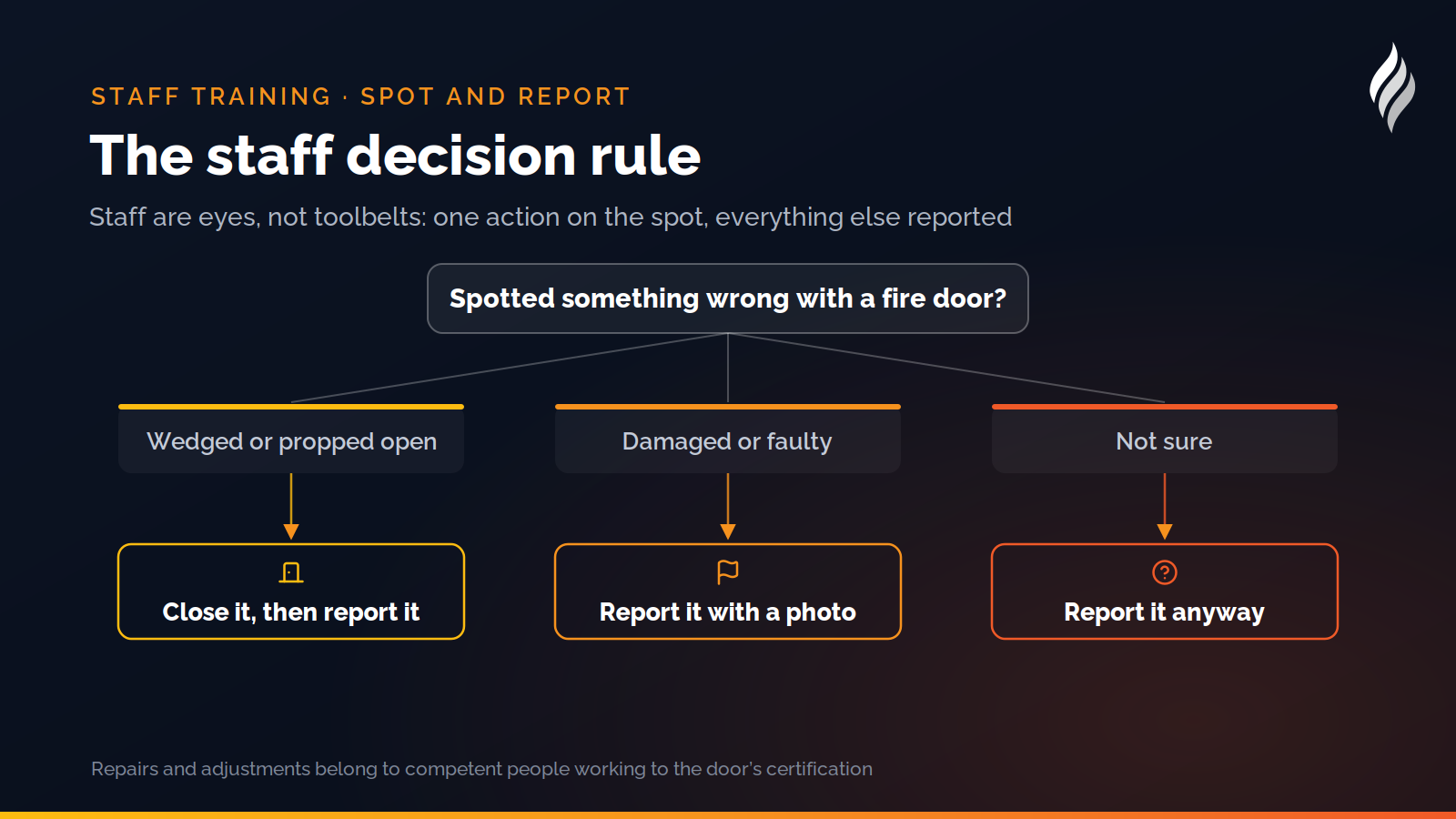
The decision rule that covers every case fits in one line: if in doubt, report. A false alarm costs a minute of someone's time; a real fault left unreported costs the door its job.
A one-hour session that sticks
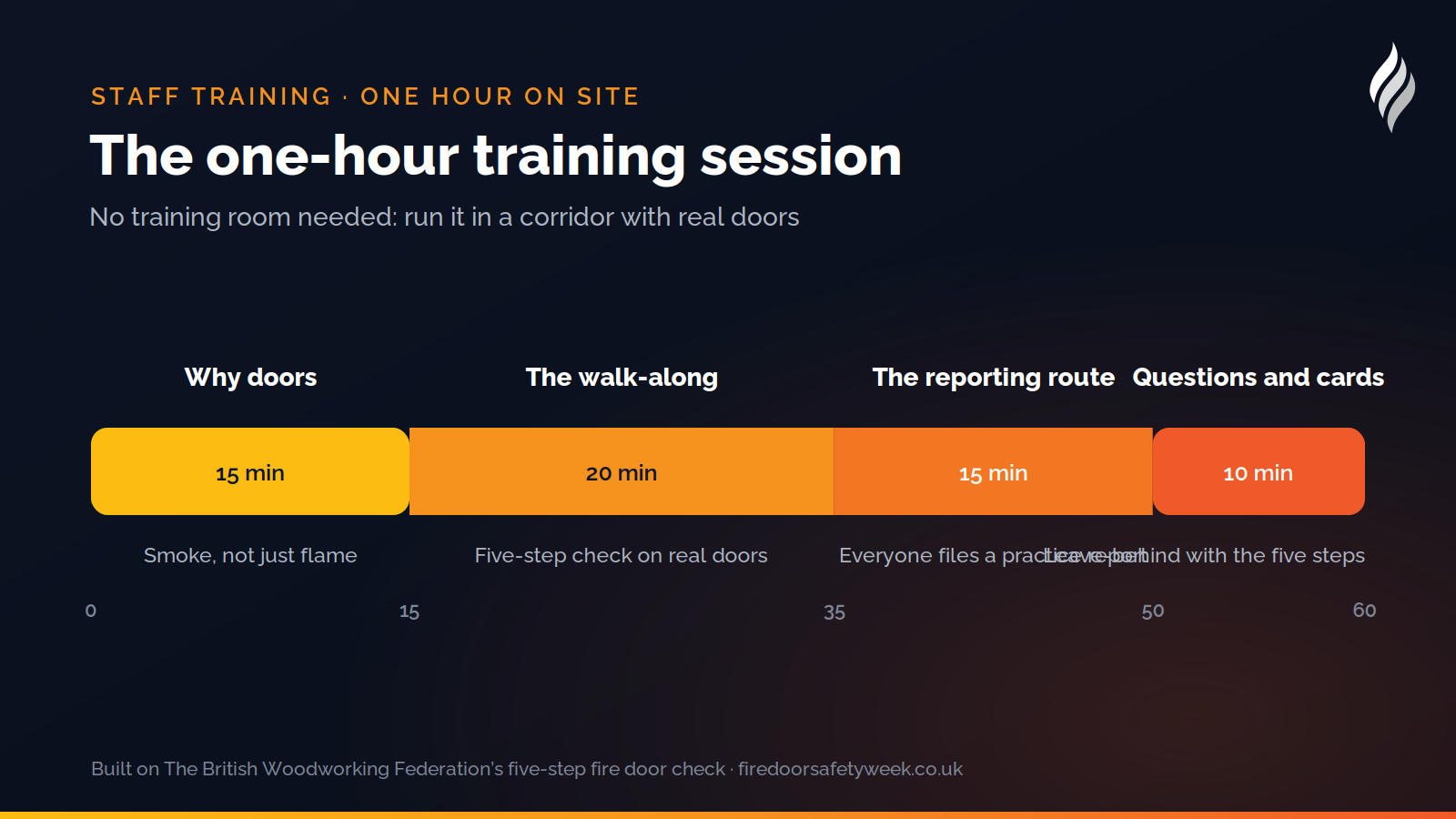
You do not need a training room or a budget. One hour, on site, in a corridor with real doors, beats a slide deck every time.
First 15 minutes: why doors. What a fire door does, and the point most people miss: it holds back smoke, not just flame, and smoke is what kills. Keep it concrete with the building's own layout: this corridor, this stairwell, these flats.
Next 20 minutes: the walk-along. Take the group down one corridor and run the five-step check together on three or four doors. Let each person find a label with their phone camera and gauge a gap with a coin. The door people touch is the lesson they keep.
Next 15 minutes: the reporting route. Show exactly how a fault gets reported in your building, and have every person submit a practice report on the spot. A route nobody has used is a route nobody will use.
Final 10 minutes: questions and the card. Close with questions and hand out a wallet or lanyard card with the five steps and the reporting route on it.
Run the session in the days before Fire Door Safety Week and the campaign does your reinforcement for you: the posters going up around the building next week will repeat everything you just taught.
Tailoring the session to the setting
The five steps do not change between buildings, but the emphasis should. In residential blocks, flat entrance doors deserve a mention even though staff will mostly check communal doors: residents own the inside, but a flat door with a missing closer is still a report. In care homes, hold-open devices linked to the alarm are common and legitimate, so teach staff the difference between an engineered hold-open that releases on the alarm and an illegal wedge; our guide to self-closers and hold-open devices covers it. In schools, site staff should expect impact damage and propping around lesson changeover, and in offices the classic fault is the fire door wedged for deliveries and never unwedged. One slide of local emphasis makes the generic material feel like it was written for the building.
Keeping it alive
One session creates awareness; the routine keeps it. Put the session in the induction pack so every new starter gets it in week one. Repeat a short refresher annually, with Fire Door Safety Week as the natural slot. Track staff reports as a number: rising reports after training is the system working, not the building getting worse. And close the loop visibly, because the fastest way to untrain people is to let their reports vanish; the 2023 research found 21% of people would not report because they believed nothing would get done.
Three months on, success looks like this: every new starter has had the session, staff reports arrive steadily rather than in a post-training spike, walkthroughs find no standing wedges, and the faults professional inspections uncover are increasingly ones a layperson could never have seen, because staff already caught the visible ones.
How DoorTRACE helps
DoorTRACE gives trained staff a route that takes seconds: every door carries a QR plaque, so a report is a scan and a photo, filed against the right door automatically. Staff reports, resident reports, routine checks and professional inspections all land on the same door history, so the fault a cleaner flags on Tuesday is in front of the person booking remedials on Wednesday, with the fix logged when it happens. See the platform overview, or get in touch to have it in place before Monday.
Approved Document B: the second staircase era starts today
The amendments to Approved Document B come into force today: more than one common stair in new blocks of flats with a storey 18m or more, evacuation shafts to support evacuation lifts, and new escape guidance. What changes, who it touches, and the fire door angle.
Remedial work is now free to record on DoorTRACE
Only inspections are charged on Pay-As-You-Go from now on. The form that closes out remedial work joins registrations and reports on the free list, so the cost of a door for the year is known before it starts.
Fire doors in warehouses and industrial units
An open warehouse floor resists traditional compartmentation, so its fire doors concentrate around the edges and take the hardest knocks in any sector. Where the doors are, the fork-lift problem, and a check regime for a hard-wearing site.