The British Woodworking Federation's Fire Door Safety Week runs from 21 to 25 September this year, and it is easy for compliance teams to treat it as an industry event: a week of webinars, supplier posts and toolbox talks. That misses the point of the campaign. Fire Door Safety Week was created to reach the public, because the people who pass a building's fire doors every day are the ones best placed to notice when something is wrong, and the campaign's own research shows most of them currently cannot.
This guide is about using the week for its original purpose: bringing your residents into the fire door system. It covers what the law already requires you to tell them, engagement ideas that work in real buildings, and the one thing that decides whether the effort lasts beyond September: a reporting route that visibly works.
Why residents are part of the system
A fire door regime run entirely by scheduled checks has a built-in blind spot: the time between them. A door damaged the week after a quarterly check can stand faulty for months, unless someone who passes it daily says something. BWF research from 2023 found that 57% of the UK public could not spot a problem with a fire door, and around half did not feel reporting was their responsibility; we unpacked those findings in our article on the fire door awareness gap. Every resident you move across that gap becomes another set of eyes between the scheduled visits.
The legal baseline: Regulation 10
Resident engagement on fire doors is not just good practice; part of it is a legal duty. Under Regulation 10 of the Fire Safety (England) Regulations 2022, Responsible Persons for all multi-occupied residential buildings, regardless of height, must give residents information about fire doors. The substance of the message is simple and worth repeating exactly as the regulation intends: keep fire doors shut when not in use, do not tamper with self-closing devices, and report any faults or damage straight away.
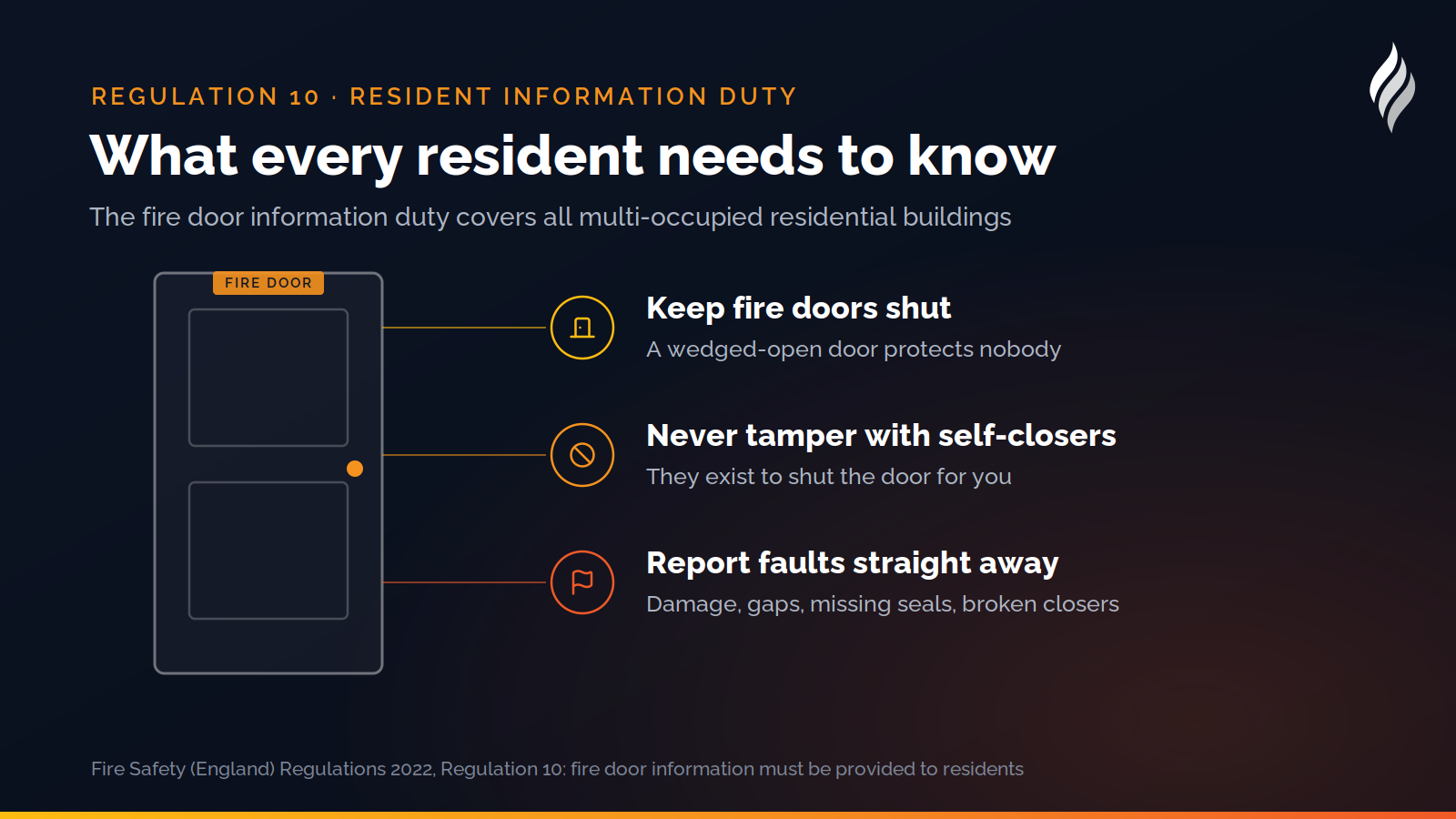
If those three messages have not gone out to your residents recently, Fire Door Safety Week is the natural moment to fix that, and doing so during a national campaign gives the message extra weight. Our guide to Regulation 10 resident information covers the duty in full, including who must receive the information and when.
Ideas that work during the week
Use the campaign's own materials. The BWF publishes a free toolkit at firedoorsafetyweek.co.uk with posters, checklists and videos designed for exactly this audience. Notice boards, lift lobbies and resident portals are the natural homes for them. The campaign asks only that you credit it, which the materials do themselves.
Teach the five-step check in person. A 20-minute walk-along where a staff member shows a small group of residents the five-step fire door check on their own corridor doors beats any leaflet. People remember the door they touched: the label they found with a phone camera, the £1 coin in the gap, the closer that pulled the door shut on its own.
Show the reporting route, live. Awareness without a route goes nowhere. Whatever your route is, a QR plaque on the door, a portal, a phone number, demonstrate it during the week and report a real fault with residents watching. Nothing builds confidence like seeing the report land.
Put fire doors in the onboarding pack. New residents are the easiest audience you will ever have. A single page in the welcome pack carrying the three Regulation 10 messages and the reporting route means every future resident arrives briefed.
Invite residents to shadow a real check. If a quarterly communal door check falls anywhere near the week, schedule it during it and invite a few residents along. Watching a trained person work through a corridor's doors makes the routine visible, answers the "does anyone actually check these?" question for good, and shows the standard a door is held to. Our article on inspection frequencies covers how often each door type should be seen.
Brief your own people first. Concierges, caretakers, housing officers and cleaners will field the questions the campaign raises. A short session with front-line staff before the week starts, using the same five-step check, means residents asking "is this door meant to do that?" get an answer rather than a shrug. We will cover staff training in depth in next week's article.
Make reporting visibly work
The BWF's 2023 research carries a warning for this whole exercise: 21% of people said they would not report a fire door fault because they did not believe anything would get done. That belief is learned. A resident who reported a wedged door in March and walked past the same wedge in June has been taught, by the building, that reporting is pointless.
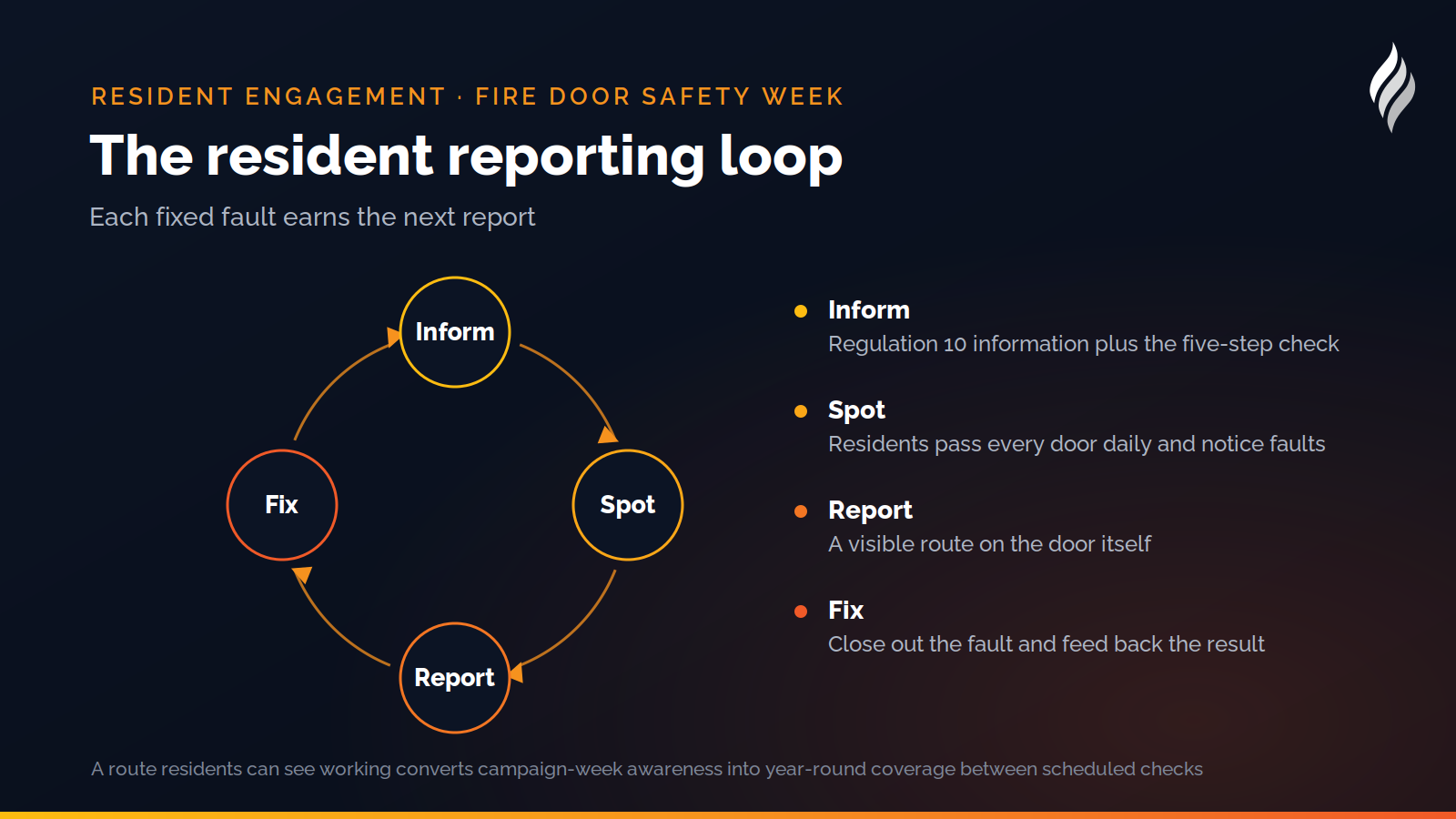
The fix is a loop, not a letterbox. A report should produce an acknowledgement the resident can see, a fix they can watch happen, and ideally a closing note: reported, repaired, date. Each completed loop earns the next report. Run the loop visibly during Fire Door Safety Week, publicise a fault found and fixed because a resident flagged it, and you convert the campaign's energy into a habit that survives the autumn.
After the week
One week of posters does not change a building's culture; the follow-through does. Keep the five-step check material up after the campaign ends, repeat the Regulation 10 messages at least annually and whenever they change, and keep publishing the loop: faults reported, faults fixed. Resident reports are also worth tracking as a number in their own right. A building where reports rise after the week and stay up has grown extra coverage between scheduled checks; a building where they fall back to zero has a communication job to repeat, not a fault-free estate. If you are still assembling your plan for the week itself, our articles on preparing for Fire Door Safety Week and Fire Door Safety Week 2026 cover the groundwork, and social housing providers will find sector-specific context on our social housing page.
How DoorTRACE helps
DoorTRACE closes the loop this guide is built around. Every door carries a QR plaque linking to its public door page, so a resident can report a fault in the moment they spot it, and every report lands against the door's record where staff can action it and the fix is logged with photos and dates. The result is a reporting route residents can see working, which is the whole game. See the platform overview, or get in touch to have it running before 21 September.
Approved Document B: the second staircase era starts today
The amendments to Approved Document B come into force today: more than one common stair in new blocks of flats with a storey 18m or more, evacuation shafts to support evacuation lifts, and new escape guidance. What changes, who it touches, and the fire door angle.
Remedial work is now free to record on DoorTRACE
Only inspections are charged on Pay-As-You-Go from now on. The form that closes out remedial work joins registrations and reports on the free list, so the cost of a door for the year is known before it starts.
Fire doors in warehouses and industrial units
An open warehouse floor resists traditional compartmentation, so its fire doors concentrate around the edges and take the hardest knocks in any sector. Where the doors are, the fork-lift problem, and a check regime for a hard-wearing site.