The fastest-growing fire risk in UK buildings does not come from wiring, cooking or smoking. It arrives through the front door on two wheels and gets plugged in overnight. Freedom of Information data gathered by QBE Insurance Group showed a 93% increase in lithium-ion battery fires between 2022 and 2024, with e-bikes and e-scooters among the most common causes. The risk was serious enough that the British Woodworking Federation built its entire Fire Door Safety Week 2025 campaign, 'Fire Travels Fast', around it.
For anyone responsible for a building, the battery story and the fire door story are the same story. When a battery fire starts in a flat or a communal store, the fire doors around it decide whether the building gets an incident report or a tragedy. This article looks at the numbers, what the BWF's research found about public confidence, and what it means for the buildings you manage, with The British Woodworking Federation's Fire Door Safety Week 2026 running from 21 to 25 September.
The numbers behind the concern
The BWF's 2025 survey put figures on how far the risk has already reached into everyday life. One in ten people said they had experienced a lithium-ion battery fire in the past year or knew someone who had. Among people who own an e-bike or e-scooter, 59% said their fears about fire risk had grown since getting the device: the closer people live with the technology, the more it worries them.
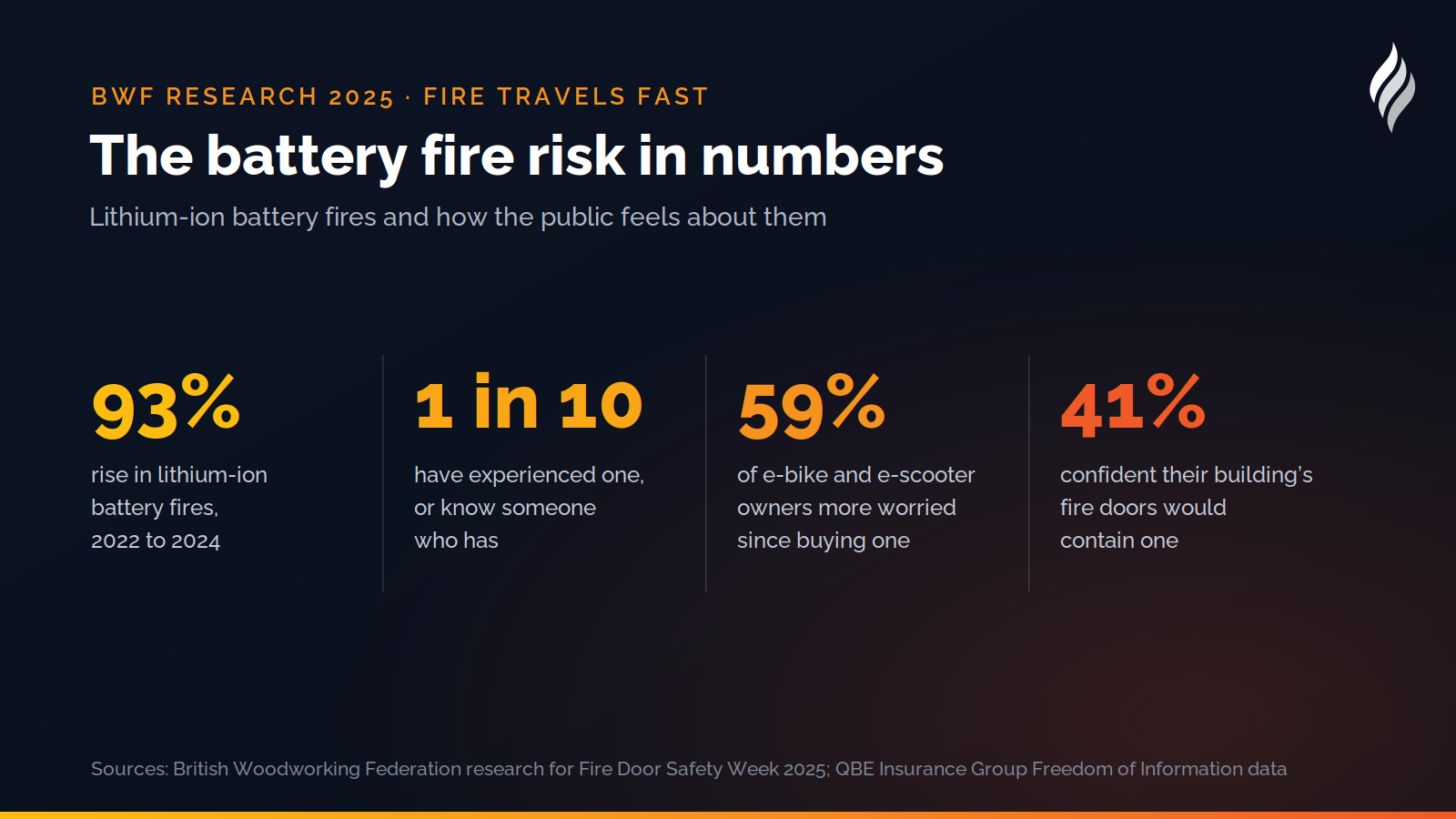
The number that should concern building managers most is the last one: only 41% of people surveyed were confident that the fire doors in their building would contain a battery fire. Whether or not that doubt is justified in any given building, it tells you residents are already asking the question.
Why battery fires are different
A lithium-ion battery that fails does not smoulder politely. A damaged, faulty or badly charged cell can enter thermal runaway, an escalating chain of overheating that releases intense heat, jets of flame and large volumes of toxic smoke within moments. These fires develop fast, are difficult to put out, and can reignite after they appear to be dealt with.
That behaviour is exactly what compartmentation exists to answer. A closed, properly maintained fire door holds back flame and smoke long enough for people to escape and for the fire service to get in, and that holding time is what a fast-developing fire eats into. The 2025 campaign name said it plainly: fire travels fast, so the doors have to work first time. What an FD30 or FD60 rating actually promises, and what it depends on, is covered in our guide to fire door ratings.
What the BWF's 2025 research found
Asked which battery-powered items they saw as most likely to be a fire hazard, respondents put e-scooters (47%) and e-bikes (45%) at the top of the list, ahead of vapes (38%) and electric vehicles (36%). The same research found that more than a third of people had spotted issues with fire doors in their own homes, which sits uncomfortably alongside the finding from the BWF's 2023 research that most people cannot recognise a fire door fault in the first place; we looked at that problem in our article on the fire door awareness gap.
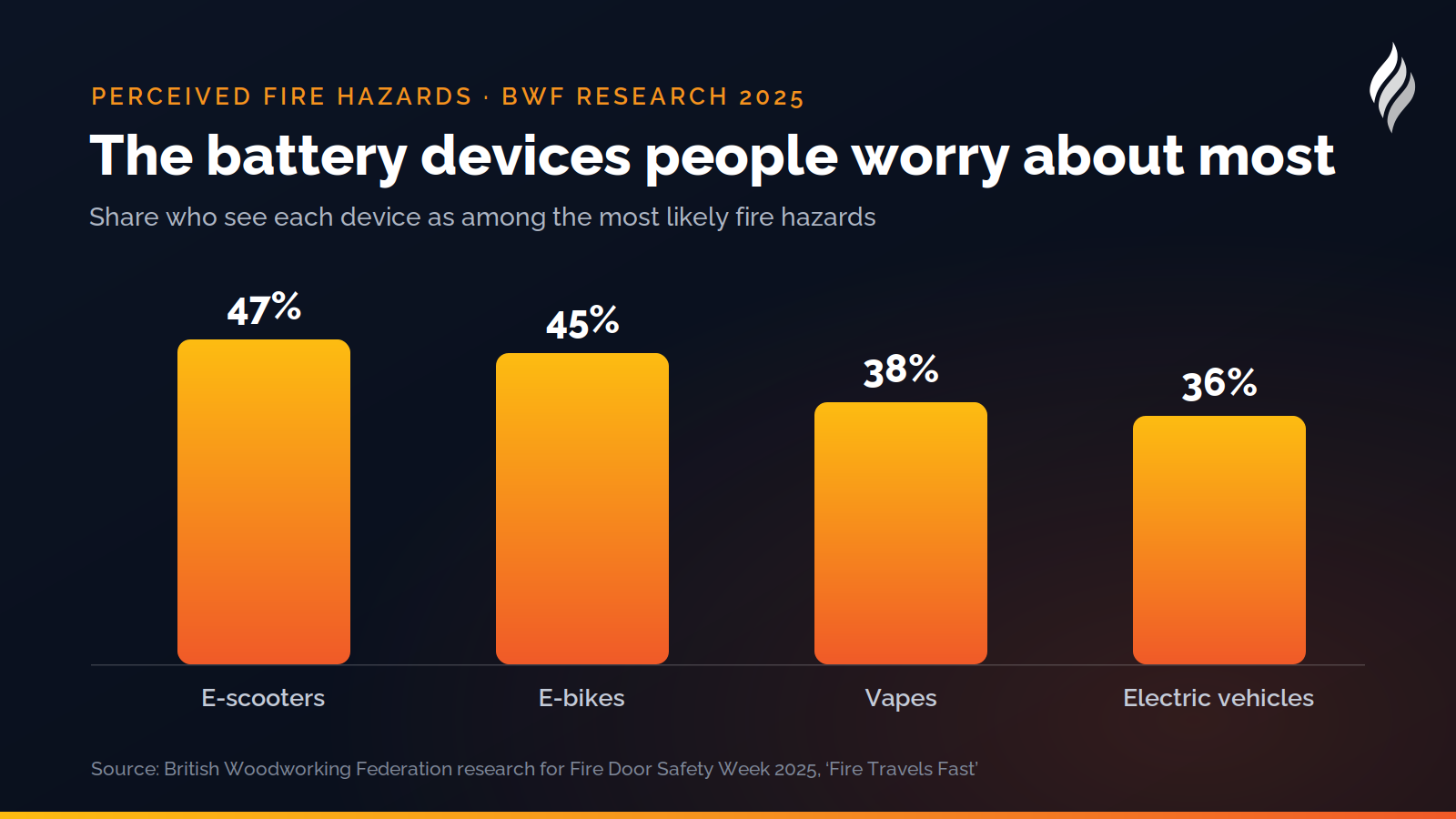
Put those findings together and the picture is clear: the public sees the battery risk, lives with the devices, doubts the doors, and struggles to judge whether that doubt is justified. Closing that gap is the building manager's job, and it is done with maintained doors and visible evidence, not reassurance.
What this means for your buildings
The practical work splits into three strands.
Where devices live and charge. E-bikes and e-scooters increasingly come indoors: into flats, hallways and communal stores. A device charging in a communal corridor is a double failure waiting to happen, an ignition source sitting in the escape route it will block. A clear, communicated policy on where devices are stored and charged, kept away from escape routes and ideally in areas separated by fire-rated construction, is the first line. Standard fire service advice applies: use the manufacturer's charger, avoid charging unattended overnight, and take damaged batteries out of use.
Doors that will actually hold. Compartmentation only works if the doors on it work. Flat entrance doors carry the load when a fire starts inside a home, and communal doors carry it when the fire starts in a shared space, which is exactly where stored devices tend to sit. Intumescent and smoke seals do the smoke-holding work, and a propped-open fire door does none of it. In buildings with a storey over 11 metres, Regulation 10 already requires communal fire doors to be checked at least quarterly and flat entrance doors at least annually on a best endeavours basis; the battery risk is a good reason to treat those frequencies as a floor, not a target.
A reporting route residents trust. The 41% confidence figure is partly a communication problem. Residents who see checks happening, know how to report a wedge or a broken closer, and see reported faults fixed will trust the doors more, and with better reason. Teaching the five-step fire door check is the quickest way to turn concerned residents into useful ones.
The BWF's campaign resources on the battery risk are free at firedoorsafetyweek.co.uk, and our guide to Fire Door Safety Week 2026 covers this year's campaign.
How DoorTRACE helps
DoorTRACE turns "trust the doors" into something you can show. Every door carries its check and inspection history, with photos and dates, and every door gets a QR plaque so a resident who spots a problem with the door guarding an e-bike store can report it on the spot. When the fire risk assessment asks whether compartmentation around new risks is being maintained, the answer is a record, not a recollection. See the platform overview, or talk to us about getting your buildings ready before Fire Door Safety Week.
Approved Document B: the second staircase era starts today
The amendments to Approved Document B come into force today: more than one common stair in new blocks of flats with a storey 18m or more, evacuation shafts to support evacuation lifts, and new escape guidance. What changes, who it touches, and the fire door angle.
Remedial work is now free to record on DoorTRACE
Only inspections are charged on Pay-As-You-Go from now on. The form that closes out remedial work joins registrations and reports on the free list, so the cost of a door for the year is known before it starts.
Fire doors in warehouses and industrial units
An open warehouse floor resists traditional compartmentation, so its fire doors concentrate around the edges and take the hardest knocks in any sector. Where the doors are, the fork-lift problem, and a check regime for a hard-wearing site.