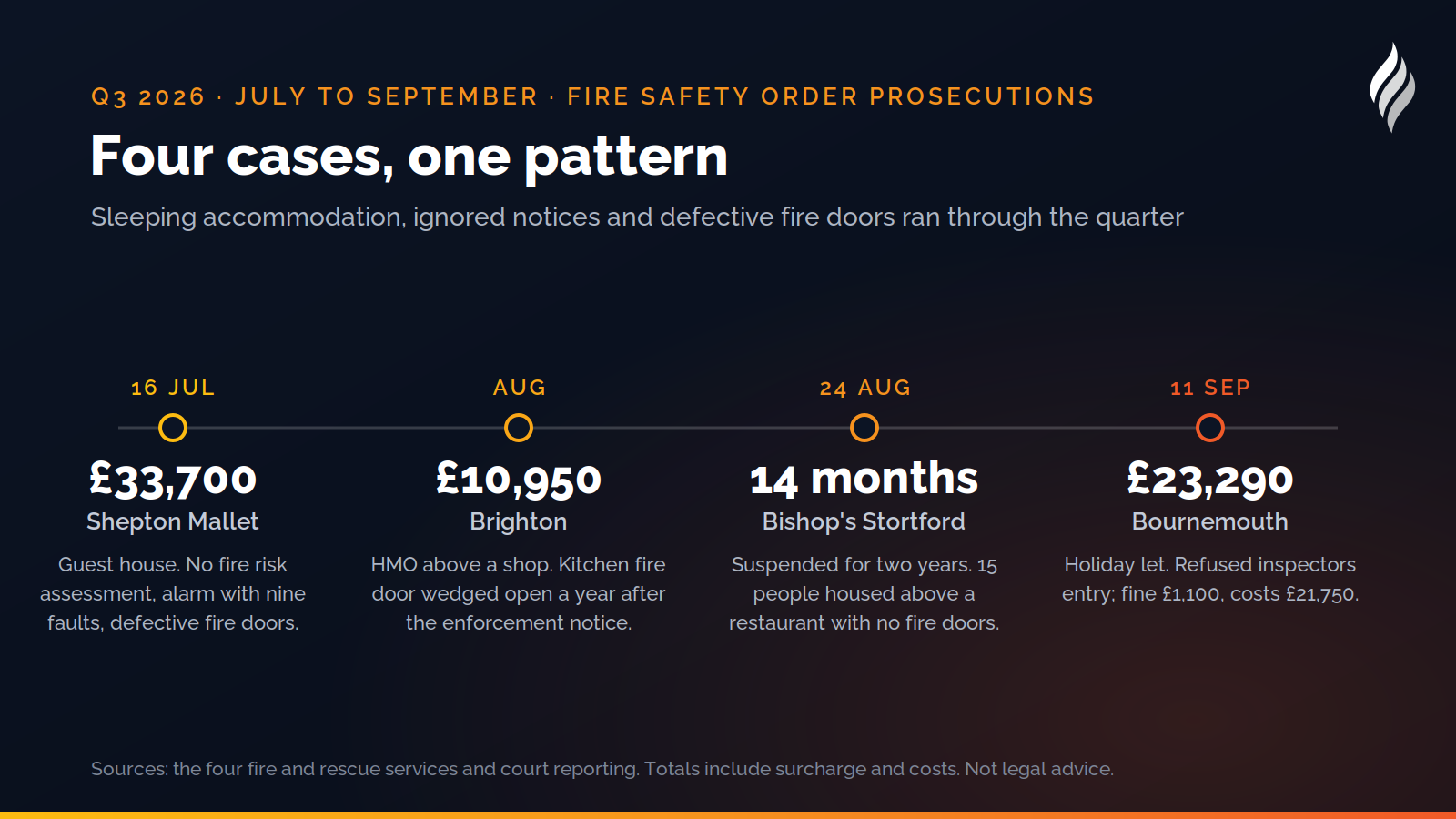
A restaurant owner who turned the floors above his premises into unlicensed sleeping accommodation for up to 15 people, with no fire doors and no detection, left St Albans Crown Court in August with a 14-month prison sentence hanging over him. It was the heaviest outcome of a quieter quarter for fire safety prosecutions, and the one that best sums up what the courts are punishing. Between July and September 2026 we found four completed prosecutions under the Fire Safety Order in England, alongside the government's annual enforcement statistics and a change to the enforcement guidance itself.
This is our second quarterly roundup, following Q2 2026. Below are the cases, the numbers behind them, and what they mean for anyone responsible for fire doors. As always, it is general information, not legal advice.
Bishop's Stortford: fifteen people upstairs and no fire doors
The quarter's most serious outcome came on 24 August at St Albans Crown Court, where Moynul Abedin pleaded guilty to four offences under the Fire Safety Order following a Hertfordshire Fire and Rescue Service prosecution. The upper floors of his Tamarind Tree restaurant in Bishop's Stortford had been converted, without authorisation, into sleeping accommodation housing as many as 15 people at a time, reported to include airline crew, at up to £500 a head per month over roughly 18 months.
Inspectors found no fire detection, inadequate fire-resisting construction, missing fire doors and insufficient means of escape, together with extensive unauthorised internal rebuilding. A prohibition notice was served and repeatedly breached: on one follow-up visit nine tenants were still living there. The recorder described the defendant's attitude as showing flagrant disregard, citing constant warnings and a lack of cooperation.
Abedin received a 14-month custodial sentence suspended for two years, and confiscation proceedings under the Proceeds of Crime Act were started to recover what the rooms had earned. Two lessons stand out: a prohibition notice is not a negotiating position, and where a Responsible Person profits from the breach, the court now looks at the profit as well as the fine.
Shepton Mallet: £33,700 for a five-bedroom guest house
On 16 July, Taunton Magistrates' Court fined Prestleigh Inn B&B Ltd £26,000 with a £2,000 victim surcharge and £5,700 in costs, a total of £33,700 to be paid in thirds by July 2029. Devon and Somerset Fire and Rescue Service had inspected the guest house near Shepton Mallet in May 2025 after a guest complained. They found no fire risk assessment at all, an alarm system showing nine faults, no regular maintenance of alarm, emergency lighting or firefighting equipment, and defective fire doors. Prohibition notices had already stopped the premises being used for sleeping.
The case is a reminder of how small a premises can be and still attract a five-figure fine, and of how often the trigger is a guest, tenant or resident picking up the phone. Fourteen months passed between the inspection and sentencing, which is fast by the standards of this quarter.
Brighton: an HMO fire door wedged open for a year
Markandayar Gowrikaran, the owner of a five-tenant HMO above a post office and shop on St James's Street in Brighton, pleaded guilty in April to three Fire Safety Order offences following an East Sussex Fire and Rescue Service prosecution; his sentence was reported in August as a £2,768 fine, a £1,107 surcharge and £7,075 in costs, £10,950 in all.
Officers first attended in February 2023 and served an enforcement notice within ten days. The failings they listed were the everyday kind that fill inspection reports: a kitchen fire door that did not close into its frame and was found wedged open on visit after visit, an electrical intake cupboard not enclosed in fire-resisting materials, combustible storage and a mattress in the escape route, missing detector heads and a faulted alarm panel. The same defects were still there in December 2023, and the work was not completed until early 2024. The judge said the efforts could not be called significant given the timeframe and the warnings, adding that thankfully no fire had broken out.
For HMO landlords this is the most instructive case of the quarter, because nothing in it was hard to fix. The costs were more than twice the fine, which is what happens when a case runs for a year longer than it needs to.
Bournemouth: £23,290 for refusing entry
The fourth case did not involve a single fire safety defect. On 11 September, Weymouth Magistrates' Court fined Elizabeth Jean Watson £1,100, with a £440 surcharge and £21,750 in costs, for failing without reasonable excuse to comply with requirements imposed by a fire safety inspector, an offence under Article 32(2)(e) of the Order. Dorset and Wiltshire Fire and Rescue Service had opened an investigation after a former guest at her Bournemouth holiday let complained; she repeatedly refused inspectors entry, then failed to attend court, and was tried in her absence.
The fine was modest. The costs were not. Obstructing an inspection is its own offence, and it ends up costing far more than opening the door would have.
The national picture: 3,355 formal notices, 33 prosecutions
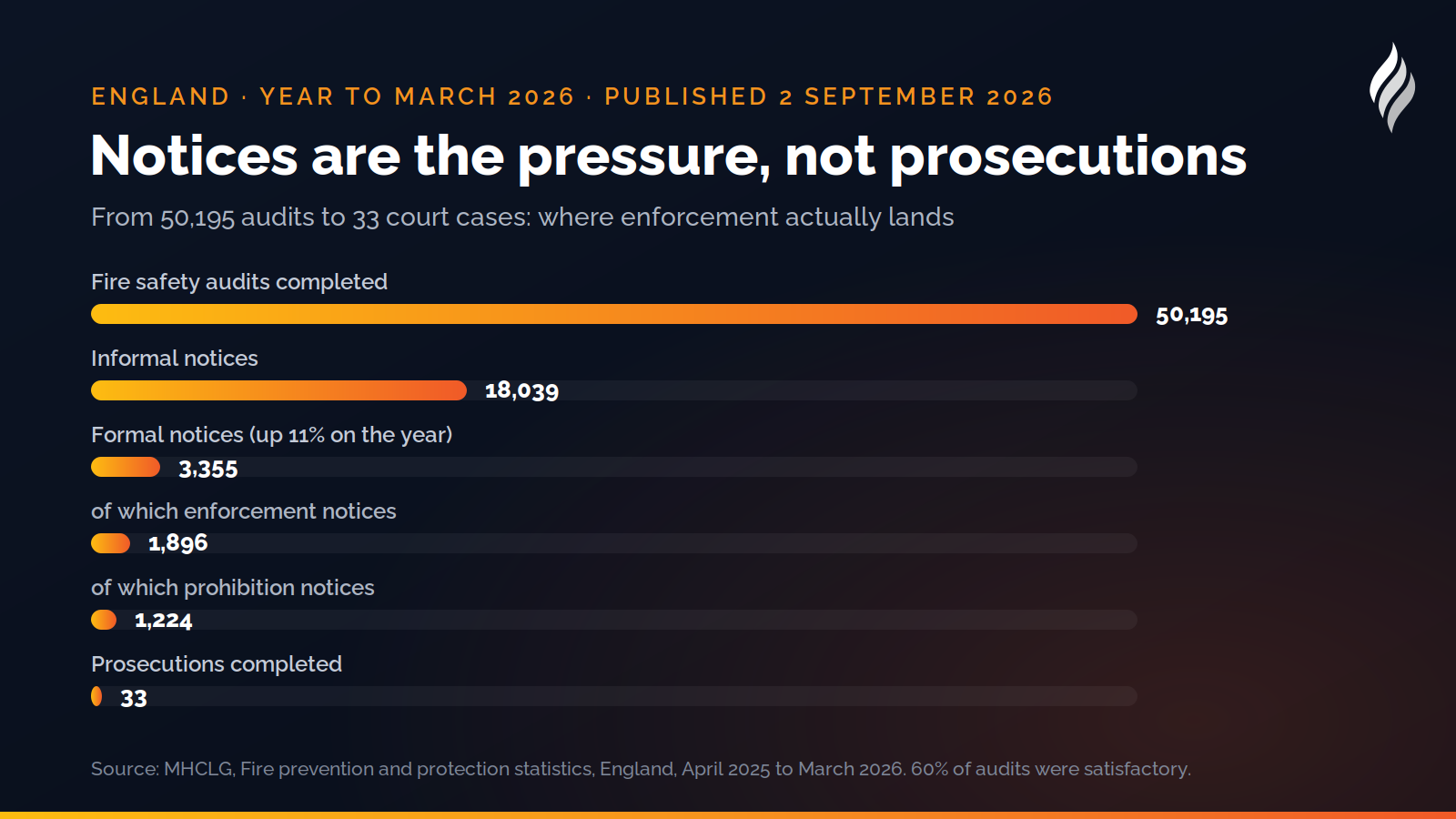
On 2 September the Ministry of Housing, Communities and Local Government published its fire prevention and protection statistics for England for the year to March 2026. They give the enforcement context for every case above.
- Fire and rescue services completed 50,195 fire safety audits, and only 60% recorded a satisfactory outcome, almost unchanged from 59% the year before.
- They issued 3,355 formal notices, up 11% on the previous year and up 46% on six years ago: 1,896 enforcement notices, 1,224 prohibition notices and 202 alteration notices. Enforcement notices went most often to shops, then to purpose-built blocks of flats of six to nine storeys, then to licensed premises.
- A further 18,039 informal notices were issued.
- 33 prosecutions were completed, down from 35 the previous year and from 52 six years ago.
- Breaches of Article 14, emergency routes and exits, were the most common reason for non-compliance, with 11,286 recorded, 13% of all breaches and up 9% year on year.
Read together, those figures explain why a quarter produces only a handful of court cases while enforcement feels more visible than ever. Prosecution is the top of the ladder and it is used sparingly: 33 cases against 3,355 formal notices. The notices are where the pressure sits, and their number keeps rising. The odds of an audit finding something are roughly two in five, and the odds of that turning into a formal notice are climbing.
Two changes to the rules of the game
Two developments this quarter sit outside the courts. On 3 July, MHCLG updated its guidance on enforcement and sanctions under the Fire Safety Order. The enforcement ladder is unchanged, but the guidance now explains how determinations by the Secretary of State work under Article 36, giving Responsible Persons and enforcing authorities a formal route to settle technical disputes about what the Order requires. We covered the update when it arrived.
And on 15 July it was reported that the Building Safety Regulator had served an improvement notice on NHBC Building Control, the largest registered building control approver, with a compliance deadline of 8 September. The regulator was clear that the notice did not mean buildings NHBC inspected were non-compliant. It is worth noting because it shows the regulator using its powers against a building control body, not only against building owners.
What Q3 tells Responsible Persons
Three of the four cases involved sleeping accommodation attached to a commercial premises: a guest house, a restaurant with rooms above, a holiday let. The fourth was an HMO above a shop. Two involved defective, missing or wedged fire doors and failed compartmentation. In every case where officers had served a notice, the prosecution followed the notice being ignored, not the original inspection. And the timelines were long: 14 months in Somerset, about three years in Brighton, 18 months of unlawful use in Bishop's Stortford.
The practical response has not changed since our Q2 roundup. Know what your fire doors are and where they are, inspect them on a schedule, fix the common defects as they are found, and keep a record that shows all of it. If a notice arrives, act on it inside the deadline; every case above that reached a courtroom did so because someone did not.
This roundup is general information about publicly reported enforcement outcomes, not legal advice. If you are facing enforcement action, take advice from a suitably qualified professional.
How DoorTRACE helps
DoorTRACE gives Responsible Persons a live, evidenced record of every fire door: what was inspected, what was found, what was fixed and when. Inspection schedules, defect tracking and audit-ready reports mean that when an inspector calls, the evidence is already in order. See the platform or book a demo to run it on your own buildings.
After the survey: building a fire door remediation plan
The survey is the easy part. A 300-door building produces a list of defects longer than anyone's budget. Here is how to turn it into a plan the board will sign, the fire officer will accept and the engineers can work from.
Building Notes: your statement on every building report
A customer surveying a heritage church needed a statement on the building report that applied to every door in it. Building Notes is the result: formatted text written once per building, printed on every report.
Fire doors in nurseries and early years settings
A nursery's occupants cannot evacuate themselves, and its doors are opened a hundred times a day by people carrying children. Here is how the Fire Safety Order applies, where the doors usually go wrong, and what to check.