DoorTRACE is in the trade press again. Our latest opinion piece, Regulation 10 Three Years On: Keeping Up With Fire Door Checks, was published by ThisWeekinFM on 11 August, written by our Managing Director, Kemble Nagan.
ThisWeekinFM is one of the UK's leading news and information services for the facilities, workplace and built environment community, so it is exactly the right home for a piece aimed at the people who actually carry out fire door checks. Here is a quick look at what the article covers and why we wrote it.
What the article covers
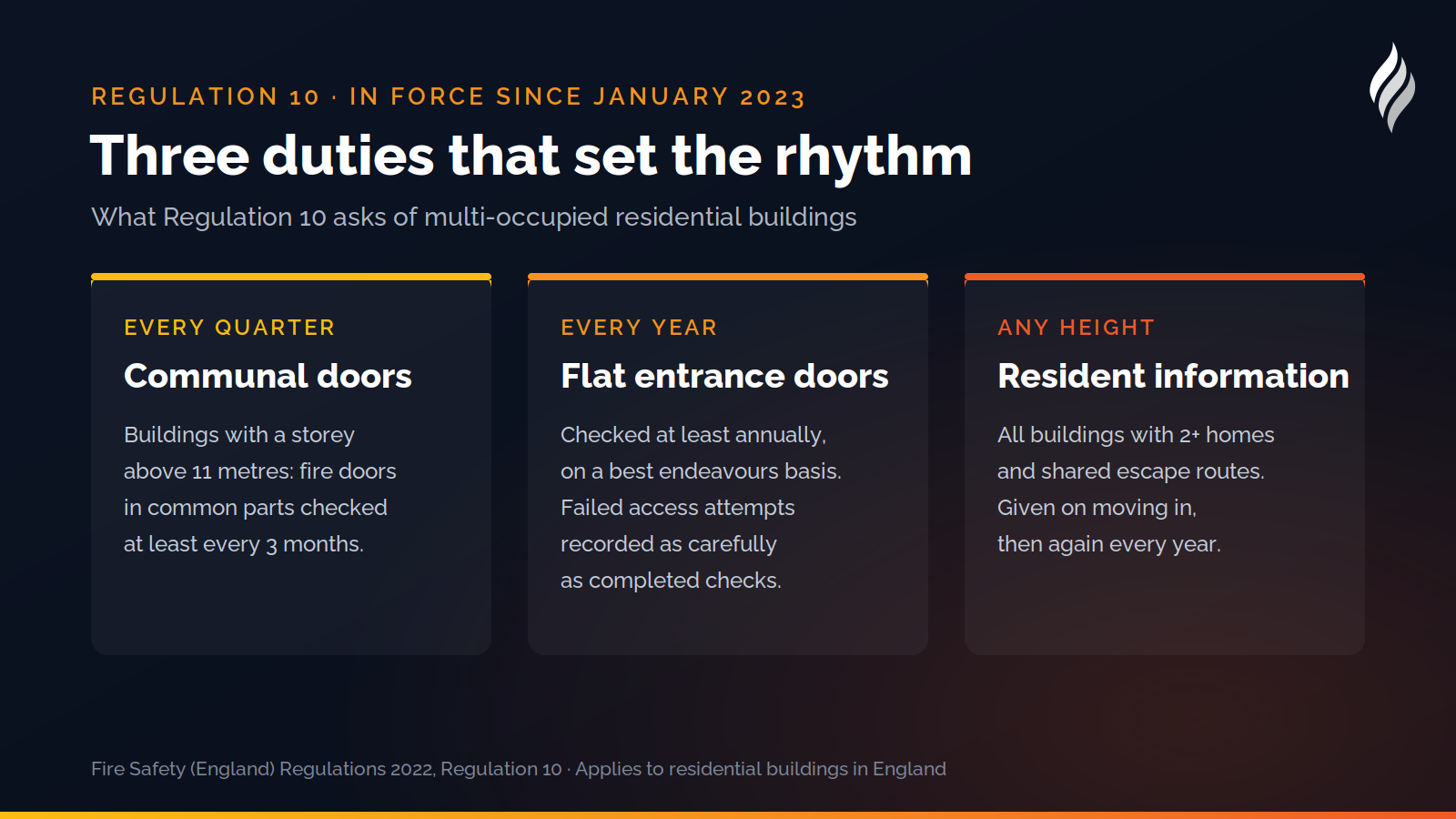
January marked three years since Regulation 10 of the Fire Safety (England) Regulations 2022 came into force. The article steps through the rhythm it set for residential buildings above 11 metres: communal fire doors checked at least every quarter, flat entrance doors checked at least annually on a best endeavours basis, and a record kept of all of it. It also picks out the duty that reaches further than most people realise: in any building with two or more homes and shared escape routes, whatever its height, residents must be given fire door information when they move in and again every year.
The piece also makes a point that surprises many teams: the routine check is not a specialist job. Government guidance is clear that the responsible person can carry out these checks themselves, escalating anything worrying to a specialist and leaving the deeper assessment of fire resistance to the fire risk assessment.
What three years of data shows
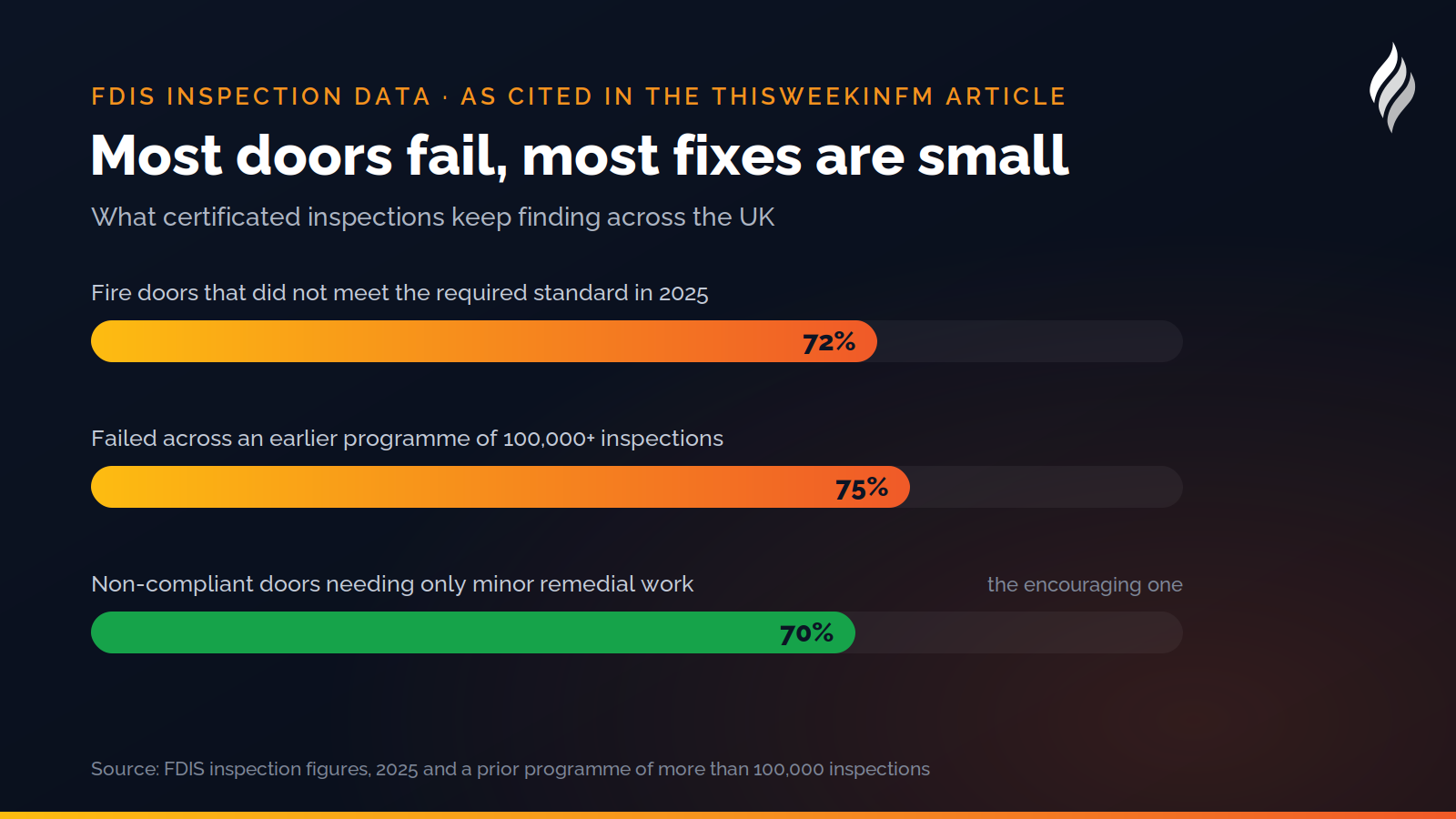
The article draws on FDIS inspection figures to show why the checks are worth doing. In 2025, 72 per cent of fire doors inspected did not meet the required standard, and an earlier programme of more than 100,000 inspections found 75 per cent failing. The encouraging number sits alongside those: around 70 per cent of non-compliant doors needed only minor remedial work. Most fire door problems are small, cheap and fixable, provided somebody spots them and follows through.
The argument in one line
Three years in, the checking itself is rarely what catches teams out. The volume is, and so is proving the checks happened. Forty doors a building, checked quarterly, across a portfolio adds up to thousands of checks a year, and when the fire and rescue authority asks what you did, the work only counts if the record exists. The article closes with the habits shared by the teams coping best, and a look at how the rules have kept moving, from the government's revised fire door guidance in August 2025 to BS 8214:2026 replacing the 2016 edition in March.
Read the full piece
You can read the article in full on ThisWeekinFM here. Our thanks to the ThisWeekinFM team for running the piece and for sharing it with their community. It follows our recent feature in the Fire Door Journal, and there is more DoorTRACE writing on the way in the run-up to Fire Door Safety Week this September.
How DoorTRACE helps
The article's closing argument is the reason DoorTRACE exists: teams struggling with Regulation 10 are rarely short of diligence, they are short of a system. Our platform keeps every check, defect and repair against the individual door, schedules the quarterly rhythm for you, and records failed access attempts as carefully as completed checks, so best endeavours is something you can prove. If that sounds like the system your portfolio is missing, get in touch or take a look at our fire door inspection software.
Approved Document B: the second staircase era starts today
The amendments to Approved Document B come into force today: more than one common stair in new blocks of flats with a storey 18m or more, evacuation shafts to support evacuation lifts, and new escape guidance. What changes, who it touches, and the fire door angle.
Remedial work is now free to record on DoorTRACE
Only inspections are charged on Pay-As-You-Go from now on. The form that closes out remedial work joins registrations and reports on the free list, so the cost of a door for the year is known before it starts.
Fire doors in warehouses and industrial units
An open warehouse floor resists traditional compartmentation, so its fire doors concentrate around the edges and take the hardest knocks in any sector. Where the doors are, the fork-lift problem, and a check regime for a hard-wearing site.