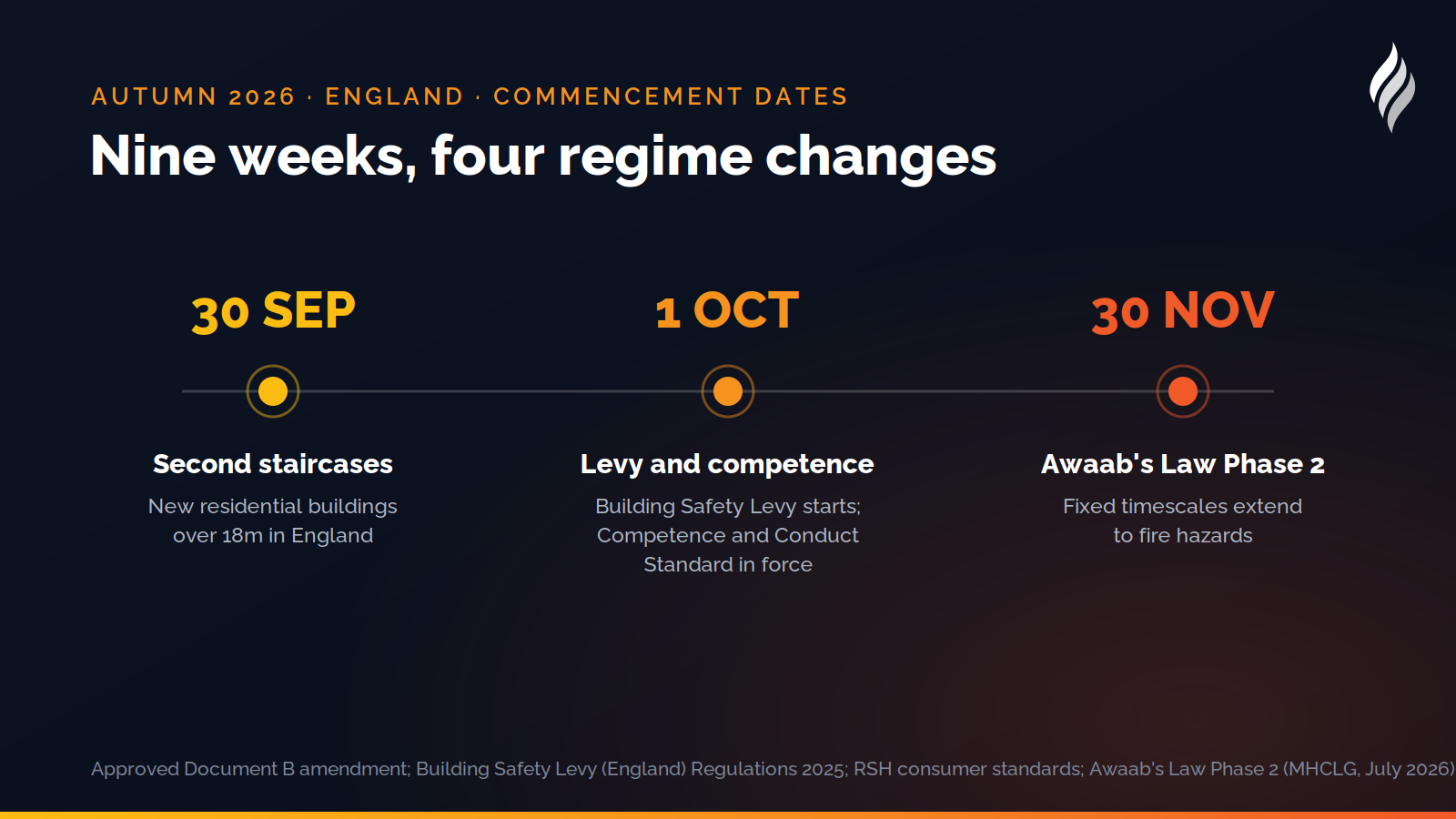
The next nine weeks bring the busiest run of building safety commencement dates in years. Between 30 September and 30 November 2026, four separate regimes change: second staircases become mandatory in new residential buildings over 18 metres, the Building Safety Levy starts applying to building control applications, the Competence and Conduct Standard comes into force for social landlords, and Awaab's Law extends to fire hazards. Each has been covered separately in the trade press. What has been harder to find is all four in one place, with the dates, the scope and the practical effect side by side.
This article is that calendar. For each deadline we set out what changes, who it applies to, and where fire doors fit, because every one of these regimes touches the doors in some way.
30 September: second staircases in new residential buildings over 18m
From 30 September 2026, the amended Approved Document B requires all new residential buildings in England over 18 metres to be designed with two staircases. The 18 metre threshold deliberately lines up with the definition of a higher-risk building under the Building Safety Act, so the two regimes now use the same height.
The change is not retrospective. Existing buildings are unaffected, and there is a transitional provision: where a building notice, initial notice or full plans application reaches building control before 30 September 2026, the older guidance can still be followed provided the work has started and is sufficiently progressed within 18 months of that date.
The fire door angle is direct. A second staircase is a second protected escape route, and a protected route is only protected while the fire doors opening onto it perform. Every additional staircase in a design is a new set of doors that will need registering, inspecting and maintaining for the life of the building, and the Golden Thread expects that record to start at design stage.
1 October: the Building Safety Levy
From 1 October 2026, the Building Safety Levy applies to building control applications for major residential development in England, defined as 10 or more new dwellings or 30 or more new bedspaces in purpose-built student accommodation. The levy is charged per square metre of chargeable floorspace, collected by local authorities, and is expected to raise around £3.4 billion over roughly ten years towards fixing building safety defects. Applications made before 1 October are not caught, and splitting one permission into several smaller applications will not avoid the charge.
One caveat worth knowing: a government consultation launched in December 2025 floated raising the small development exemption to fewer than 50 dwellings, so the thresholds may yet move. Until any change is made, 10 dwellings and 30 bedspaces are the figures in the regulations.
The levy does not regulate fire doors, but it changes the economics around them. The money exists because remediating unsafe buildings costs billions, and much of that remediation is compartmentation work: doors, walls and fire stopping that were never right or were never maintained. The cheapest fire door programme is the one that keeps doors compliant from day one.
1 October: the Competence and Conduct Standard
Also from 1 October 2026, the Regulator of Social Housing's new Competence and Conduct Standard comes into force, alongside its revised Transparency, Influence and Accountability Standard. Registered providers must ensure senior housing managers and senior housing executives hold, or are working towards, a specified housing management qualification, must have a written policy on staff skills and conduct, and must give tenants a say in how it all works. Transition periods for the qualification requirement run three years for providers with 1,000 or more homes and four years for smaller providers, though the wider requirements apply from day one.
To be clear about what this is not: it is a professionalisation standard for housing staff, not a competence requirement for fire door inspectors. Article 9A of the Fire Safety Order, which would introduce a statutory fire risk assessor competence requirement, is still not in force. But housing management competence includes safety duties in practice: knowing what Regulation 10 requires, acting on resident reports of defective doors, and keeping the records that prove it. Qualified staff make those systems work.
30 November: Awaab's Law reaches fire hazards
The biggest date on the calendar for anyone running social housing. From 30 November 2026, Awaab's Law Phase 2 extends the fixed investigation and repair timescales beyond damp and mould to a wider set of hazards, including fire. MHCLG published its Phase 2 guidance for landlords on 13 July 2026, with the amendment regulations laid before Parliament the following day.
In practical terms, once Phase 2 is in force, a reported hazard that meets the significant threshold, which could include a flat entrance door that no longer self-closes or damaged seals on an escape route, triggers statutory clocks: investigate within a set period, make safe, complete the repair, and keep the resident informed in writing. We covered the fire door implications in detail in our Phase 2 explainer, and the general duties in social housing fire door duties. If your defect reporting and repair workflow cannot currently show dates against every step, the twelve weeks between now and 30 November are the time to fix that.
Also moving this autumn: the Building Safety Regulator
Not a statutory deadline, but worth a line on the same calendar. In July 2026 the BSR announced a more proportionate, risk-based approach to building assessment certificates after a difficult first phase, with updated resources for duty holders expected from September 2026 onwards. If you hold or manage a higher-risk building, watch for those. Our piece on the BSR's assessment reset covers the background.
The same thread runs through all four
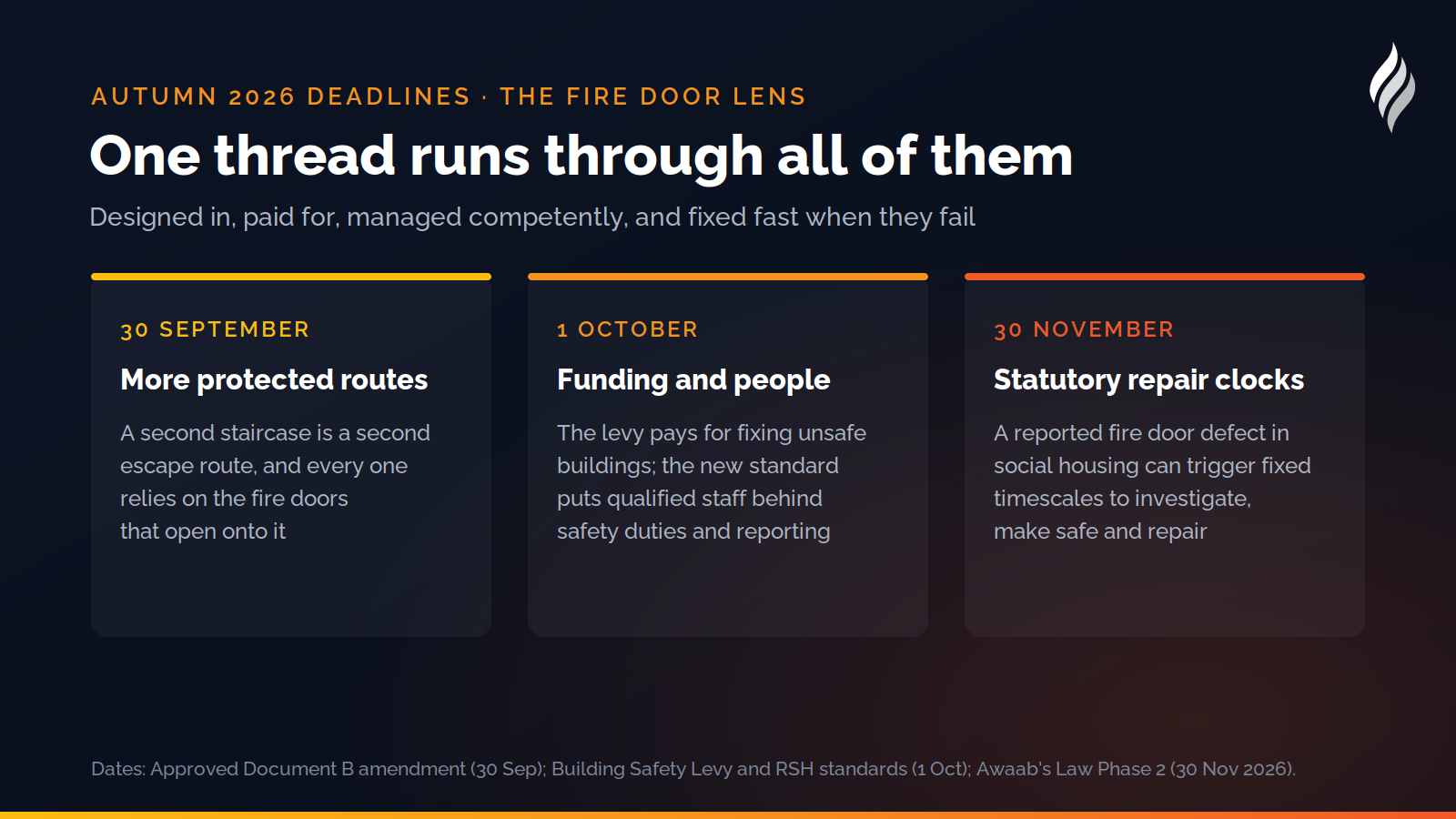
Stand back and the four deadlines tell one story. New buildings must be designed with more protected escape routes. Development must help pay for fixing past safety failures. The people managing social housing must be qualified to manage it. And when a resident reports a fire hazard, the landlord must act on a statutory clock. Every part of that story runs through doors: designed in, paid for, managed competently, and fixed fast when they fail.
How DoorTRACE helps
Deadlines like these are easier to meet when the door records already exist. DoorTRACE gives every fire door a QR-tagged identity with a full inspection and defect history, so a resident report can be logged against a specific door in seconds, repairs are tracked with dates against every step, and the evidence for regulators and residents alike is a report away. If autumn's deadlines are on your desk, talk to us before they arrive.
This article is general guidance, not legal advice. Commencement dates and thresholds were correct at the time of writing; always check the current position before acting.
Approved Document B: the second staircase era starts today
The amendments to Approved Document B come into force today: more than one common stair in new blocks of flats with a storey 18m or more, evacuation shafts to support evacuation lifts, and new escape guidance. What changes, who it touches, and the fire door angle.
Remedial work is now free to record on DoorTRACE
Only inspections are charged on Pay-As-You-Go from now on. The form that closes out remedial work joins registrations and reports on the free list, so the cost of a door for the year is known before it starts.
Fire doors in warehouses and industrial units
An open warehouse floor resists traditional compartmentation, so its fire doors concentrate around the edges and take the hardest knocks in any sector. Where the doors are, the fork-lift problem, and a check regime for a hard-wearing site.