For close to a year, Awaab's Law has required social landlords in England to deal with damp and mould within fixed legal timescales. From 30 November 2026 the regime expands well beyond damp and mould, and fire hazards are on the list. In practical terms, a tenant reporting a flat entrance fire door that will not close properly could soon start a statutory clock ticking.
This article covers what Phase 2 changes, the deadlines that will apply, where fire doors fit in, and what social landlords should be doing between now and November.
A quick recap: what Awaab's Law does
Awaab's Law was introduced under the Social Housing (Regulation) Act 2023, following the death of two-year-old Awaab Ishak from prolonged exposure to mould in his family's home in Rochdale. Phase 1 came into force on 27 October 2025. Since then, registered providers of social housing in England have been legally required to address all emergency hazards within 24 hours, and to investigate and fix significant damp and mould hazards within fixed timescales.
The principle behind the law is simple: when a tenant reports a hazard, the landlord cannot let it drift. Investigation, communication with the resident and repair all run to legally enforceable deadlines, and a failure to meet them can be pursued by the tenant through the courts as a breach of the tenancy agreement.
What changes on 30 November 2026
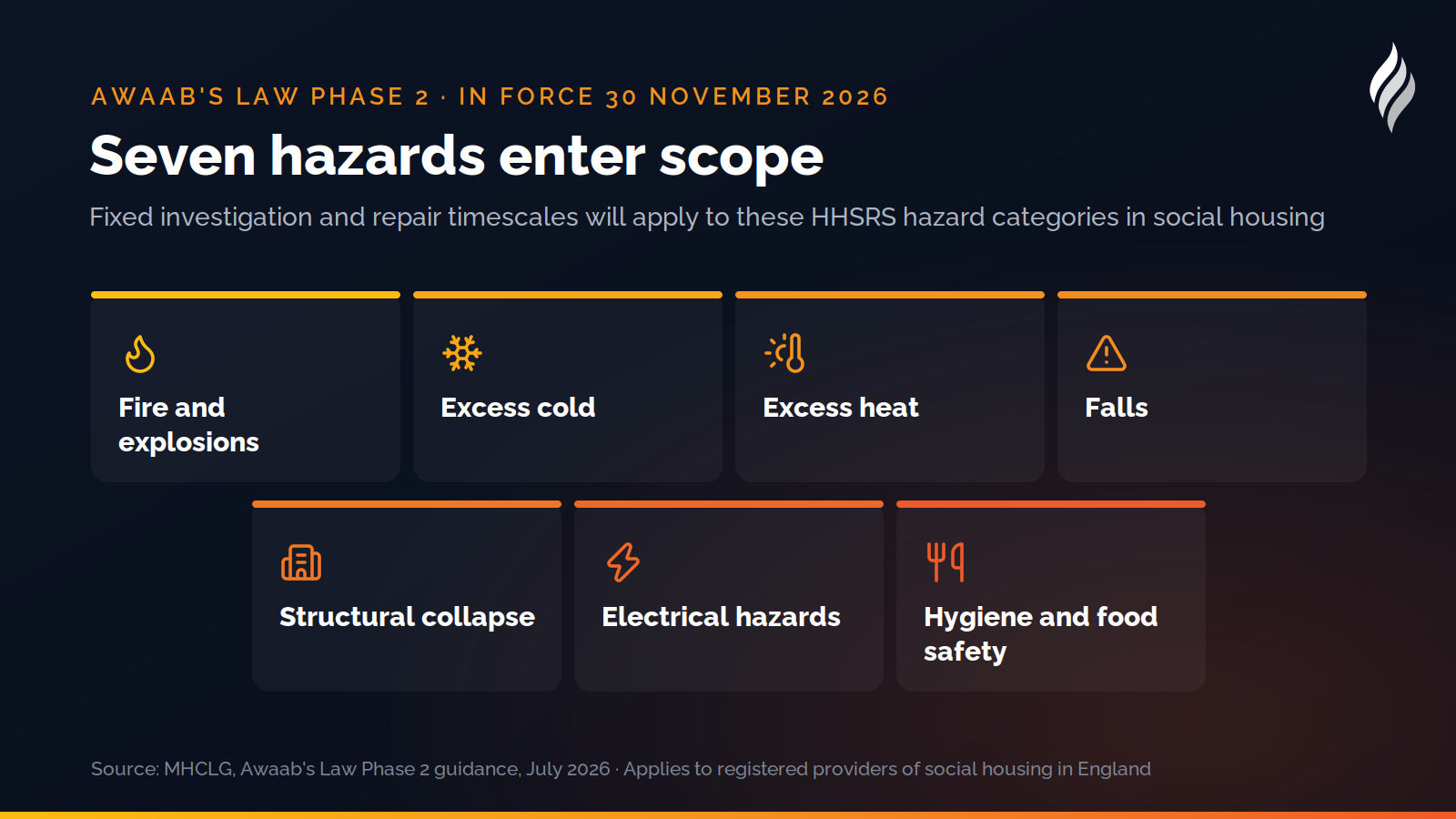
On 13 July 2026, the Ministry of Housing, Communities and Local Government published its Phase 2 guidance and laid the draft amendment regulations before Parliament. Subject to parliamentary approval, Phase 2 comes into force on 30 November 2026 and brings seven further Housing Health and Safety Rating System (HHSRS) hazard categories within the regime:
- Fire and explosions
- Excess cold
- Excess heat
- Falls
- Structural collapse
- Electrical hazards
- Domestic and personal hygiene and food safety
A hazard is in scope where it presents a significant risk of harm to an occupier's health or safety, arises from a deficiency in a building or land the landlord is responsible for, and is not the result of the tenant's own breach of contract. A third phase is expected in 2027, extending the regime to the remaining HHSRS hazards apart from overcrowding.
The government's impact assessment puts the total cost of implementing Phase 2 across the social housing sector at around £213.6 million, covering preparation, triage and associated costs. That figure gives a sense of the operational scale involved: this is not a minor widening of scope.
The deadlines that will apply
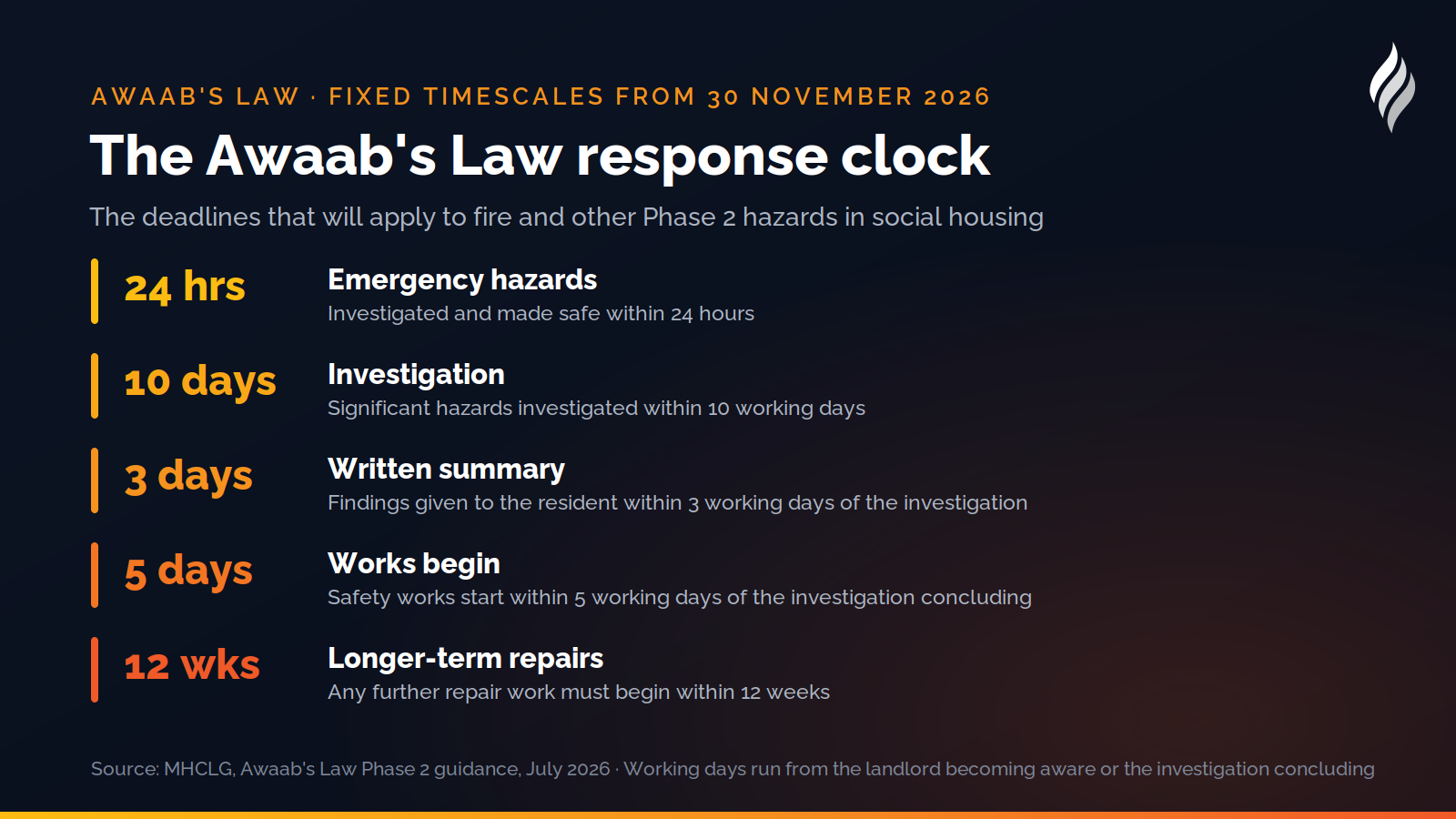
Phase 2 applies the same response framework that Phase 1 established for damp and mould. Under the MHCLG guidance:
- Emergency hazards must be investigated and made safe within 24 hours
- Significant hazards must be investigated within 10 working days of the landlord becoming aware of them
- A written summary of findings must be given to the resident within 3 working days of the investigation concluding
- Works to make the home safe must begin within 5 working days of the investigation concluding
- Any longer-term repair work must begin within 12 weeks
If the home cannot be made safe within the required time, the landlord must offer the resident suitable alternative accommodation. These are enforceable legal duties rather than service standards: a tenant can take a landlord to court for failing to meet them.
Where fire doors come in
Fire and explosions is the HHSRS category most directly relevant to fire door compliance. A fire door's job is to hold back smoke and flame long enough for people to escape, and the defects that stop it doing that job are well known: a flat entrance door that does not self-close, damaged or missing intumescent seals, a leaf replaced with a non-fire-rated door, excessive gaps around the frame. Deficiencies of this kind could present a significant fire risk under HHSRS, which would bring them squarely within Awaab's Law.
The consequence is that a tenant report about a faulty fire door could trigger the statutory clock: investigation within 10 working days, a written summary to the resident, works starting within 5 working days of the investigation concluding. Landlords who currently push fire door defects through a general repairs queue, on whatever timescale the backlog allows, will need a way to recognise these reports, triage them correctly and evidence every step of the response.
This sits alongside the duties social landlords already carry. In buildings with a storey over 11 metres, Regulation 10 requires quarterly checks of communal fire doors and annual checks of flat entrance doors. Awaab's Law adds a reactive duty on top of that proactive regime: the quarterly check finds defects on the landlord's schedule, but a tenant report starts a legal countdown regardless of when the next check is due. For the proactive side of the picture, see our guides to social housing fire door duties and flat entrance fire doors.
Who is covered, and who is not
Phase 2 applies to all registered providers of social housing in England: local authorities, housing associations and other registered providers. It does not currently apply to private landlords, so the November change is squarely a social housing duty. Landlords operating across both tenures should be careful not to assume the same rules apply everywhere.
What social landlords should do now
Between now and 30 November, the preparation is mostly about triage, records and response capability:
- Teach your triage process to recognise fire hazards. Contact centre and repairs teams need to identify a fire door report as a potential Awaab's Law hazard, not a routine joinery job. The MHCLG has published a hazards annex specifically to support triage.
- Get your fire door records in order. You cannot evidence a 10-working-day investigation without knowing which door was reported, where it is, what was found and when. A current fire door register is the starting point.
- Connect tenant reports to your inspection programme. A reported defect and a defect found on a quarterly check should land in the same system, so nothing is investigated twice or missed entirely.
- Test your response times against the deadlines. Run recent fire door repairs through the Phase 2 timescales on paper. If the backlog would have breached them, that is the gap to close before November.
- Keep residents informed in writing. The written summary duty means communication has to be recorded, not just made.
How DoorTRACE helps
DoorTRACE gives social landlords a live digital record of every fire door across their stock, with defect logging, photographic evidence and timestamps that show exactly when a problem was found and what was done about it. That is the evidence base an Awaab's Law response has to stand on. Inspections, defect management and repair records sit in one place, so a tenant report can be matched to a door and tracked against a deadline in seconds. See how our fire door inspection software supports social housing providers, or get in touch for a demo.
This article is general information about upcoming regulation, not legal advice. Social landlords should take their own advice on how Awaab's Law applies to their organisation.
Approved Document B: the second staircase era starts today
The amendments to Approved Document B come into force today: more than one common stair in new blocks of flats with a storey 18m or more, evacuation shafts to support evacuation lifts, and new escape guidance. What changes, who it touches, and the fire door angle.
Remedial work is now free to record on DoorTRACE
Only inspections are charged on Pay-As-You-Go from now on. The form that closes out remedial work joins registrations and reports on the free list, so the cost of a door for the year is known before it starts.
Fire doors in warehouses and industrial units
An open warehouse floor resists traditional compartmentation, so its fire doors concentrate around the edges and take the hardest knocks in any sector. Where the doors are, the fork-lift problem, and a check regime for a hard-wearing site.