Guest accommodation is one of the highest-risk settings there is for fire. People are asleep, they do not know the building, and many of them will have had a drink. When a fire starts at 2am in a hotel corridor, the fire doors between the guest and the smoke are doing more of the life-safety work than almost any other measure in the building. That is why fire door failures in hospitality attract some of the firmest enforcement action in the sector, as a Somerset guest house found out this summer.
This guide covers who carries the legal duty in a hotel or B&B, where fire doors are needed and why, the defects that show up most in hospitality settings, and the routine that keeps a busy building compliant.
Who carries the duty
Under the Regulatory Reform (Fire Safety) Order 2005, every hotel, guest house, B&B and hostel in England and Wales must have a Responsible Person: typically the owner, the operator or whoever has control of the premises. The size of the operation makes no difference. A five-bedroom B&B carries the same duty as a 400-room chain hotel, and the duty applies to informal lettings too, including rooms and properties let through platforms like Airbnb. If paying guests sleep under your roof, the Order applies.
The Responsible Person must carry out a suitable and sufficient fire risk assessment, put appropriate precautions in place, and maintain them. Fire doors sit inside every one of those duties: the risk assessment identifies where they are needed, the precautions include having them, and the maintenance duty keeps them working. Our guide to who the Responsible Person is covers the role in more detail.
Why sleeping accommodation raises the stakes
Most workplaces empty out at night. Guest accommodation fills up. Escape from a hotel depends on protected corridors and stairways staying smoke-free long enough for people to wake, orient themselves in an unfamiliar building, and get out. Fire doors are what make those routes protected: the bedroom door holds fire in the room of origin, corridor doors break the escape route into defended sections, and stairway doors keep the vertical route clear.
The practical consequence is that fire doors in guest accommodation are not a background compliance item. They are the compartmentation strategy. Government guidance for sleeping accommodation reflects this, expecting bedroom doors and doors protecting escape routes to be fire-resisting and self-closing, with the fire risk assessment determining the detail for each building.
What a £33,700 sentence looks like
In July 2026, Prestleigh Inn B&B Limited, which runs a five-bedroom guest house near Shepton Mallet, was sentenced at Taunton Magistrates' Court after pleading guilty to four offences under the Fire Safety Order. The court fined the company £26,000 and ordered it to pay a £2,000 victim surcharge and £5,700 in costs: £33,700 in total.
The case, brought by Devon and Somerset Fire and Rescue Service, began with something every operator should think about: a guest complained. Inspectors visited in May 2025 and found no fire risk assessment, a fire alarm system that was not working and showed nine faults, inadequate emergency lighting, and defective fire doors, which formed part of a charge of failing to provide an adequate means of escape. The premises were prohibited from taking guests until the failures were put right.
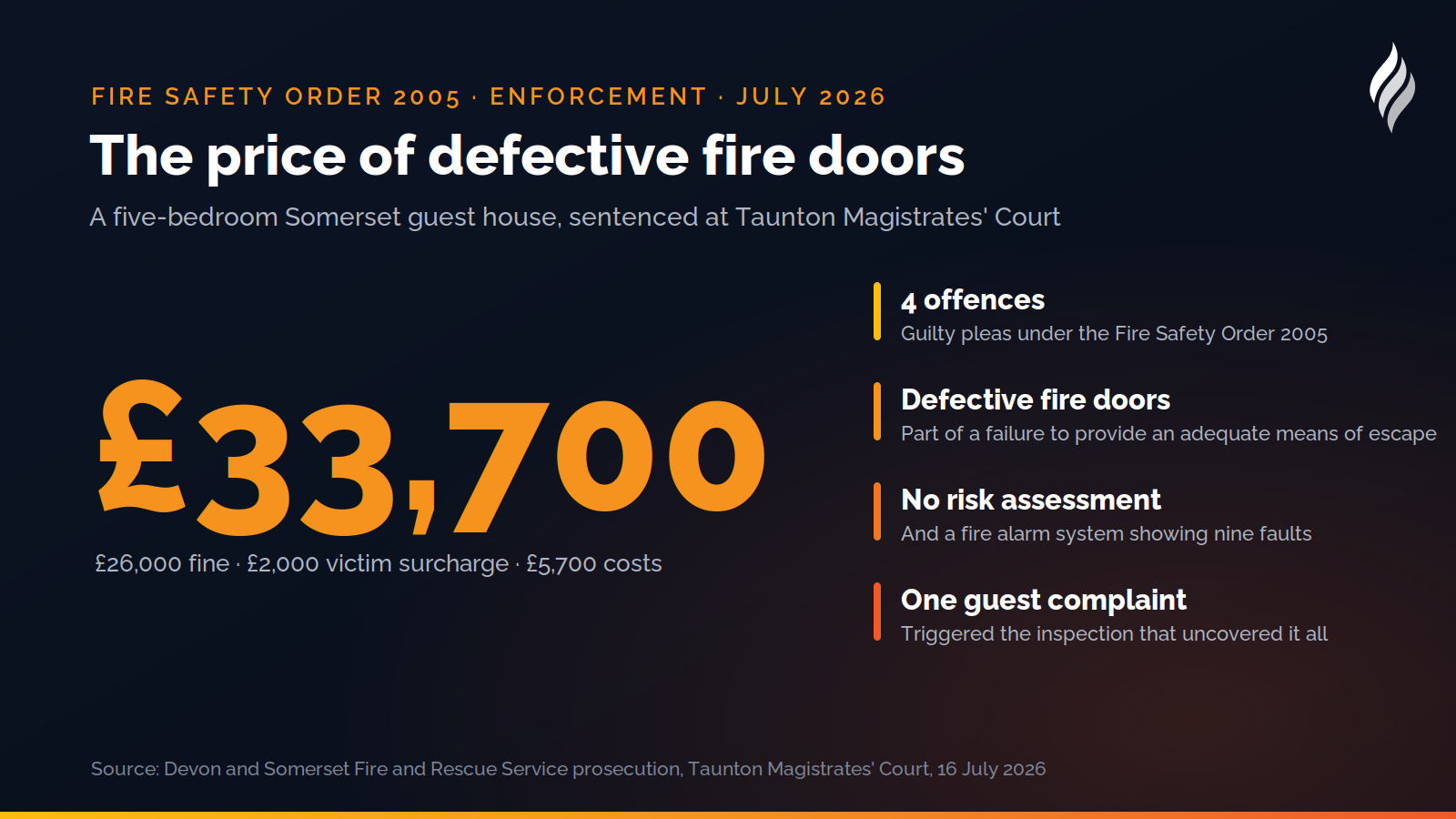
Two things stand out. First, the size of the business offered no protection: five bedrooms, four offences, a five-figure penalty. Second, the trigger was not a scheduled inspection but a guest who noticed something wrong. In hospitality, every guest is a potential inspector.
The defects hospitality buildings produce
Hotels are hard on fire doors. The same defects come up again and again:
- Wedged and propped doors. Housekeeping props doors for cleaning and forgets them; guests wedge corridor doors on hot nights. A wedged fire door protects nobody. If a door needs to stay open for operations, a hold-open device that releases on the alarm is the lawful answer, covered in our guide to self-closing devices and hold-opens.
- Damaged closers and slamming doors. Bedroom doors cycle thousands of times a year. Closers drift out of adjustment, doors stop latching, and a door that does not latch will not hold back fire.
- Impact damage. Luggage trolleys, cleaning carts and delivery cages chip leaves, split frames and tear seals, particularly on service routes.
- Worn or painted-over seals. Intumescent and smoke seals get damaged by repeated redecoration cycles and heavy use.
- Non-compliant replacements. A damaged bedroom door swapped for a lookalike that has no fire rating, often during a quick refurbishment.
Our guide to common fire door defects covers the full list and what each one means for performance.
A routine that stands up
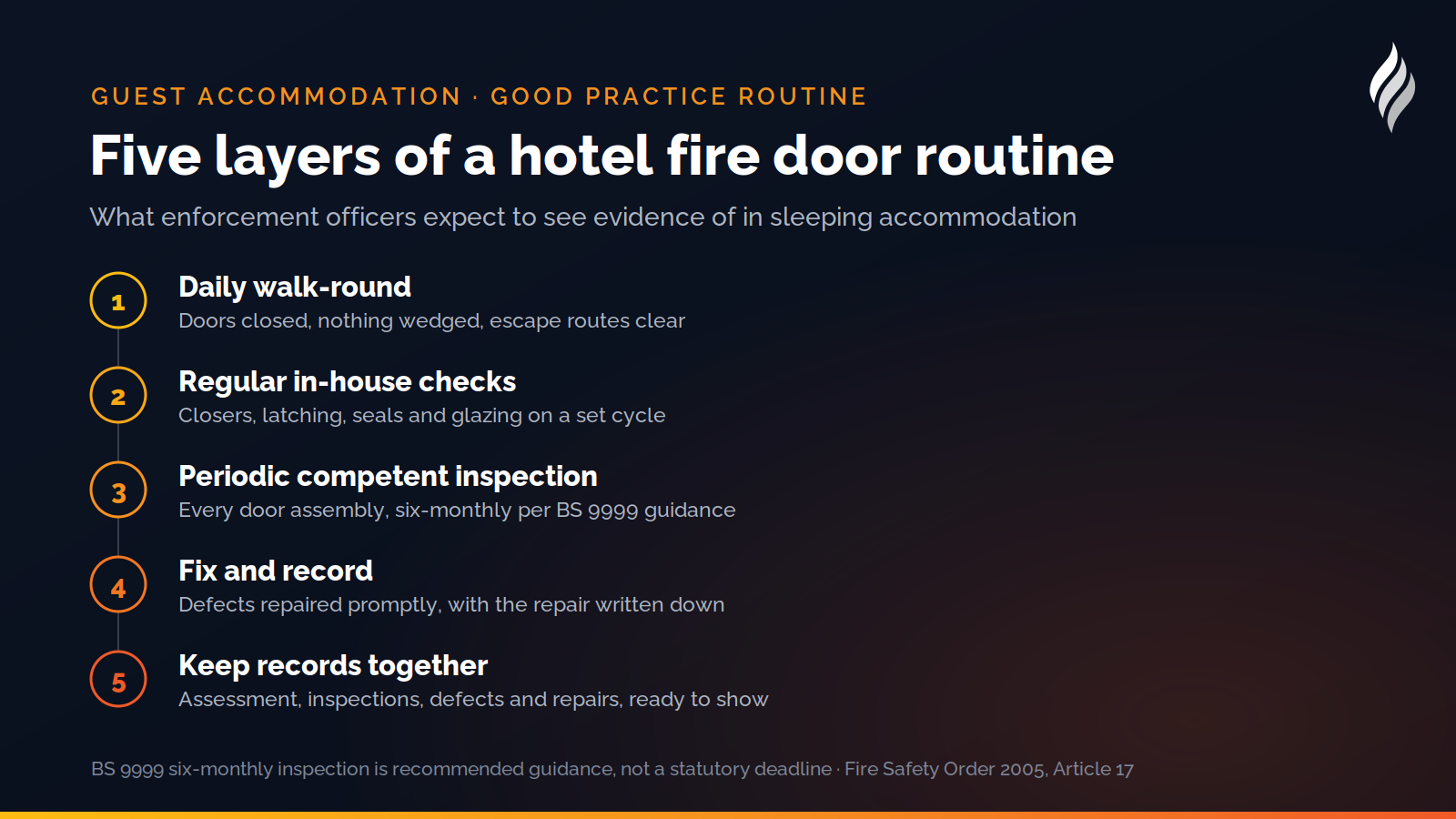
The Fire Safety Order requires fire precautions to be kept in efficient working order and good repair, but it does not prescribe an inspection interval for most premises. For guest accommodation, a layered routine is the practical answer, and it is what enforcement officers expect to see evidence of:
- Daily, as part of normal operations: doors closed, nothing wedged, escape routes clear. Front-of-house and housekeeping teams can cover this as they work.
- Regular in-house checks: a walk-round of closers, latching, seals and glazing on a set cycle, with anything found written down.
- Periodic competent inspection: a thorough check of every door by someone competent to judge the whole assembly. Six-monthly is the interval commonly recommended in BS 9999 guidance, with busier doors checked more often. This is guidance rather than a legal deadline, but it is the benchmark a court will hear about.
- Fix defects promptly and record the repair. A defect log with open items and no follow-up is worse in court than no log at all.
- Keep the records together. Risk assessment, inspection results, defects, repairs and staff training, all retrievable when an officer asks.
Our guides to inspection frequency and the free inspection checklist are useful starting points for building the routine.
How DoorTRACE helps
DoorTRACE gives hotel and guest house operators a digital record of every fire door on the premises, with QR-tagged doors, guided inspections, photographic defect evidence and a full repair history in one place. When a fire officer visits, the evidence of your routine is on screen in seconds rather than in a folder somewhere in the back office. See how the platform supports hotels and hospitality, or get in touch for a demo.
This article is general information, not legal advice. Enforcement examples are drawn from published reports of court proceedings.
After the survey: building a fire door remediation plan
The survey is the easy part. A 300-door building produces a list of defects longer than anyone's budget. Here is how to turn it into a plan the board will sign, the fire officer will accept and the engineers can work from.
Building Notes: your statement on every building report
A customer surveying a heritage church needed a statement on the building report that applied to every door in it. Building Notes is the result: formatted text written once per building, printed on every report.
Fire doors in nurseries and early years settings
A nursery's occupants cannot evacuate themselves, and its doors are opened a hundred times a day by people carrying children. Here is how the Fire Safety Order applies, where the doors usually go wrong, and what to check.