There is a persistent belief that fire door duties only bite in tall buildings. It is easy to see where it comes from: the best-known fire door rules, the quarterly and annual checks under Regulation 10, apply to residential buildings with a storey over 11 metres. But under 11 metres is not a regulation-free zone, and treating it as one is how low-rise buildings end up with failing doors and no records to show for them.
This guide sets out what applies to fire doors below the 11 metre line: the duties that never went away, the one duty people forget applies at every height, and what sensible checking looks like when no frequency is prescribed.
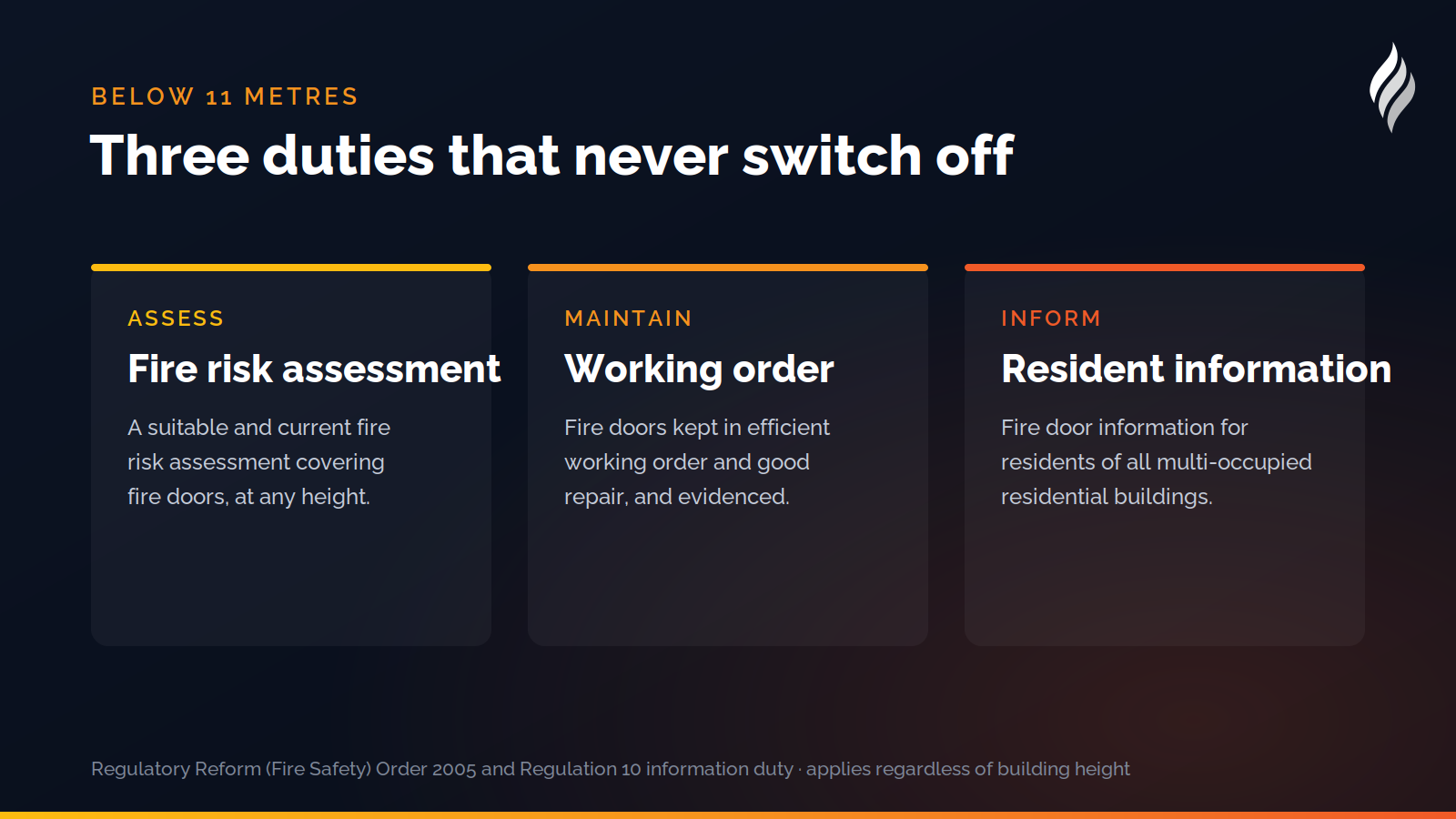
The Fire Safety Order applies at any height
The Regulatory Reform (Fire Safety) Order 2005 applies to virtually all non-domestic premises and to the common parts of multi-occupied residential buildings, and it contains no height threshold. If your building is in scope, the Responsible Person must carry out and keep up to date a suitable fire risk assessment, and fire doors are part of the fire precautions that assessment has to consider.
The Fire Safety Act 2021 put the residential position beyond doubt: for multi-occupied residential buildings, the Order covers the structure, the external walls and the flat entrance doors. A two-storey converted house is covered just as surely as a twenty-storey tower.
Maintenance is a legal duty, not a preference
The Order also requires fire precautions to be kept in an efficient state, in efficient working order and in good repair. A fire door with a broken self-closer, damaged seals or a warped leaf is not doing its job, and in a building the Order covers, leaving it that way is an enforcement exposure at any height. The common defects that fail doors in high-rise blocks fail them just as reliably in low-rise ones.
What Regulation 10 adds above 11 metres
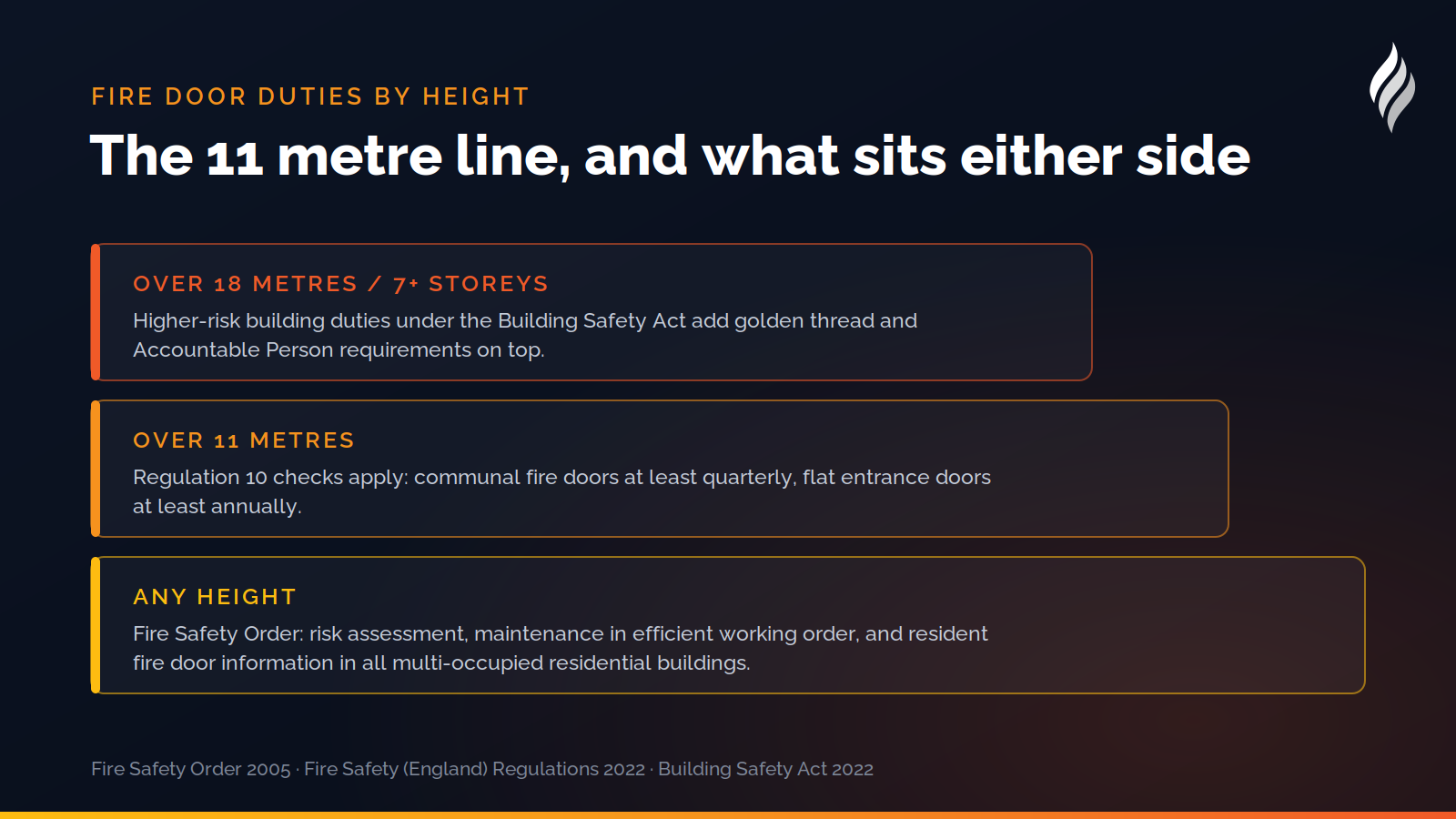
Regulation 10 of the Fire Safety (England) Regulations 2022 is where the height line sits. In residential buildings with a storey over 11 metres, Responsible Persons must check communal fire doors at least every three months, and flat entrance doors at least every twelve months on a best endeavours basis. Below 11 metres, those prescribed frequencies do not apply.
The duty that applies at every height
Here is the part low-rise landlords most often miss: Regulation 10's information duty is not height-limited. In every multi-occupied residential building, whatever its height, residents must be given information about fire doors: keep them shut, do not tamper with self-closers, and report faults. If you own or manage a converted house or a three-storey block and have never given residents that information, that is a live gap right now.
What checking should look like under 11 metres
With no prescribed frequency below 11 metres, the fire risk assessment sets the rhythm. In practice, many organisations mirror the over-11m pattern as good practice: communal doors quarterly, flat entrance doors annually, with heavily used doors looked at more often. That is a commonly adopted approach rather than a legal requirement, and your own risk assessment and the door manufacturer's guidance take precedence.
What is not optional is evidence. If a fire and rescue authority asks how you satisfy the maintenance duty, "we keep an eye on them" is not an answer. Each check should leave a record behind: the date, who looked, what they found, and what was done about anything wrong. A door register with dated checks and recorded outcomes is what turns a defensible position into a demonstrable one, and it costs far less effort than reconstructing history after an incident. If you are unsure how often to look, our guide to inspection frequency works through the factors.
It is also worth reviewing the risk assessment itself when things change. A change of use, building works, new occupants with different needs, or a run of fire door faults are all reasons to revisit what the assessment says about doors and how often they get looked at, rather than waiting for the next scheduled review.
Enforcement does not check the height first
Fire and rescue authorities enforce the Fire Safety Order in buildings of every size, and low-rise premises, HMOs and small blocks feature regularly in enforcement activity. The tools are the same at any height: informal notification, enforcement notices, prohibition or restriction notices, and prosecution in serious cases, with the possibility of unlimited fines. A missing self-closer in a two-storey HMO can end up in front of a court just as surely as one in a tower. None of this is legal advice; the practical point is simply that "we are under 11 metres" has never been a defence to a poorly maintained fire door.
HMOs: licensing raises the bar
For houses in multiple occupation, height is irrelevant to the fire safety conditions attached to licensing and to the HMO management regulations. Fire doors, escape routes and precautions have to be provided and maintained in even the smallest licensed HMO, and local authorities inspect. Our guide to HMO fire door duties covers the detail, and our HMO landlord page shows how operators keep on top of it.
How DoorTRACE helps
DoorTRACE works the same at any height: a full register of every fire door, dated checks and inspections against a recognised checklist, defect tracking and records you can produce on demand. If your low-rise portfolio currently runs on memory and good intentions, see how fire door inspection software replaces both, take a look at the platform, or talk to us.
Approved Document B: the second staircase era starts today
The amendments to Approved Document B come into force today: more than one common stair in new blocks of flats with a storey 18m or more, evacuation shafts to support evacuation lifts, and new escape guidance. What changes, who it touches, and the fire door angle.
Remedial work is now free to record on DoorTRACE
Only inspections are charged on Pay-As-You-Go from now on. The form that closes out remedial work joins registrations and reports on the free list, so the cost of a door for the year is known before it starts.
Fire doors in warehouses and industrial units
An open warehouse floor resists traditional compartmentation, so its fire doors concentrate around the edges and take the hardest knocks in any sector. Where the doors are, the fork-lift problem, and a check regime for a hard-wearing site.