A village hall, a scout hut, a cricket pavilion or a church hall is a non-domestic building, and the Regulatory Reform (Fire Safety) Order 2005 applies to it in exactly the same way as it applies to an office block. The difference is who carries the duty. In a community building the Responsible Person is usually a management committee or a board of trustees made up of volunteers, the building is let to hirers who come and go, and the busiest hours are Saturday nights, when nobody from the committee is there.
This guide covers who holds the duty for the fire doors in a community building, what that duty asks of them, where these buildings usually go wrong, and a routine that fits a committee that meets once a month.
Who the Responsible Person is
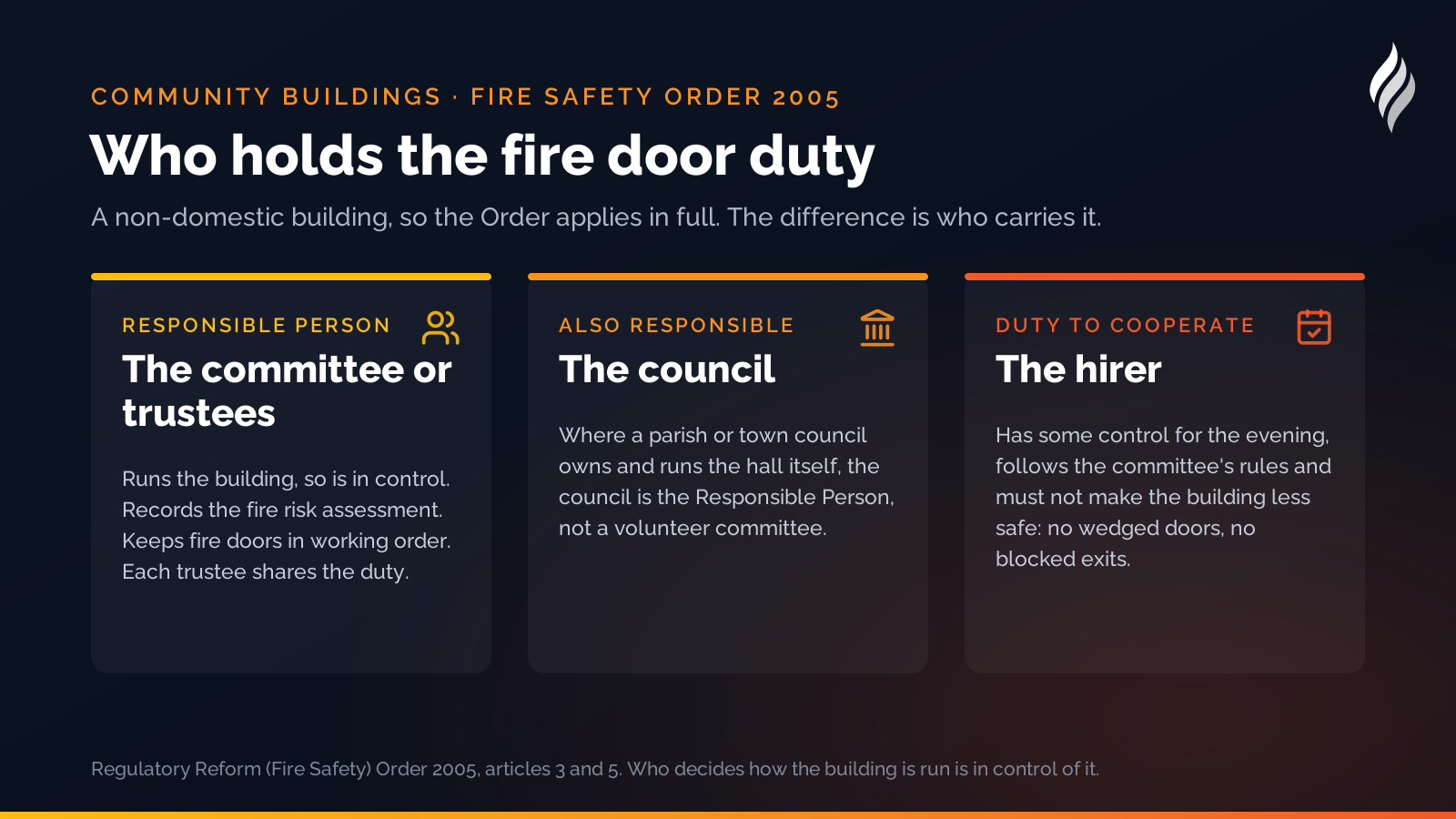
Under the Fire Safety Order, the Responsible Person for a non-domestic building is the employer if there is one, otherwise the person who has control of the premises, otherwise the owner. For a community building that usually means:
- The management committee or trustees where the hall is run by a charity or an unincorporated association. The committee as a whole holds the duty, and each trustee shares in it.
- The parish or town council where the council owns and runs the hall directly.
- The club committee for a sports club, bowls club or social club that runs its own premises.
A hirer who takes the hall for an evening also has a duty, because the Order places obligations on anyone who has some control over the premises. The hirer has to cooperate with the committee's arrangements and must not do anything that makes the building less safe, which is where propped fire doors on a party night come in. The committee stays the Responsible Person throughout; the hiring agreement is how its arrangements reach the hirer.
If a committee is unsure where it sits, the test is simple: whoever decides how the building is run is in control of it. Our guide to who the Responsible Person is covers the hierarchy in full.
What the duty asks for
The Fire Safety Order does not say "inspect your fire doors quarterly". It asks the Responsible Person to carry out a fire risk assessment, to act on its findings, and to keep the fire precautions the building relies on in efficient working order and good repair. Fire doors are one of those precautions. Since October 2023 the assessment has to be recorded in full whatever the size of the building, and the Responsible Person has to keep a record of who carried it out, so the "under five employees, nothing written down" position no longer exists.
The government's own guide, Fire safety risk assessment: small and medium places of assembly, is written for buildings of this kind, and it is where a committee should start. It expects the doors that protect the escape routes, the kitchen and any store rooms to be fire doors in working order, to close fully on their own, and to be kept shut when they are not in use.
For a committee that means three things in practice: know which doors in the building are fire doors, check them on a routine, and fix what the checks find. Our article on the difference between a fire door check and an inspection explains what a volunteer can do and when a competent inspector is needed.
Where community buildings usually go wrong
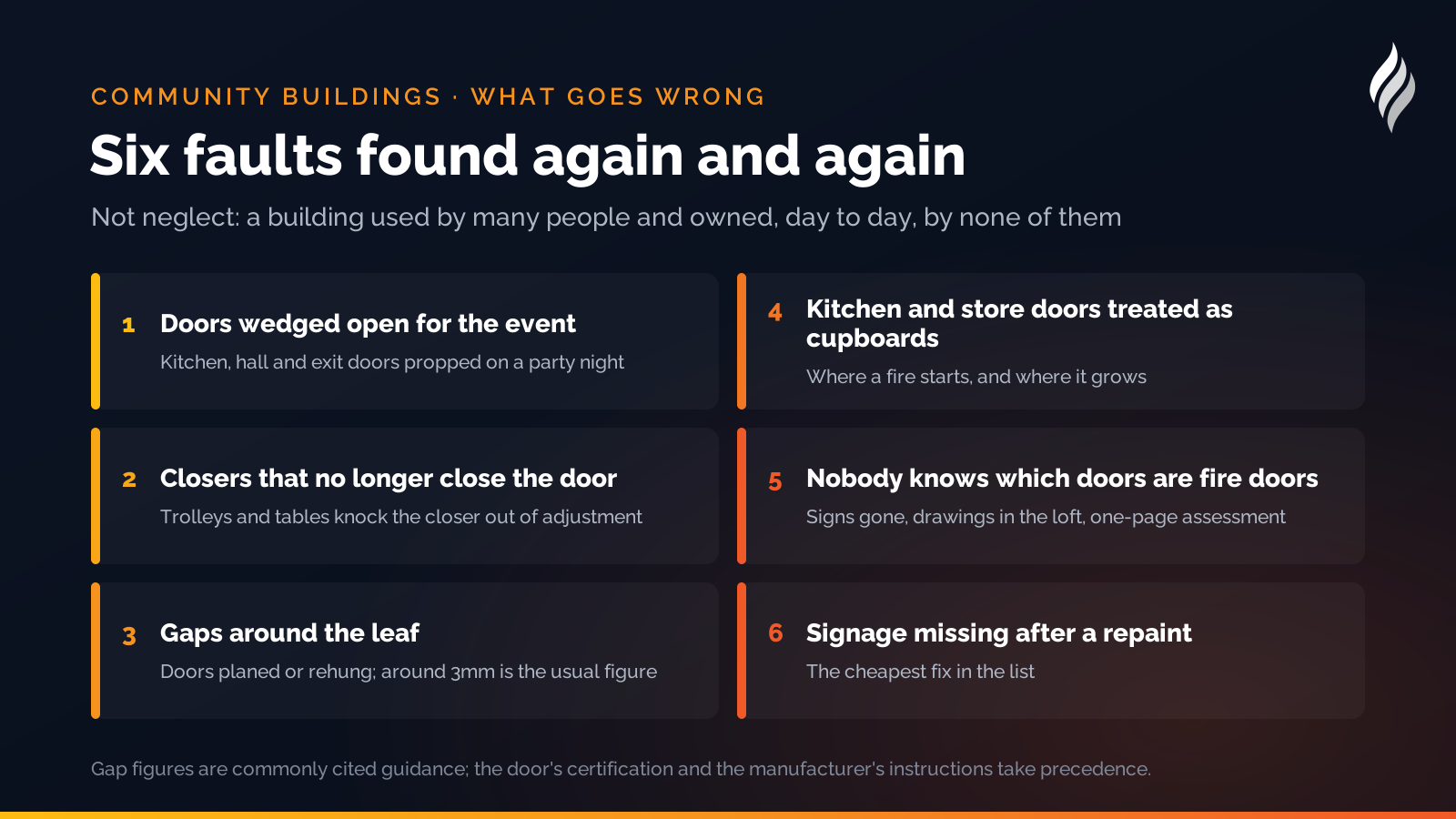
The pattern in community buildings is not neglect; it is that the building is used by many people and owned, in day-to-day terms, by none of them. These are the faults that come up again and again:
- Doors wedged open for the event. The kitchen door is propped for serving, the main hall door is propped for the band's gear, the fire exit is propped for the smokers. Every one of those doors is a fire door with a reason to be shut. If a door has to stay open while the hall is in use, the answer is a hold-open device linked to the fire alarm, not a chair. Our guide to self-closing devices and hold-open systems covers the options.
- Closers that no longer close the door. A door that swings to within a hand's width of the frame and stops has failed. Hall doors take a lot of traffic from pushchairs, tables and trolleys, and the closer drifts out of adjustment.
- Gaps around the leaf. Older halls often have doors that were fire-rated when fitted and have since been planed, rehung or had the frame move. The gap at the edge of a fire door should be around 3mm, and the door's certification and the manufacturer's instructions take precedence over any general figure. Our article on fire door gaps has the detail.
- Kitchen and store doors treated as cupboards. The kitchen is the most likely place for a fire to start and the store room the most likely place for it to grow. Their doors are fire doors even when the room behind them feels like a cupboard.
- Nobody knows which doors are fire doors. Signs have gone, the original drawings are in a loft, and the last fire risk assessment is a single page from years ago. Our guide to spotting a certified fire door is a good first step.
- Signage missing after a repaint. "Fire door keep shut" signs come off when the hall is decorated and do not go back on. The signage requirements are modest, and a sign is the cheapest fix in this list.
A routine a committee can keep
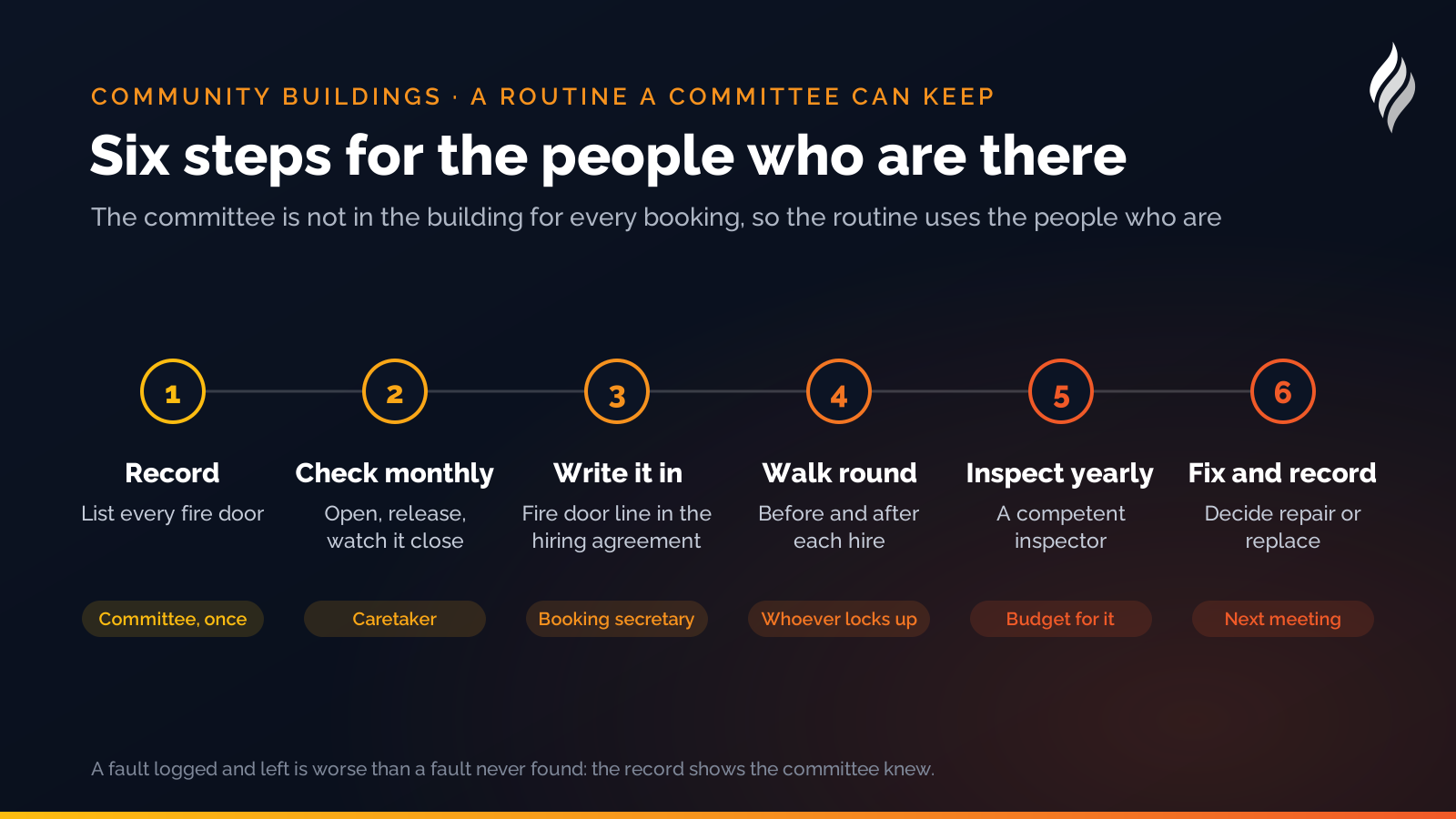
The committee cannot be in the building for every booking, so the routine has to work with the people who are: the caretaker or booking secretary, the hirers, and a competent inspector once a year.
- Record which doors are fire doors. Walk the building once with the fire risk assessment in hand, list every fire door with its location, and give each one a number or a tag. This list is the basis of everything else. A simple fire door register is enough.
- A monthly check by the caretaker or a named committee member. Open and release every fire door and watch it close fully into the frame on its own. Look at the seals, the gaps, the glazing and the signs. Our free printable checklist takes about two minutes a door.
- A fire door line in the hiring agreement. Tell hirers in writing that fire doors are not to be wedged, that the fire exits must be kept clear, and where the exits are. Many halls add a short "end of hire" list, and "all fire doors closed" belongs on it.
- A quick walk round before and after each hire. Whoever opens up or locks up checks that no door has been propped, no exit is blocked and nothing has been stored against a fire door. This is a one-minute job and it catches most problems within a day.
- A competent inspection once a year. A trained inspector will find the faults a monthly check cannot see, such as a hinge that has lost its intumescent pad or a door that has been planed below its rating. A committee with no in-house knowledge should budget for this in the same way it budgets for the annual electrical check.
- Fix what you find, and keep the record. A fault logged and left is worse than a fault never found, because the record shows the committee knew. Decide at the next meeting what is repaired and what is replaced; our guide to repairing or replacing a fire door helps with that choice.
Sleepovers, bars and licences
Three things change the picture for some community buildings:
- Overnight stays. A scout sleepover or a youth group camping in the hall turns a daytime place of assembly into sleeping accommodation for the night. The fire risk assessment should say whether that is allowed and on what conditions, and the fire doors to the sleeping area have to be in good order because people will be asleep behind them.
- A licensed bar. Where the hall holds a premises licence under the Licensing Act 2003, the licensing authority and the fire and rescue service both take an interest in the escape routes and the capacity. A fire door that will not close is the kind of fault that comes up at a licensing inspection.
- Flats or caretaker's accommodation above. If someone lives in the building, the doors between the hall and the living space are part of the escape route from a home, and the duty is heavier. Our article on fire doors where people live above a business covers the same situation for pubs and shops.
Trustees and personal responsibility
A charity trustee is not expected to be a fire safety professional, but the Charity Commission expects trustees to manage the risks to the people who use their building, and the Fire Safety Order can be enforced against the Responsible Person whoever that is. Enforcement starts with advice and an enforcement notice; prosecution is for serious or repeated failures. A committee that can show a recorded assessment, a monthly check with dates and names, a yearly inspection and a repair log is in a strong position. One that can show nothing is not. This is not legal advice, and a committee with a specific concern should ask its fire and rescue service, who will usually help a community group before they will enforce against one.
How DoorTRACE helps
DoorTRACE gives a committee one place for the fire door register, the monthly checks and the yearly inspection, with every door on a QR tag so the caretaker scans it and follows the checklist on a phone. The record builds itself, the annual inspector works from the same list, and a trustee can show the whole history at the next meeting or to a fire officer at the door. See the platform, how it works for Responsible Persons, or try the free fire door inspection checklist first. Our fire door inspection software suits a single hall as well as an estate of a hundred buildings. Get in touch if you would like to talk it through.
After the survey: building a fire door remediation plan
The survey is the easy part. A 300-door building produces a list of defects longer than anyone's budget. Here is how to turn it into a plan the board will sign, the fire officer will accept and the engineers can work from.
Building Notes: your statement on every building report
A customer surveying a heritage church needed a statement on the building report that applied to every door in it. Building Notes is the result: formatted text written once per building, printed on every report.
Fire doors in nurseries and early years settings
A nursery's occupants cannot evacuate themselves, and its doors are opened a hundred times a day by people carrying children. Here is how the Fire Safety Order applies, where the doors usually go wrong, and what to check.