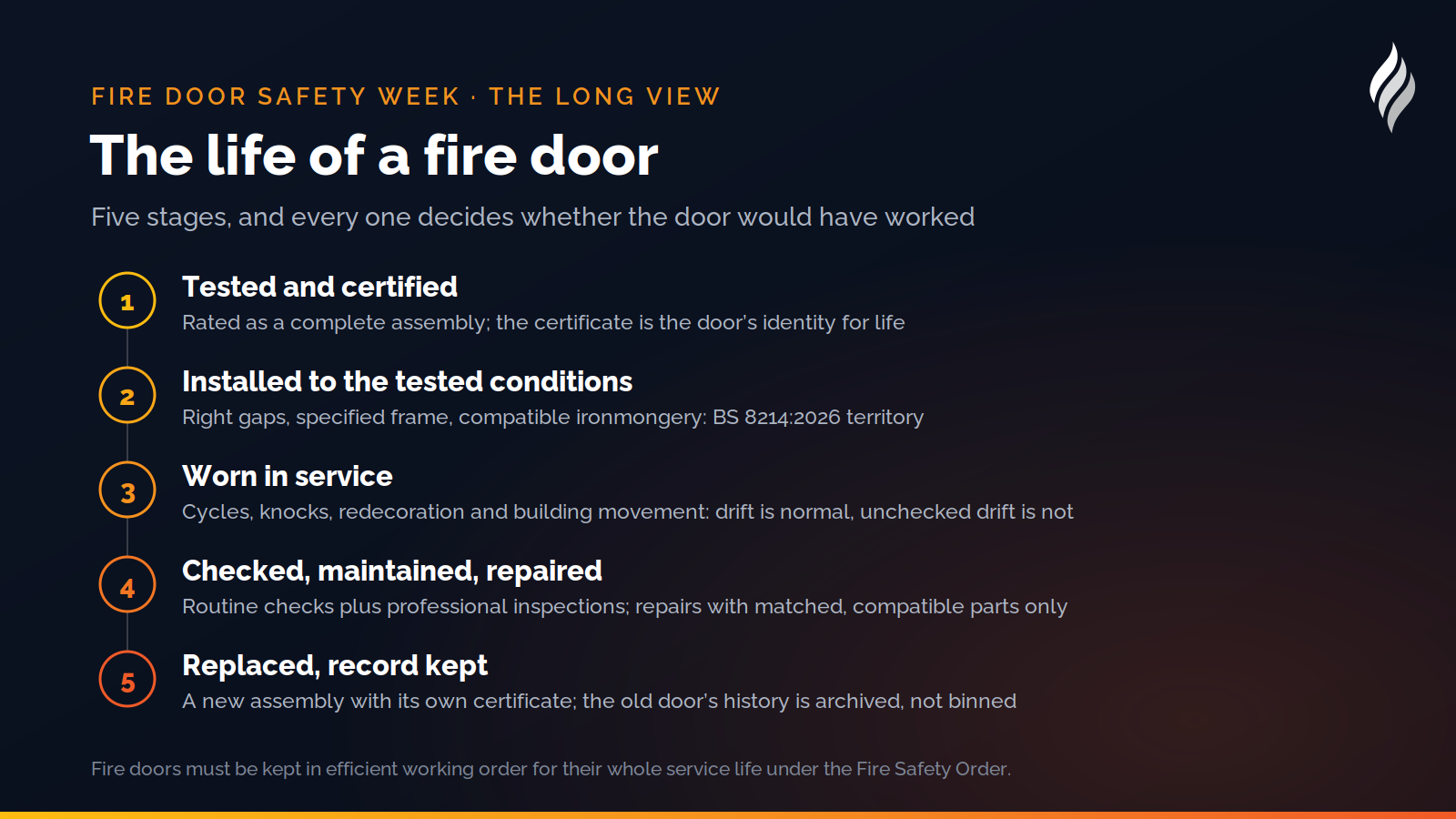
It is day four of Fire Door Safety Week, and today's angle is the long view. Every fire door in your building is somewhere in a life story that starts in a test furnace and ends in a skip, usually decades later. Whether it would actually have worked on any given day in between depends on what happened at every stage. Walk the story once and the maintenance duties stop feeling like admin and start making sense.
Born certified
A fire door earns its rating in a furnace, tested as a complete assembly: leaf, frame, seals, hardware and glazing together. The certification that comes out of that test, carried on the label or plug fitted to the door and in the paperwork behind it, is the door's identity for life. It says what the door is, what it was tested with, and what it must be maintained to match. Spotting a certified fire door covers the marks; the point for the lifecycle is that the certificate is not a birth souvenir, it is the reference every later decision checks against.
That paperwork is also the golden thread in miniature: accurate information about a safety-critical asset, kept current and accessible for the building's whole life. A door whose certificate is lost has not become a worse door, but nobody can prove what it is, and every future repair and inspection gets harder.
Installed right, or ruined on day one
The tested performance only exists in your building if the installation reproduces the tested conditions: the right gaps, the specified frame and packing, compatible ironmongery, seals fitted as designed. BS 8214:2026, the code of practice for fire door assemblies, exists for exactly this stage, and our guides to the 2026 revision and installation under BS 8214 cover it in detail. A certified door badly installed is a non-compliant door from its first day in service, and no amount of later maintenance fixes what the installation got wrong.
A working life of wear
Then the door goes to work, and work wears it. Hundreds of open-close cycles a week on a busy corridor. Trolleys and knocks. Redecoration that paints over the seals. Buildings that move with the seasons, opening gaps that were right when fitted. Closers that drift out of adjustment a quarter-turn at a time. None of this is anyone's failure; it is what service life is, and it is why the law expects fire doors to be kept in efficient working order rather than assumed to stay as installed.
The rhythm that catches drift before it becomes failure is the check-and-inspect cycle: routine checks like the five-step check between periodic professional inspections, at a frequency set by the fire risk assessment, covered in how often fire doors need inspecting. In buildings over 11 metres, quarterly communal door checks put a legal floor under that rhythm. Fire door maintenance covers what good upkeep looks like between checks.
Repair, and the certification question
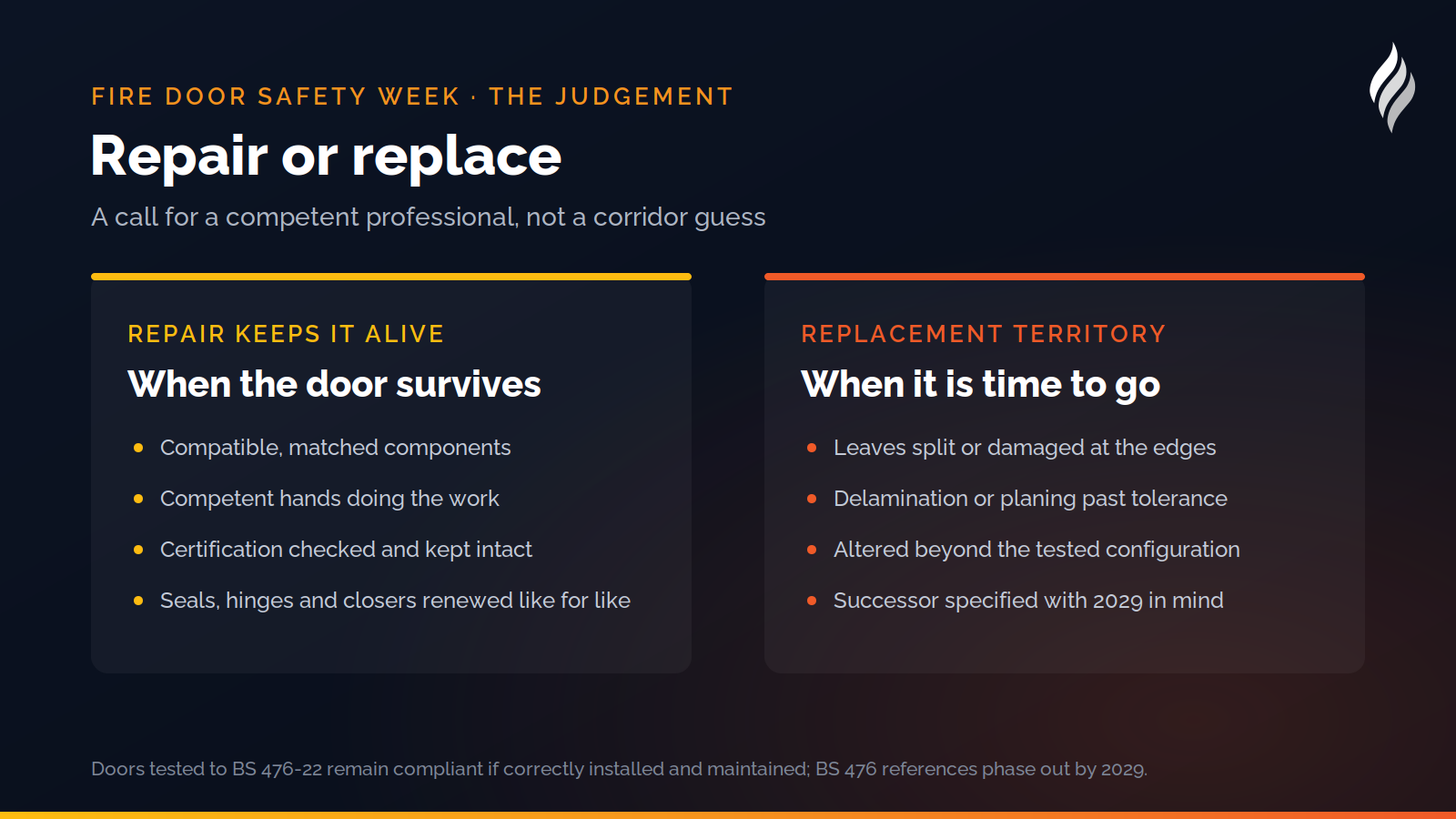
Sooner or later every door needs work, and this is the stage where doors are most often quietly ruined. A repair with compatible, matched components, done by someone competent, keeps the door alive and the certification intact. A repair with whatever the van had, a standard hinge here, an unrated letter plate there, leaves a door that looks fixed and is no longer the tested assembly. The certificate names what the door was tested with; hinges and hardware explains why the small parts carry so much of the load.
Repair or replace
Some damage ends the argument: leaves split at the edges, delamination, doors planed down past their tolerances, or alteration so far from the tested configuration that no repair can bring it back. Our repair or replace guide covers the judgement in detail, and it is a judgement for a competent professional, not a corridor guess.
There is also a longer clock ticking. Doors tested to the withdrawn BS 476-22 remain compliant if correctly installed and maintained, but the regulatory direction is toward the European EN 1634-1 test standard, with references to BS 476 being phased out by 2029. Nobody needs to replace a sound door because of that today: what it changes is replacement planning. When a door reaches the end of its life from here on, its successor should be specified with the transition in mind. The BS 476 withdrawal explained covers the timeline.
Retirement done properly
Replacement is a certification event, not a joinery job: the new door is a new assembly, installed to its own tested conditions, with its own certificate joining the record. And the outgoing door's history should not go in the skip with it. Keep the retired door's record archived rather than deleted: it is evidence of the compliance regime that ran for its whole service life, it answers questions if anything about the building's fire safety history is ever examined, and under the golden thread way of thinking, information about safety-critical assets is kept, not shredded at retirement.
The record is the part that should outlive the door itself. A building that can show each door's history, installed when, checked when, repaired with what, replaced why, is a building where the next fire risk assessment, the next inspection and the next insurance renewal start from evidence instead of archaeology.
If you are closing out Fire Door Safety Week tomorrow, that record is the week's real product: the five-day plan ends with exactly this, findings filed somewhere permanent.
How DoorTRACE helps
DoorTRACE is the biography keeper: every door gets a digital record from registration onward, with its certification details, inspection history, defects and repairs in one place for the door's whole life, and the whole building's history exportable when the assessor or insurer asks. See the platform overview or talk to us.
Approved Document B: the second staircase era starts today
The amendments to Approved Document B come into force today: more than one common stair in new blocks of flats with a storey 18m or more, evacuation shafts to support evacuation lifts, and new escape guidance. What changes, who it touches, and the fire door angle.
Remedial work is now free to record on DoorTRACE
Only inspections are charged on Pay-As-You-Go from now on. The form that closes out remedial work joins registrations and reports on the free list, so the cost of a door for the year is known before it starts.
Fire doors in warehouses and industrial units
An open warehouse floor resists traditional compartmentation, so its fire doors concentrate around the edges and take the hardest knocks in any sector. Where the doors are, the fork-lift problem, and a check regime for a hard-wearing site.