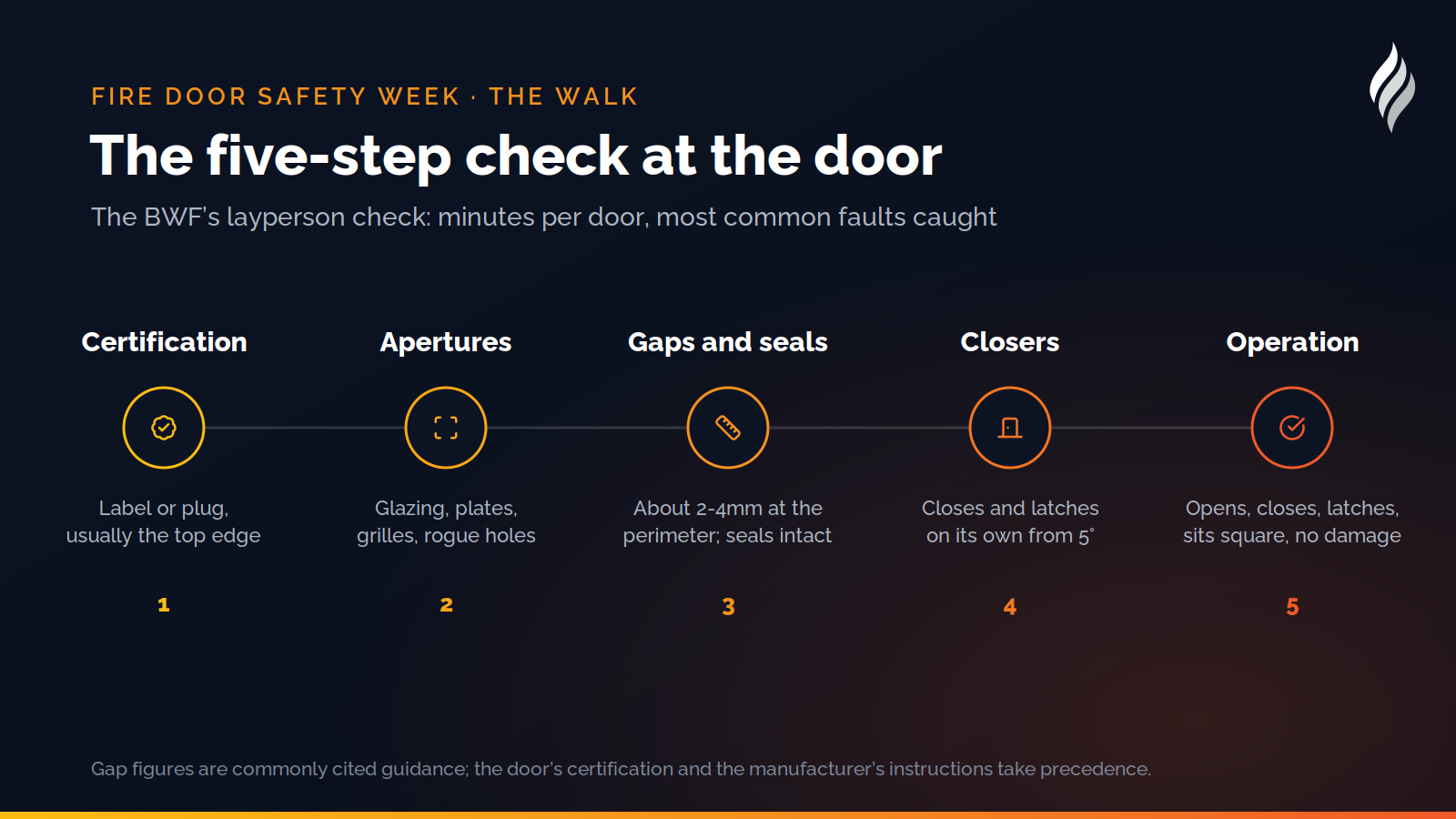
It is day three of Fire Door Safety Week, and if you are following the five-day plan the door sweep is either done or booked. The campaign's five-step check is the tool for it, and our August guide covered what the five steps are. This piece is the companion for the walk itself: standing in front of a real door, what each step looks like in practice, what you will realistically find, and what to do about it.
One framing note before the corridor. This is a layperson's check, designed by the BWF so a non-specialist can spot the most common problems. It is not a professional inspection, which goes further and needs a competent inspector: the difference is covered in what happens during a fire door inspection. The five-step check finds the problems; it does not certify the door.
What to bring
Not much, which is the point: the printed checklist, a phone for photographs, and something to measure gaps with. A gap gauge is ideal, but a pound coin is close to 3mm thick, and two stacked are about 6mm: an improvised gauge that fits in a pocket. A small torch earns its place too, because certification labels live on top edges in dim corridors. For double doors, the gap between the two leaves needs checking as well as the frame edges, and the meeting stiles are where seals most often fail. Bring a way to record which door is which, because "the door by the lift" stops being useful the moment there are two lifts.
The five steps at the door
1. Certification. Look for the label, plug or plaque, usually on the top edge of the door on the hinge side, sometimes on the frame. You may need to open the door and look up. No label does not automatically condemn the door, but it means nobody can prove what it is, so note it and move on. Spotting a certified fire door shows the common marks.
2. Apertures. Look at anything that pierces the door: glazing, letter plates, air grilles, or the holes left by hardware that has been removed. Glazing should sit in intact beads with visible seals; a hole drilled through a fire door for a cable is a breach, not a detail. Altered or added apertures are one of the fastest ways a door loses its integrity.
3. Gaps and seals. Check the gap between the door and frame along the top and both sides: the commonly cited guidance is around 2 to 4mm, with the door's certification and manufacturer's instructions taking precedence. Then the threshold, which can be larger for doors without a threshold seal. Run your eye along the intumescent strips and smoke seals: present, continuous, not torn, not painted into uselessness. Fire door gaps explained and intumescent and smoke seals cover both in depth.
4. Closers. Open the door to around 5 degrees and let go: it should close and engage the latch fully on its own. Then again from wider. A door that stalls on the carpet, bounces off the frame, or needs a shoulder to latch has a closer problem, and a closer problem means the door will be standing open when it counts. Check for hold-open wedges while you are there, including the one hiding behind the door.
5. Operation. The whole-door question: does it open freely, close fully, latch positively, and sit square in its frame? Three hinges minimum on a standard door, all screws present, no visible damage to leaf or frame edges. If the door drags, sits proud, or rattles loose when closed, note it.
What you will actually find
A first sweep of a building that has not been checked recently tends to turn up the same list: wedges, gaps outside tolerance at one or two edges, seals painted over during the last redecoration, closers out of adjustment, a couple of missing labels, and at least one door with damage nobody reported. None of this should be discouraging: finding it is the entire purpose. Common fire door defects puts photographs and severity against each of these.
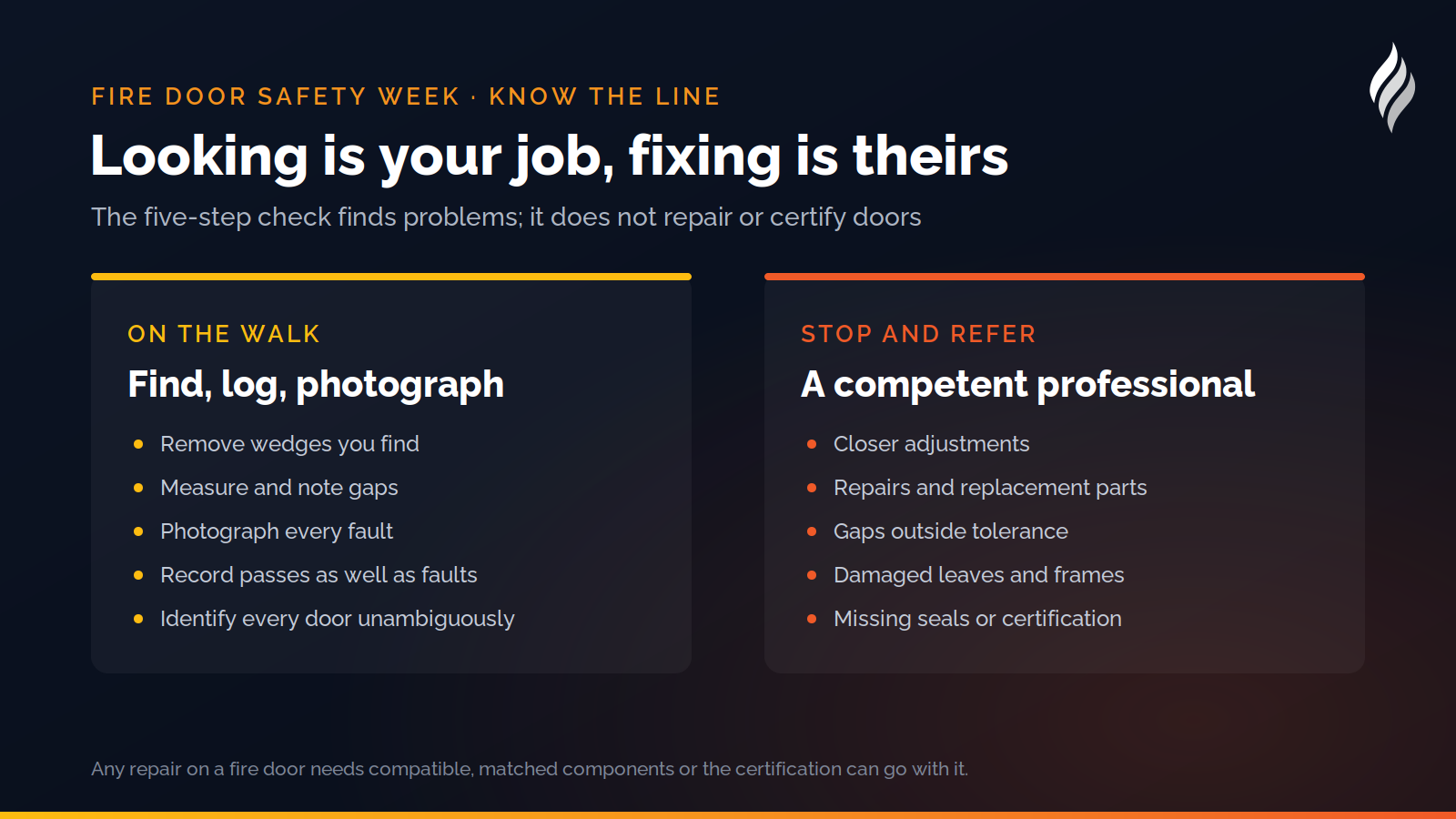
Record passes as well as faults. A record showing thirty doors checked and six faults found is evidence of a working routine; a list of six faults on its own is just a snag list. Photograph every fault, and identify every door unambiguously: number them if the building has not.
When to stop and refer
The five-step check is looking, not fixing, and the line is worth respecting. Removing a wedge is always fair game. Beyond that, be careful even with jobs that look simple: a closer adjustment done wrong leaves the door failing to latch, and any repair on a fire door needs compatible, matched components or the certification goes with it. Gaps outside tolerance, damaged leaves or frames, missing seals, unlabelled doors and anything involving the door's construction belong with a competent professional. Your job on the walk is to find, photograph and log them so the professional arrives to a worklist, not a mystery.
From walk to record
The sweep only counts if it lands somewhere permanent. Faults triaged by severity, quick wins booked, the rest referred, and the whole set, passes included, filed where the next check can build on it. If tomorrow is your fix-it day, the five-day plan's Day 4 covers doing the visible repairs loudly, so the people who reported faults see that reporting works.
How DoorTRACE helps
DoorTRACE turns the walk into the record as you go: scan the door's QR plaque, log the check from your phone, photograph faults into defects that are triaged and tracked to completion. By the end of the corridor the evidence exists, door by door, with nothing to type up afterwards. See the platform overview or talk to us.
Approved Document B: the second staircase era starts today
The amendments to Approved Document B come into force today: more than one common stair in new blocks of flats with a storey 18m or more, evacuation shafts to support evacuation lifts, and new escape guidance. What changes, who it touches, and the fire door angle.
Remedial work is now free to record on DoorTRACE
Only inspections are charged on Pay-As-You-Go from now on. The form that closes out remedial work joins registrations and reports on the free list, so the cost of a door for the year is known before it starts.
Fire doors in warehouses and industrial units
An open warehouse floor resists traditional compartmentation, so its fire doors concentrate around the edges and take the hardest knocks in any sector. Where the doors are, the fork-lift problem, and a check regime for a hard-wearing site.