An article by our Managing Director, Kemble Nagan, has been published by News on the Block. Fire door duties in blocks of flats, three years on went live on 20 August, and it takes the Fire Safety (England) Regulations 2022 into the setting where they are hardest to apply: the leasehold block, where the person responsible for a fire door is often not the person who owns it.
News on the Block is read by the people who actually run blocks of flats: freeholders, resident management company directors, right to manage companies, leaseholders and the managing agents who act for them. Three years after Regulation 10 came into force, that audience still carries most of the confusion the article sets out to clear up. Here is what it covers and why we wrote it.
Who carries the duty
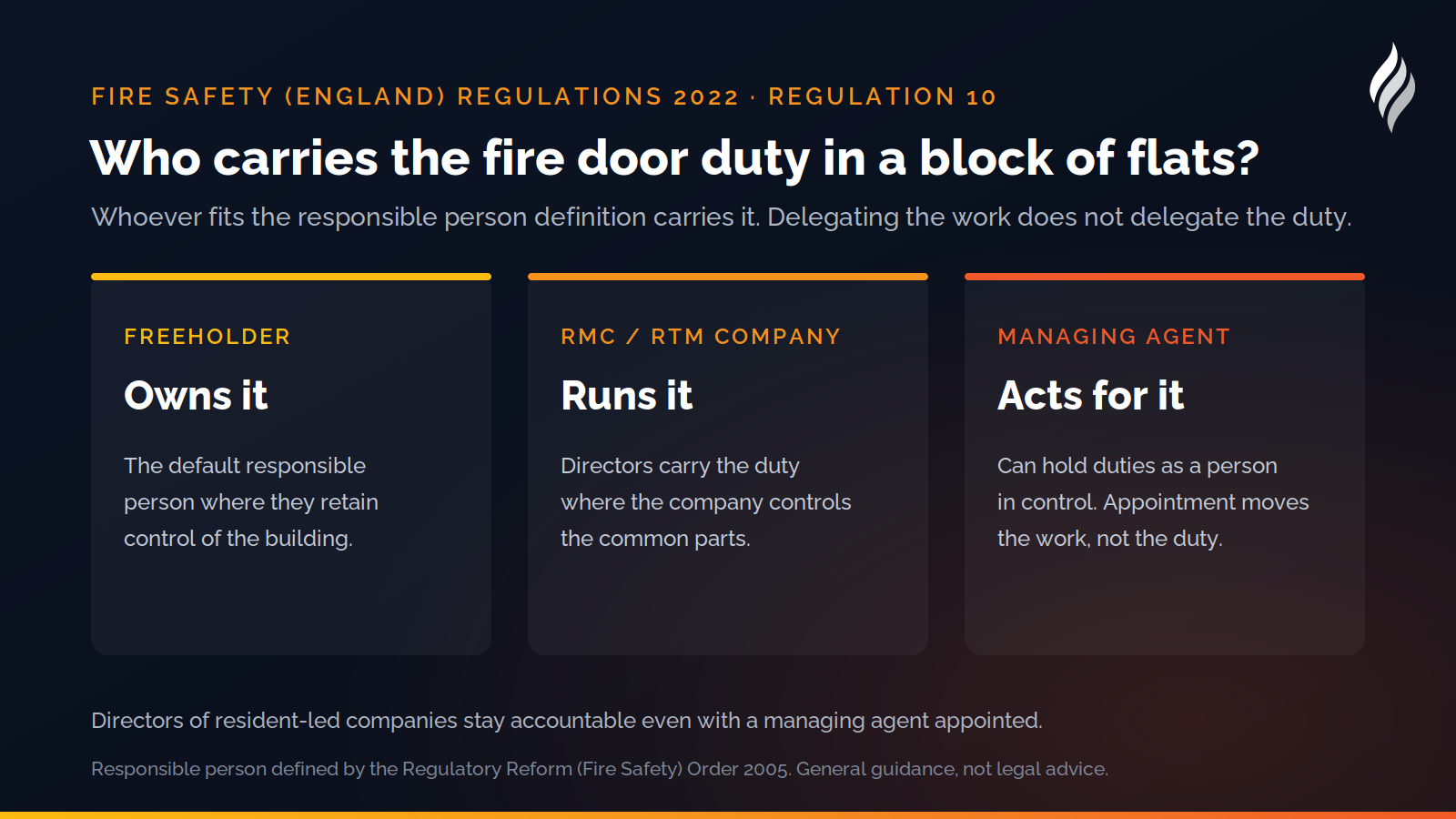
The regulations attach to the responsible person as defined by the Regulatory Reform (Fire Safety) Order 2005. In a block of flats that is typically the freeholder, a resident management company, a right to manage company, or a managing agent acting on their behalf. The article's message for directors of resident-led companies is a blunt one: appointing a managing agent delegates the work, not the duty. Accountability stays where the Order puts it, which is why the piece is aimed as much at RMC and RTM boards as at the property managers they appoint.
The duty with no height threshold
The most overlooked part of Regulation 10 applies to every block, whatever its height. In any building with two or more homes and common parts residents would escape through, the responsible person must give residents fire door information: keep them shut when not in use, do not tamper with self-closers, report faults straight away. New residents get it when they move in, and everyone gets it again at least once every 12 months. A converted house with two flats and a shared hallway is in scope, a point our guides to buildings under 11 metres and the resident information duty both make in more detail.
Above 11 metres, the clock starts
Where the building has a storey above 11 metres, communal fire doors must be checked at least every three months and flat entrance doors at least every 12 months, on a best endeavours basis. The flat entrance door is where leasehold reality meets fire safety law: under most leases the front door is demised to the leaseholder, yet the Fire Safety Act 2021 put those doors beyond doubt within the scope of the Fire Safety Order, and the 2022 Regulations require the responsible person to check them whoever owns them. As the article puts it, ownership and the duty to check now run on separate tracks. Our guide to flat entrance fire doors covers what the annual check looks for.
Best endeavours means documented endeavours
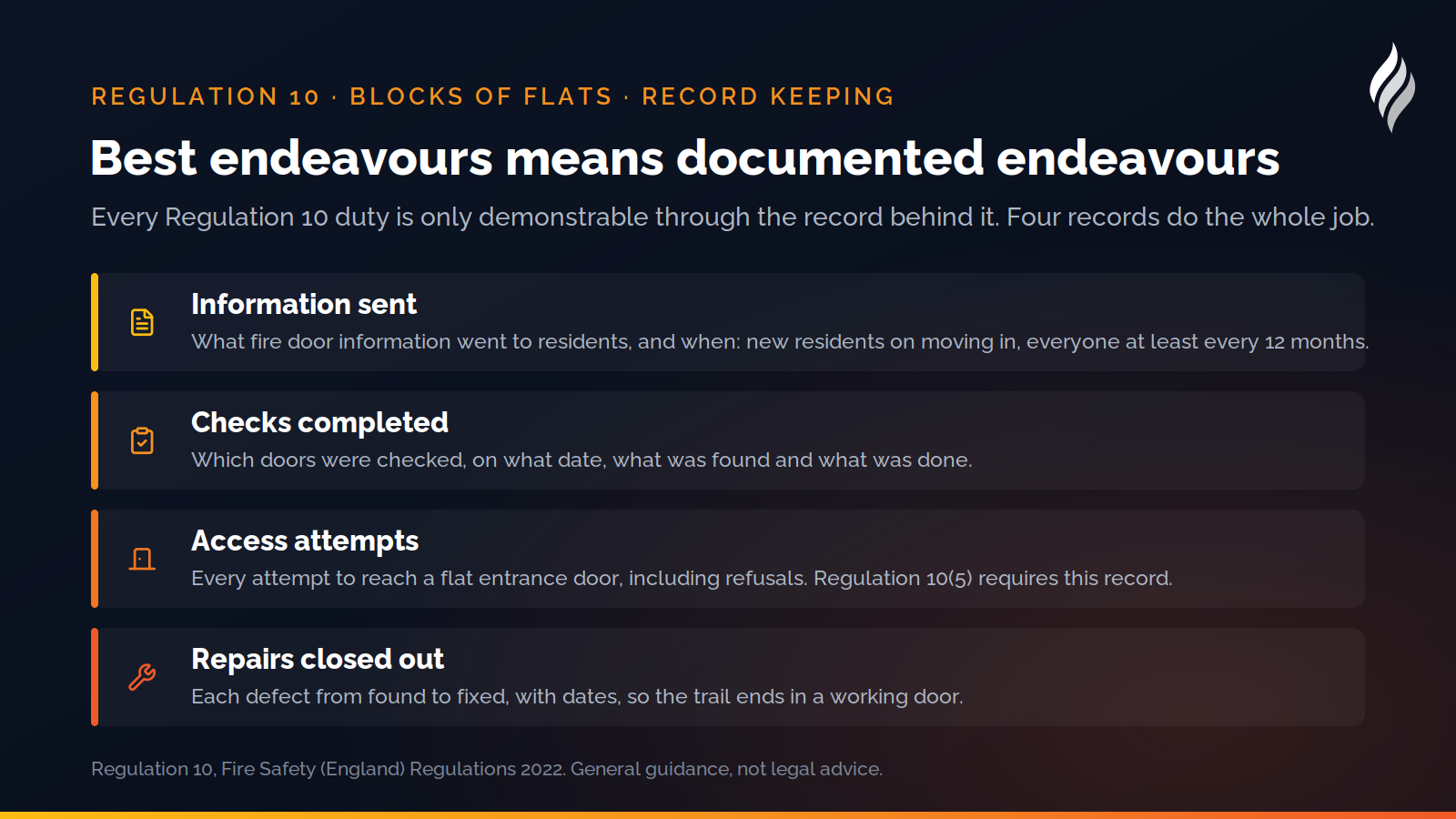
The section most likely to change behaviour is about records. Regulation 10(5) requires a record of the steps taken to comply, and, where access to a flat was not granted in a 12-month period, a record of the attempts made. One unanswered letter is not best endeavours; varied, repeated, logged attempts are. The same logic runs through every duty in the piece: information sent, checks completed, defects repaired, access attempted. A responsible person who has done everything but written nothing down is, on paper, indistinguishable from one who has done nothing.
Enforcement makes the point sharper. The article cites a February 2026 case in which a housing association was fined more than £120,000 after admitting fire safety breaches that included a flat entrance door left without a self-closing device, following a fatal fire. The cost of running the checks properly sits nowhere near sums like that.
Read the full piece
You can read the article in full on News on the Block. Our thanks to Vikki Morlang and the News on the Block team for taking the piece and turning it around so quickly. It follows our recent features in LABM Weekly and ThisWeekinFM, with more DoorTRACE writing on the way ahead of Fire Door Safety Week next month.
How DoorTRACE helps
The article closes on the idea that the whole job is a list of doors, a routine that runs to schedule, information that goes out on time and a record behind all of it. That is what our platform does for a block: every check, defect and repair held against the individual door, the checking rhythm scheduled for you, and failed access attempts recorded as carefully as completed checks, so best endeavours is something you can show. If you manage or direct a block of flats, take a look at our fire door inspection software or get in touch.
This article is general guidance, not legal advice.
Approved Document B: the second staircase era starts today
The amendments to Approved Document B come into force today: more than one common stair in new blocks of flats with a storey 18m or more, evacuation shafts to support evacuation lifts, and new escape guidance. What changes, who it touches, and the fire door angle.
Remedial work is now free to record on DoorTRACE
Only inspections are charged on Pay-As-You-Go from now on. The form that closes out remedial work joins registrations and reports on the free list, so the cost of a door for the year is known before it starts.
Fire doors in warehouses and industrial units
An open warehouse floor resists traditional compartmentation, so its fire doors concentrate around the edges and take the hardest knocks in any sector. Where the doors are, the fork-lift problem, and a check regime for a hard-wearing site.