An article by our Managing Director, Kemble Nagan, has been published by LABM Weekly. Fire door compliance for social housing went live on 17 August, and it reads three years of Regulation 10 at the scale social landlords actually work at: not one building, but a whole stock.
LABM Weekly is the news service from Local Authority Building & Maintenance, read by the local authority and housing association teams who build, maintain and manage public sector homes. Those are the people who carry these duties day to day, so it is the right home for a piece about making the rules work across thousands of doors rather than dozens. Here is what the article covers and why we wrote it.
Three duties, scoped correctly
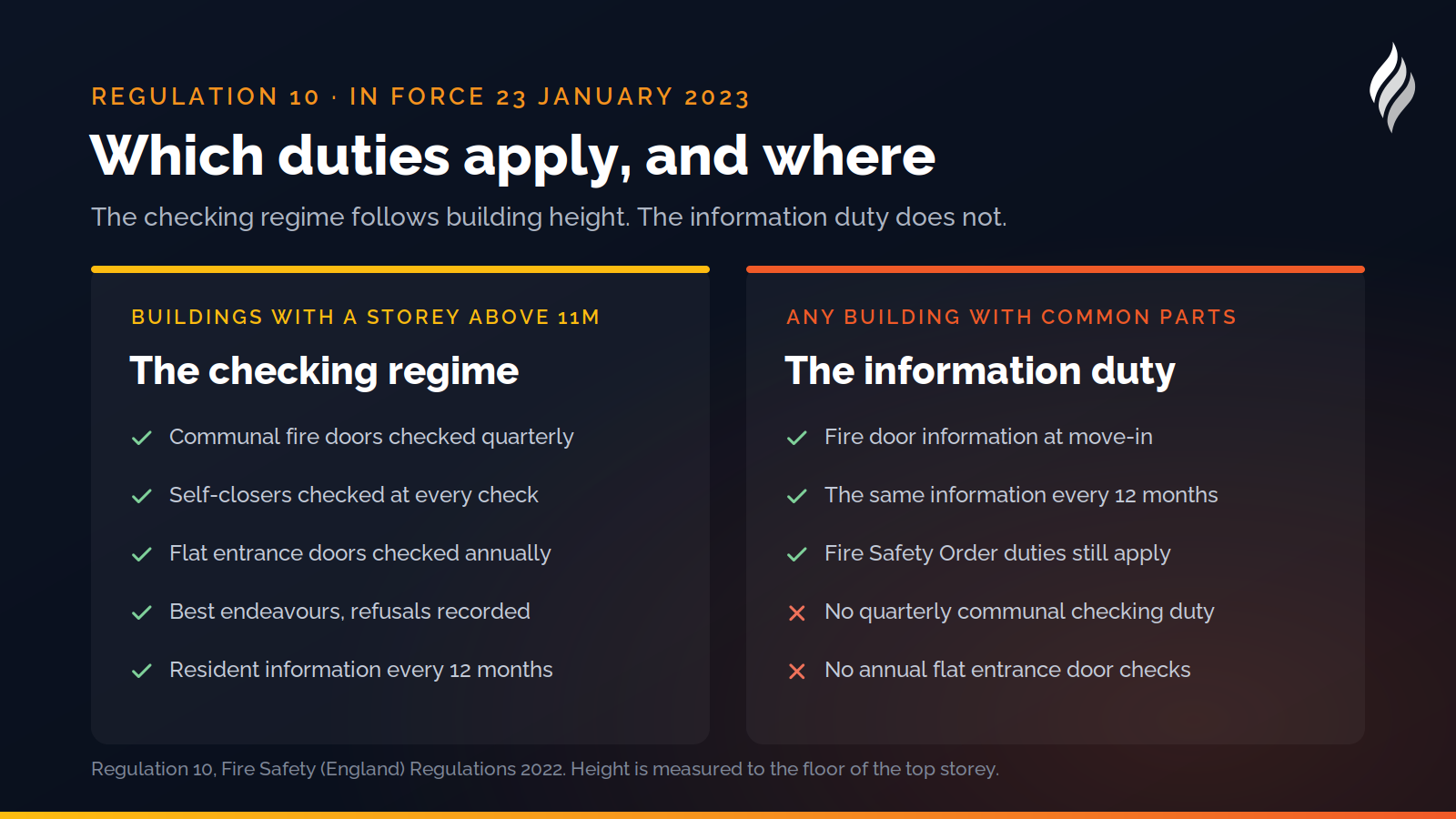
Regulation 10 of the Fire Safety (England) Regulations 2022 came into force on 23 January 2023. In buildings with a storey above 11 metres, fire doors in communal areas must be checked at least every three months, and those checks must include making sure self-closing devices work. Flat entrance doors opening onto common parts must be checked at least every 12 months, on a best endeavours basis.
The third duty is the one the article singles out, because it is the one most often mis-scoped. In any building with two or more homes and common parts, at any height, residents must be given fire door information when they move in and again at least every 12 months. For a landlord with a large low-rise stock, that duty reaches far more homes than the quarterly checking regime does. Our guide to the resident information duty goes through what has to be said and how often.
The piece also repeats a point worth repeating: the routine check is not specialist work. Government guidance says it should not be necessary to engage a specialist, so instructed staff, caretakers, housing officers and maintenance operatives can carry the checks out, escalating anything worrying to a competent person and leaving the deeper assessment of fire resistance to the fire risk assessment.
Two numbers that look like a contradiction
On paper the sector's performance is excellent. Landlord-reported figures for 2024/25 show more than 98% of required fire safety checks complete, with a median of 100%. Independent inspection data says something else entirely: Fire Door Inspection Scheme figures for 2025 found 72% of the fire doors inspected did not meet the required standard, and an earlier FDIS dataset of more than 100,000 inspections found 75% failing, led by excessive gaps, care and maintenance issues, and smoke sealing problems.
The article's argument is that these figures are not in conflict, because they are not measuring the same thing. One counts whether a required process was carried out. The other describes the physical condition of doors put in front of an inspector. A completed process and a working door are two different claims, and the distance between them is where the risk sits.
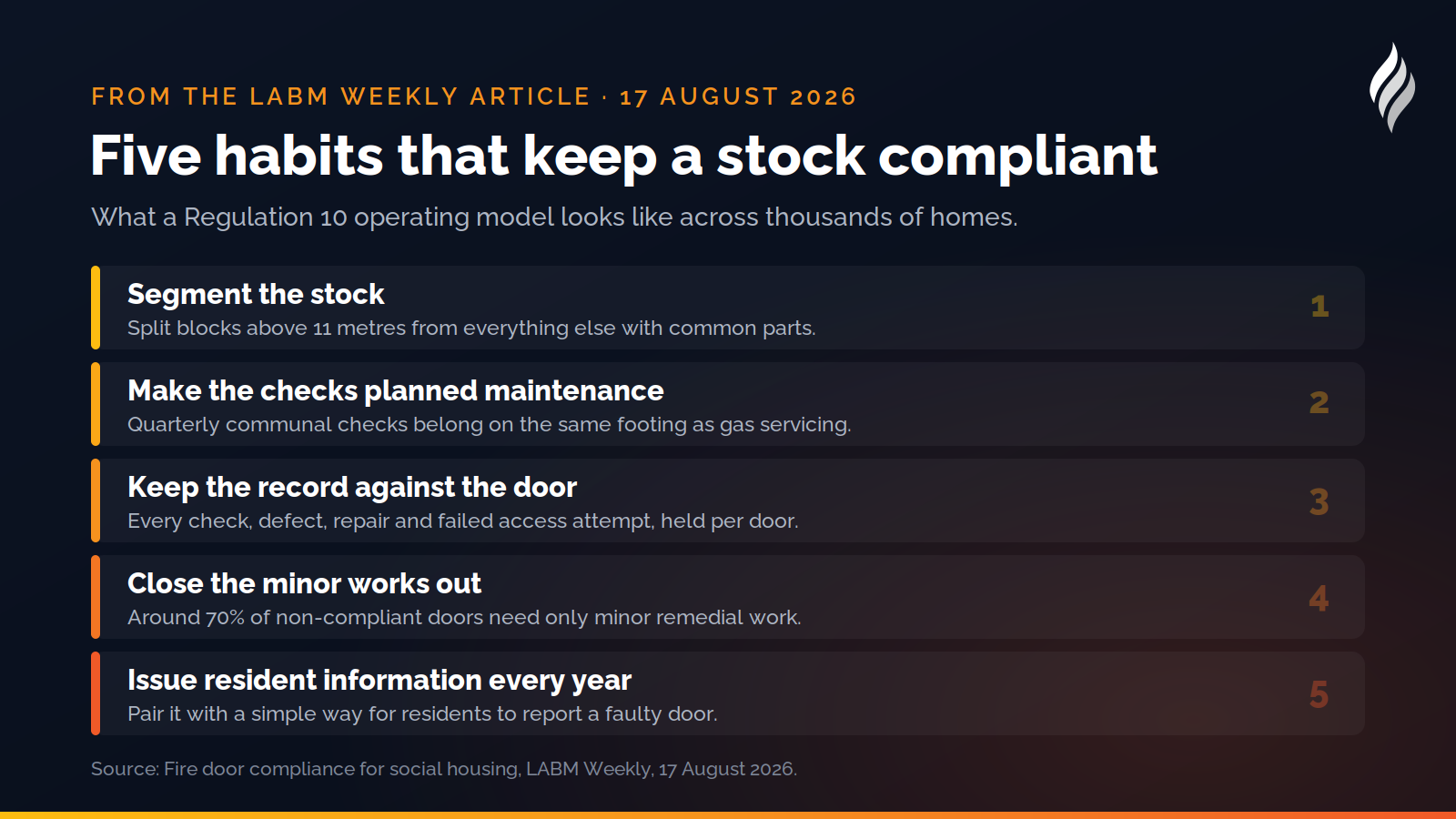
That distance is a maintenance problem rather than a capital one. Around 70% of non-compliant doors needed only minor remedial work, which means most of the gap closes with a disciplined pipeline from found to fixed to verified. It is the pattern we see every week: the repairs are small, and the difficulty is making sure nothing is lost between the two.
Why the doors carry the strategy
Most purpose-built flats rely on a stay put strategy, and stay put only holds if compartmentation holds. Home Office fire statistics show the effect: in purpose-built high-rise flats, 6.8% of fires spread beyond the room of origin, against 14% in houses and other dwellings. Fire doors are the moving parts of that compartmentation, the only elements of the compartment opened hundreds of times a week, which is why they are the part that needs checking on a clock.
Best endeavours, and proving you tried
The hardest operational problem in the article is access to flat entrance doors. Best endeavours is not a soft phrase: it means taking all reasonable steps and being able to evidence them. Agree dates in advance, contact residents more than once, and keep a per-flat record of every attempt including the refusals, because the regulations require a record of the steps taken where access was not granted. Effort nobody wrote down counts for nothing when a fire and rescue authority or the Housing Ombudsman asks.
The resident information duty turns out to be the access lever too. Residents who understand what a fire door does, and why somebody wants 10 minutes at their front door once a year, tend to open it.
What a workable model looks like
The closing section of the article sets out an operating model for a whole stock: segment it by height, treat the quarterly checks as planned maintenance rather than an annual project, hold every record against the individual door, close minor works out quickly, and issue the resident information every year without fail.
The test it offers is a good one to hold any system against: could you show three years of history for any door in the stock within the hour? If the answer is no, the record is the thing to fix first, whether it lives in a purpose-built platform or a well-run register.
The rules keep moving
The article closes on what is coming. From 30 November 2026, Awaab's Law extends to fire hazards, putting a reported defect such as a non-closing fire door on a statutory investigation and repair clock. BS 8214:2026 replaced the 2016 edition in March and widened the code of practice beyond timber. Enforcement has stopped being theoretical, as our quarterly enforcement roundup sets out. None of it changes the quarterly rhythm; all of it raises the value of records that show what you have and what you did about it.
Read the full piece
You can read the article in full on LABM Weekly. Our thanks to the LABM team for running it. It follows our recent pieces in ThisWeekinFM and the Fire Door Journal, and there is more DoorTRACE writing on the way ahead of Fire Door Safety Week next month.
How DoorTRACE helps
The article's conclusion is the reason DoorTRACE exists: the landlords finding Regulation 10 heavy are rarely short of diligence, they are short of a system that keeps the rhythm and holds the proof. Our platform schedules the quarterly cycle, keeps every check, defect and repair against the individual door, and records failed access attempts as carefully as completed ones, so best endeavours becomes something you can evidence. If you manage a social housing portfolio, see how it works for social housing teams, take a look at our fire door inspection software, or get in touch.
This article is general guidance, not legal advice.
Approved Document B: the second staircase era starts today
The amendments to Approved Document B come into force today: more than one common stair in new blocks of flats with a storey 18m or more, evacuation shafts to support evacuation lifts, and new escape guidance. What changes, who it touches, and the fire door angle.
Remedial work is now free to record on DoorTRACE
Only inspections are charged on Pay-As-You-Go from now on. The form that closes out remedial work joins registrations and reports on the free list, so the cost of a door for the year is known before it starts.
Fire doors in warehouses and industrial units
An open warehouse floor resists traditional compartmentation, so its fire doors concentrate around the edges and take the hardest knocks in any sector. Where the doors are, the fork-lift problem, and a check regime for a hard-wearing site.