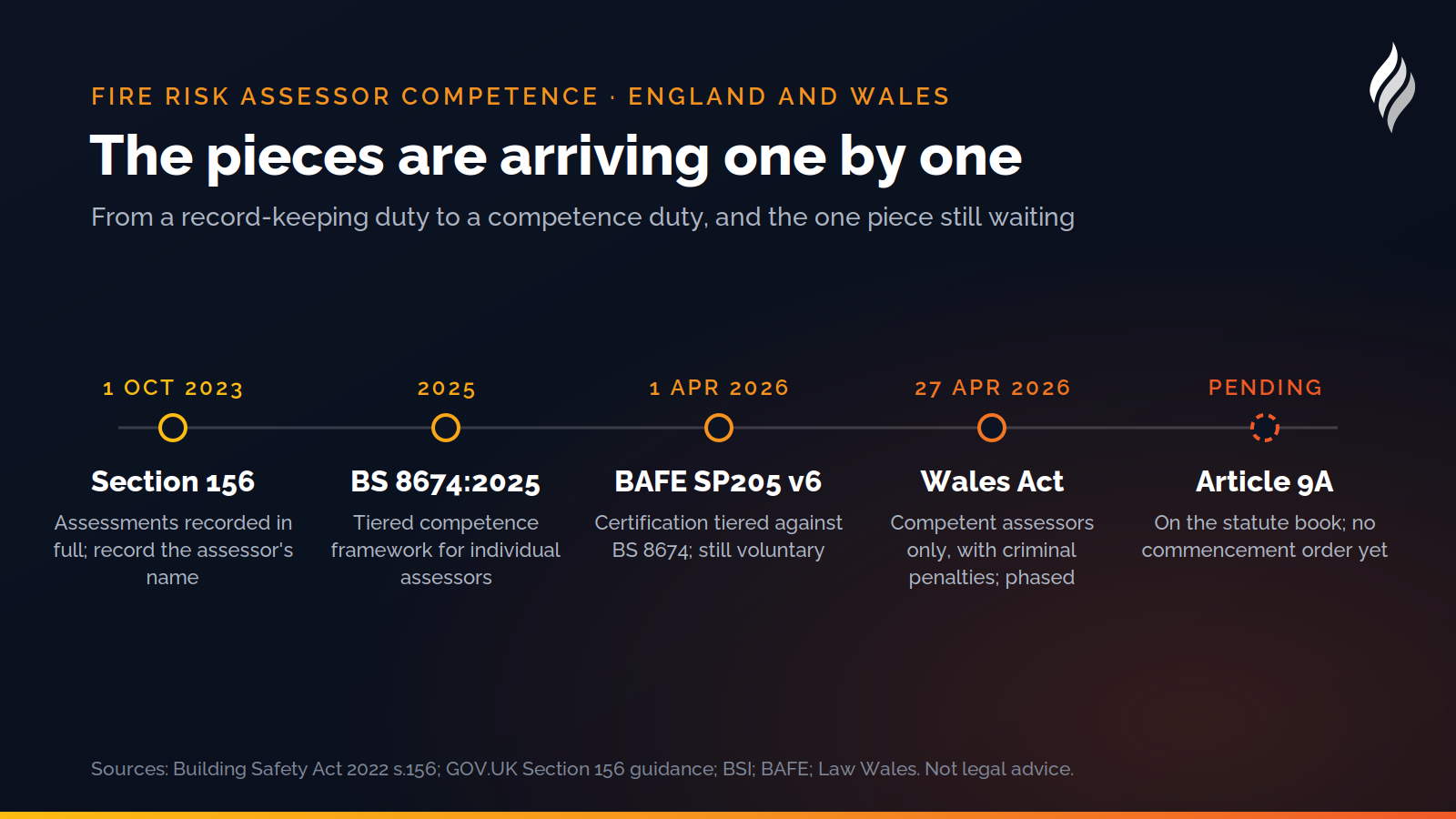
Almost every fire safety duty in England and Wales starts with the fire risk assessment, and there is still no legal rule about who is allowed to carry one out. The Responsible Person can do it themselves, appoint a qualified consultant, or hire the cheapest name on a search page, and the law says only that the result must be suitable and sufficient. That gap was identified by the Grenfell Tower Inquiry, and the pieces to close it have been arriving one by one: a new British Standard on assessor competence in 2025, a tiered certification scheme from April 2026, a Welsh Act that makes incompetent assessment a criminal matter, and a provision already written into the Fire Safety Order that will make appointing an incompetent assessor a breach in itself, waiting only for a commencement date.
This article explains where each of those pieces stands, what they will mean in practice, and how a Responsible Person should choose and record an assessor now, before the law catches up. It applies to England and Wales and is general information, not legal advice.
The law today: suitable and sufficient, by anyone
Article 9 of the Fire Safety Order requires the Responsible Person to make and review a suitable and sufficient assessment of the risks. Article 18 lets them appoint one or more competent persons to assist, and defines competence as sufficient training and experience or knowledge and other qualities to enable the person properly to assist. That is the whole of it: no named qualification, no register, no licence. The duty to get a suitable and sufficient assessment sits with the Responsible Person regardless of who did the work, which is why, in the Plymouth case we covered in our Q2 roundup, both the developer and the assessor who signed off his block were sentenced.
Section 156 of the Building Safety Act 2022 tightened the record-keeping side from 1 October 2023: every assessment must now be recorded in full, whatever the size of the premises, and government guidance asks Responsible Persons to record the name and organisation of any assessor they use, so enforcing authorities, residents and any incoming Responsible Person can see who did it.
Article 9A: written, not yet switched on
The same section 156 inserted a new Article 9A into the Order. It reads, in its first paragraph, that the Responsible Person must not appoint a person to assist them with making or reviewing an assessment unless that person is competent, with competence defined in the same terms as Article 18. Unlike the rest of section 156, Article 9A needs a commencement order before it takes effect, and none has been made. Government guidance says it will be brought into force at a later date, with guidance to follow ahead of commencement, and that in the meantime Responsible Persons should make sure any assessor they appoint is competent.
When it is commenced, the change is significant. Today, an inadequate assessment is a breach of Article 9 and the question is whether the assessment was good enough. After commencement, appointing someone who was not competent to do it becomes a breach of the Order in its own right, whatever the assessment said.
BS 8674:2025: what competent means
Until 2025 the phrase "sufficient training and experience or knowledge" had no agreed content. BS 8674:2025, Built environment. Framework for competence of individual fire risk assessors, gives it one. Published in response to the Grenfell Tower Inquiry's Phase 2 recommendations, it sets out a tiered framework of competence for individual assessors, matching the level of competence to the complexity and risk of the premises being assessed. A small shop and a high-rise residential block with a complex evacuation strategy do not need the same assessor, and the standard says so.
The standard is a code of practice, not law. Its importance is that it is now the reference point that certification schemes, enforcing authorities and courts will use when they ask whether an assessor was competent, and it is the framework a Responsible Person can point to when explaining how they chose one.
BAFE SP205 Version 6: certification catches up
BAFE SP205 is the UKAS-accredited third-party certification scheme for organisations providing life safety fire risk assessments. From 1 April 2026, Version 6 of the scheme governs all certification audits, moving to a tiered structure aligned with BS 8674:2025. Audits before 31 March 2026 followed the previous scheme. One published briefing on the transition reports that mandatory qualifications for assessors under the scheme follow in March 2028; treat that date as the scheme's own timetable rather than a legal deadline.
Two things to keep straight. SP205 remains voluntary: nothing in the Order requires an assessor to be certified, and Article 9A, when commenced, will not require it either. And SP205 certifies organisations, while BS 8674 describes individuals; other registers, such as those run by the Institution of Fire Engineers, list individual assessors. A certified organisation with an assessor whose tier does not match your building has not answered the competence question.
Wales has gone further
The Building Safety (Wales) Act 2026, which received Royal Assent on 27 April, requires that fire risk assessments in the buildings it covers are carried out only by competent persons, with criminal penalties for non-compliance, a point the Welsh Government describes as a direct answer to the Inquiry. Most of the Act is not yet in force and will be commenced in phases by Welsh Ministers. We covered the Welsh regime in our guide to fire door duties in Scotland and Wales. For a portfolio that crosses the border, the practical consequence is that the standard Wales will enforce is the one England's Article 9A will eventually require, so meeting it now covers both.
Choosing an assessor now
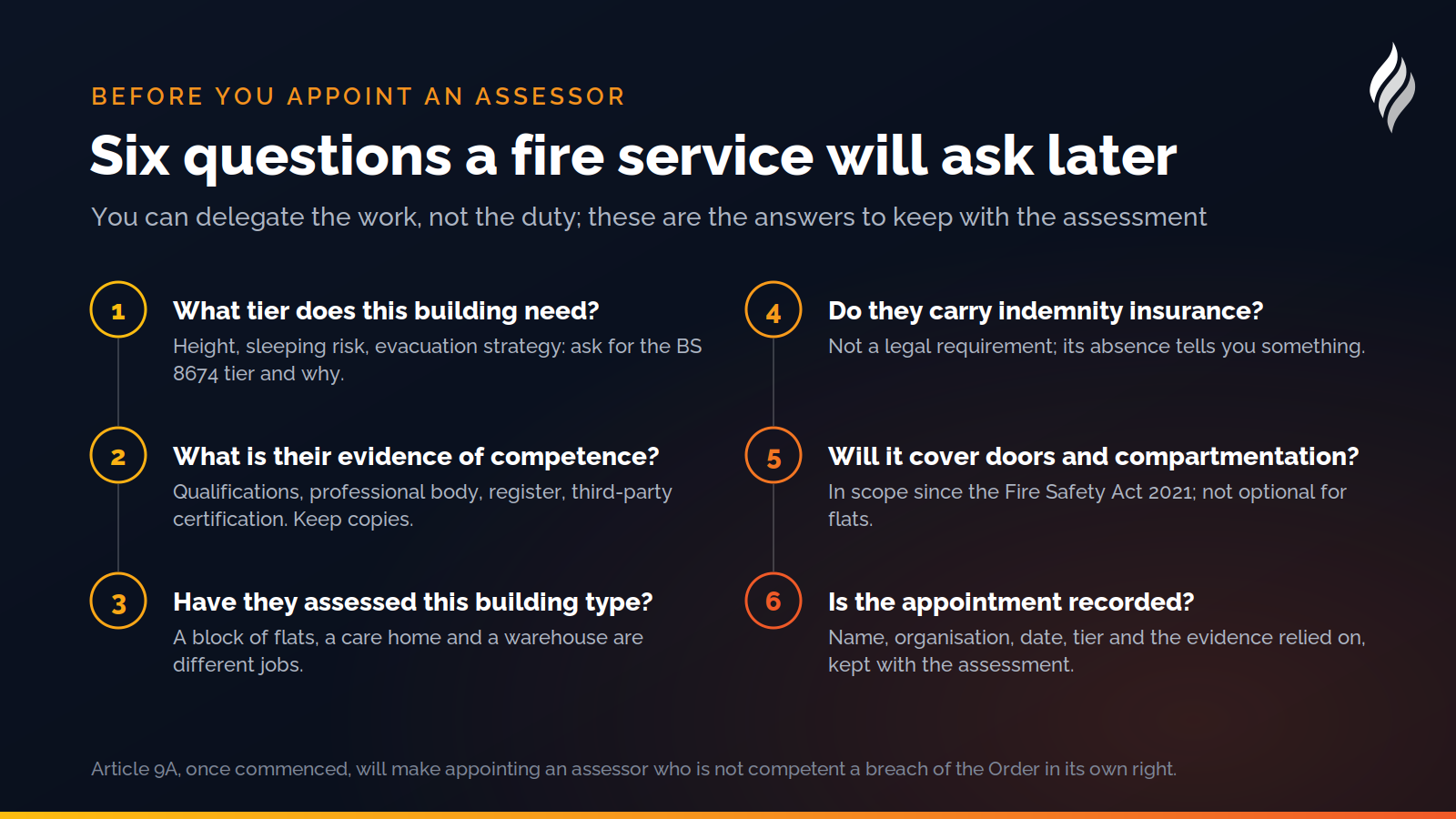
The Responsible Person cannot delegate the duty, only the work, and the questions below are the ones a fire and rescue service will ask if the assessment turns out to be inadequate.
- What tier of assessor does this building need? Height, occupancy, sleeping risk, evacuation strategy and construction all raise it. Ask the assessor to say, in BS 8674 terms, which tier they work at and why it fits.
- What is their evidence of competence? Qualifications, membership of a professional body, a place on a recognised register, and third-party certification of their organisation. Ask which, and keep copies.
- Have they assessed this type of building before? A residential block, a care home and a warehouse are different jobs. Experience of the building type is part of the competence definition.
- Do they carry professional indemnity insurance? It is not a legal requirement; its absence tells you something.
- Will the assessment cover the fire doors, compartmentation and, where relevant, external walls? The Fire Safety Act 2021 put them squarely in scope; an assessment that does not address them is not suitable and sufficient for a multi-occupied residential building.
- Record who did it. Name, organisation, date, tier and the evidence of competence you relied on, kept with the assessment. This is what Article 9A will ask for, and it is what section 156 guidance already asks for.
What the assessment should say about fire doors
Whoever carries it out, the assessment is only as good as what it records. For fire doors that means a statement of which doors are fire doors and where, their condition, the defects found and the actions required with priorities and dates. An assessment that says "fire doors appear satisfactory" without a door-by-door basis is one of the most common findings in enforcement reports, and it is the point at which a competent assessor's report and an incompetent one diverge most clearly. A fire door register with an inspection history gives the assessor the evidence to work from, and it is the document that shows the assessment's fire door findings were grounded rather than assumed.
This article is general information about fire safety law and standards, not legal advice. Whether a particular assessor is competent for a particular building is a judgement the Responsible Person has to make and be able to explain.
How DoorTRACE helps
DoorTRACE gives an assessor the door-by-door evidence a suitable and sufficient assessment needs: every fire door registered by location and rating, its inspection history, open defects and what was done about them, in a report the assessor can cite and the Responsible Person can keep with the assessment. See DoorTRACE's inspection software in practice, or book a demo.
After the survey: building a fire door remediation plan
The survey is the easy part. A 300-door building produces a list of defects longer than anyone's budget. Here is how to turn it into a plan the board will sign, the fire officer will accept and the engineers can work from.
Building Notes: your statement on every building report
A customer surveying a heritage church needed a statement on the building report that applied to every door in it. Building Notes is the result: formatted text written once per building, printed on every report.
Fire doors in nurseries and early years settings
A nursery's occupants cannot evacuate themselves, and its doors are opened a hundred times a day by people carrying children. Here is how the Fire Safety Order applies, where the doors usually go wrong, and what to check.