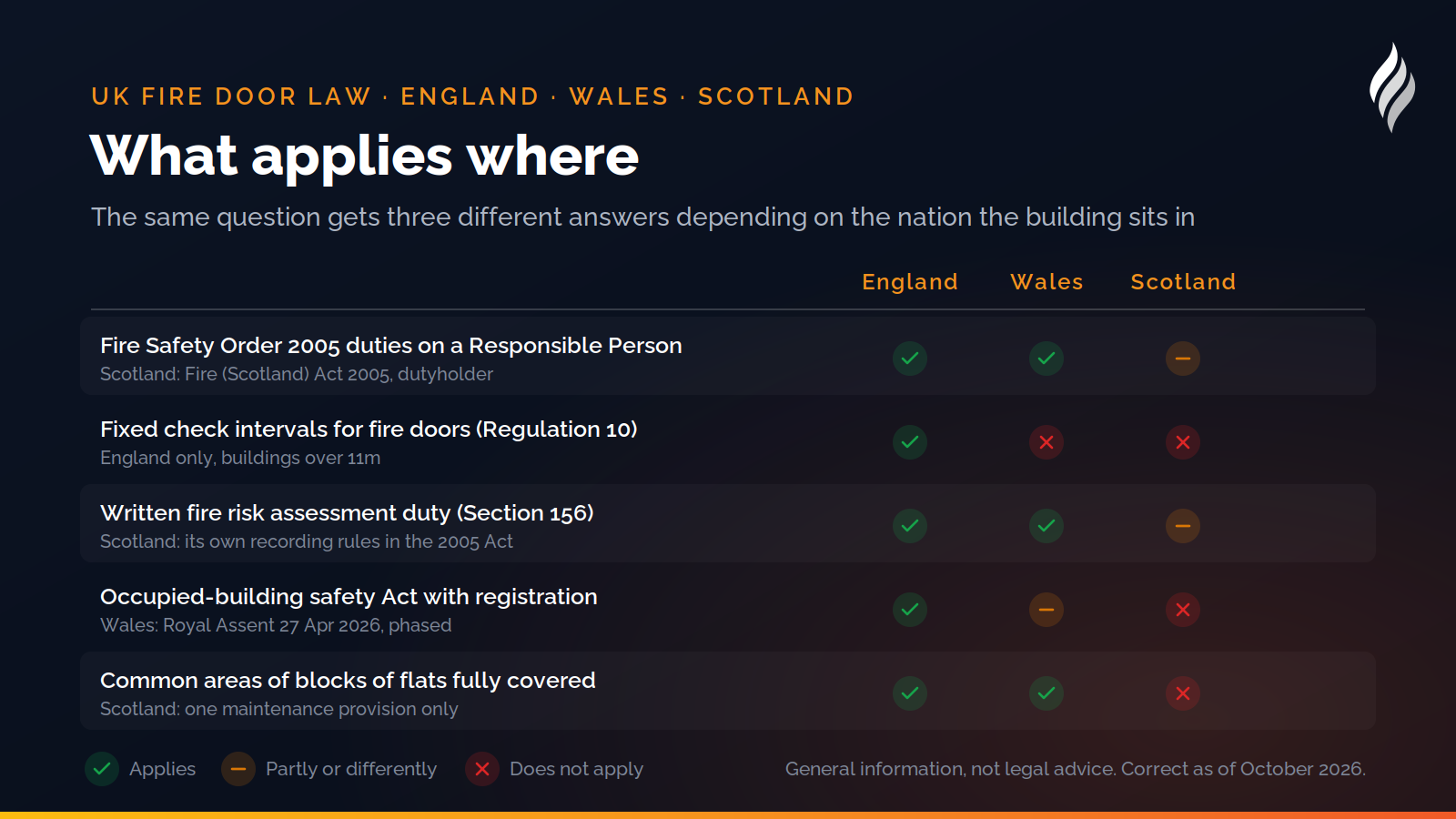
Most fire door guidance you will read online is written for England, and much of it does not say so. If you manage buildings in Wales or Scotland, or a portfolio that crosses the border, that is a bigger problem than it looks: the quarterly and annual fire door checks that everyone quotes come from the Fire Safety (England) Regulations 2022, and they apply in England only. Wales shares England's main fire safety law but not its 2022 regulations, and has just passed a Building Safety Act of its own. Scotland runs on a different statute altogether, one that does not generally reach the common areas of a block of flats.
This guide sets out what applies where: the law behind fire doors in each nation, the checking duties that do and do not exist, what changed in 2026, and what a sensible policy looks like for anyone responsible for doors in more than one country. It is general information, not legal advice; the differences below are exactly the kind of thing worth confirming with a professional for your own buildings.
England: the baseline everyone quotes
England's regime is the one most fire door articles describe, so a short recap is enough. The Regulatory Reform (Fire Safety) Order 2005 puts the duties on the Responsible Person: assess the risk, put general fire precautions in place, and keep them maintained. The Fire Safety Act 2021 confirmed the Order covers the structure, external walls and flat entrance doors of multi-occupied residential buildings. Section 156 of the Building Safety Act 2022 added a written record duty for every fire risk assessment from October 2023.
On top of that sits the Fire Safety (England) Regulations 2022. Regulation 10 is the fire door rule: in residential buildings with a storey above 11 metres, communal fire doors are checked at least quarterly and flat entrance doors at least annually on a best endeavours basis, and residents in every multi-occupied residential building get information about their fire doors. The Building Safety Act then adds the higher-risk building regime, the Building Safety Regulator and the golden thread for buildings of 18 metres or seven storeys.
Hold that shape in mind, because the other two nations diverge from it at different points.
Wales: the same Order, no Regulation 10, a new Act
The Fire Safety Order applies in England and Wales, so a Responsible Person in Cardiff has the same basic duties as one in Coventry. The Fire Safety Act 2021 applies in Wales too, and the Welsh Government's own guidance is unambiguous that flat entrance doors form part of the common parts and are covered by the Order, so failing to provide suitable fire doors can be a breach that leads to enforcement. Section 156's written record duty also applies: the Welsh Government issued guidance on it ahead of 1 October 2023.
What Wales does not have is the Fire Safety (England) Regulations 2022. There is no statutory quarterly check of communal doors and no annual best endeavours check of flat entrance doors written into Welsh law. The duty to maintain fire doors is still there, through Article 17 of the Order, and a Welsh fire and rescue service can still enforce against a defective door; what is missing is the fixed frequency that gives English Responsible Persons a clear yardstick. Welsh building regulations also run separately, with Wales' own Approved Document B, so the English 2026 amendments we covered when they came into force do not apply west of the border.
The big change is the Building Safety (Wales) Act 2026. Passed by the Senedd on 10 March 2026 and given Royal Assent on 27 April, it creates a new regime for the occupation phase of multi-occupied residential buildings that the Welsh Government describes as broader than England's, applying to shared buildings regardless of height or tenure. Its main features:
- Registration of regulated buildings, meaning those at least 11 metres tall or with at least five storeys, with a building safety authority. Welsh Ministers will designate a local authority in each fire and rescue authority area to take that role.
- A fire safety authority, the fire and rescue authority for the area, given new functions.
- Duties to assess and manage fire safety risks in every in-scope building.
- Competent fire risk assessors only, with criminal penalties for non-compliance, answering a concern raised directly by the Grenfell Tower Inquiry.
- Accountability for those managing buildings and a stronger resident voice.
Only a handful of sections came into force on 28 April 2026 (the definitions and some enabling powers). The rest is switched on by Welsh Ministers by order, and the Act requires them to report to the Senedd on progress until it is fully in force. So Welsh duty-holders have a new regime on the statute book, a phased implementation ahead, and no date yet for most of it. The practical response is the same as it was for English Responsible Persons before the Building Safety Act bit: get the door records in order now, because a competent assessor will ask for them.
Scotland: a different Act, and a gap around flats
Scotland's fire safety law is Part 3 of the Fire (Scotland) Act 2005 and the Fire Safety (Scotland) Regulations 2006. The Responsible Person is called the dutyholder, and for non-domestic premises the duties will feel familiar: carry out and review a fire safety risk assessment, put measures in place, maintain them, and nominate competent people to help. Fire doors sit inside those maintenance duties, and the Scottish Fire and Rescue Service enforces. Offices, shops, hotels, schools and care homes in Scotland are covered in much the way their English equivalents are.
The difference is residential. The 2005 Act does not generally apply to domestic premises, and the Scottish Government's own guidance says plainly that the legislation does not generally apply to individual dwellings or to the common areas of blocks of flats. One provision does reach the common areas: whoever has control of them must keep the common areas, and any facilities or equipment provided for firefighters, maintained in an efficient state, and the Scottish Fire and Rescue Service can inspect for that and require steps to remedy a breach. Beyond that single provision, a fire risk assessment of a block's common areas is a strong recommendation in the Scottish Government's practical guidance for existing high rise domestic buildings (revised February 2022), not a legal requirement, and there is nothing equivalent to Regulation 10.
Two categories of residential building are pulled back inside the Act: premises providing a care home service, and any property that needs a licence as a house in multiple occupation. Some supported housing is covered as well. So a Scottish HMO landlord has full dutyholder obligations while the owners of a private tenement next door largely do not.
That gap is acknowledged. The post-Grenfell Review of the Fire Safety Regime for High Rise Domestic Buildings in Scotland recognised that buildings with multiple owners and enforcement in high rise domestic buildings needed further consideration over the longer term, including potential changes to housing and fire safety law. The Scottish Government has since consulted on strengthening fire safety in high rise domestic buildings and legislated on other fronts (interlinked alarms in every home, tighter building standards), but as of the date of this article there is no Scottish equivalent of Regulation 10 or of the English and Welsh Building Safety Acts for occupied residential buildings. Building standards for new work are Scotland's own too: since May 2005 new high rise domestic buildings have needed 60-minute fire-resisting, self-closing flat entrance doors and automatic suppression, a stricter starting point than England's, which is one reason the occupation-phase law has been slower to follow.
What this means on the ground
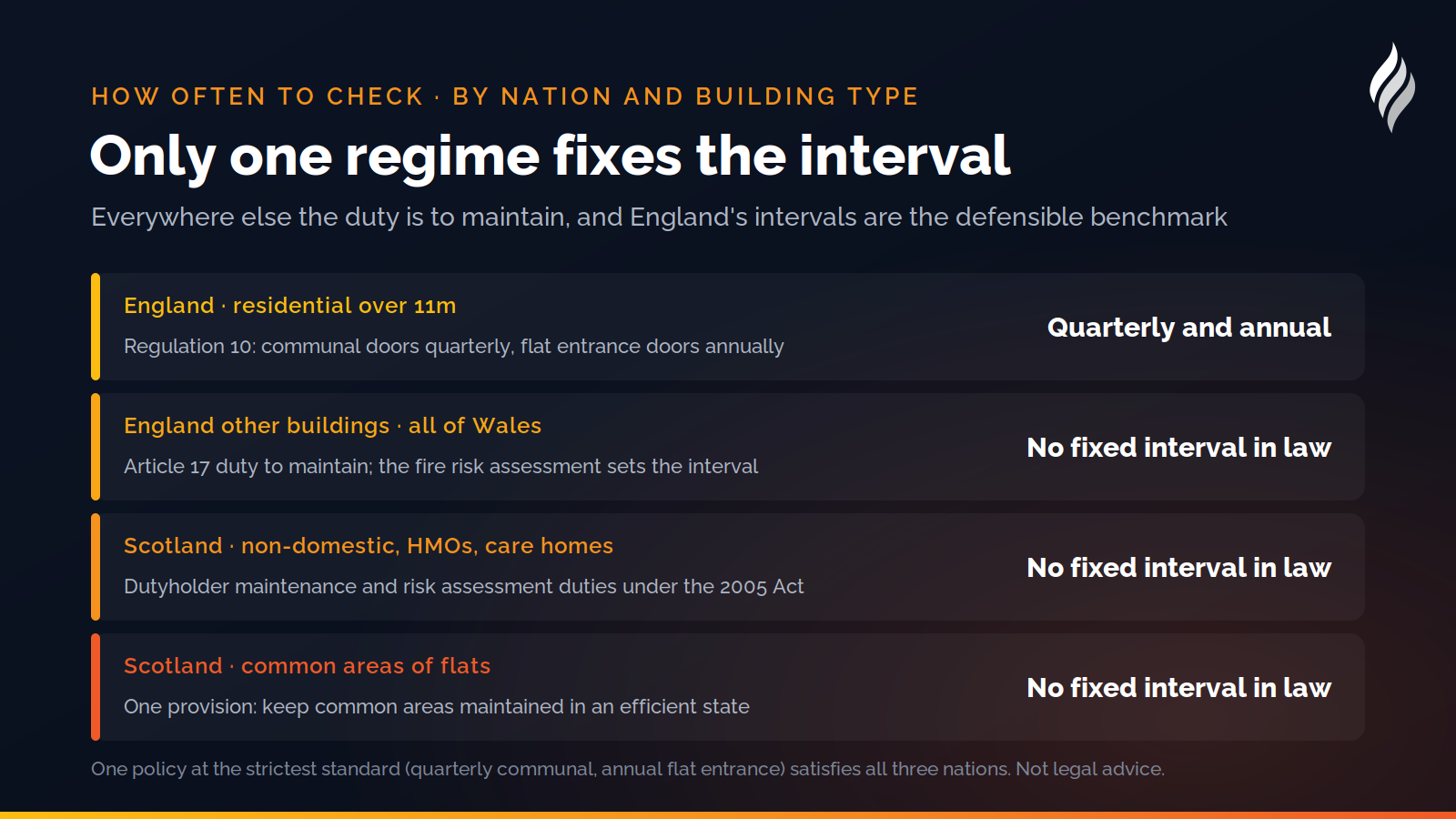
The question that lands on desks is "how often do we have to check the doors?", and the answer depends on which side of which border the building sits:
- England, residential over 11m: communal doors quarterly, flat entrance doors annually, by regulation.
- England, everything else, and all of Wales: no fixed frequency in law, but a duty to maintain under Article 17 and a fire risk assessment that must justify whatever interval you choose. Quarterly for communal doors and annual for flat entrance doors is the frequency English regulators consider reasonable, which makes it a defensible benchmark anywhere the Order applies.
- Scotland, non-domestic, HMOs and care homes: maintenance and risk assessment duties under the 2005 Act; the same benchmark is a sensible reading of "maintained".
- Scotland, common areas of flats: the maintenance-in-efficient-state provision, and strongly recommended good practice on top of it.
A portfolio that spans the border has a choice: run three policies, or run one policy at the strictest standard and let the paperwork prove it. The second is almost always simpler. If every communal door in every building gets a quarterly check and every flat entrance door an annual one, the English buildings are compliant with Regulation 10, the Welsh buildings walk into the new Act with a record already in place, and the Scottish buildings can show a level of care well above what the law demands. The cost is the inspections themselves; the saving is never having to explain why a door in Wrexham was treated differently from one in Chester.
Whatever the interval, the record is what survives contact with a regulator, an insurer or a fire. A fire door register, an inspection history for each door and a defect log with closure dates are the evidence that counts in all three nations, and none of the three regimes is moving in the direction of asking for less of it.
How DoorTRACE helps
DoorTRACE runs the same inspection schedule, defect tracking and audit-ready reporting for every building in a portfolio, whichever nation it is in, so a single policy is a single system rather than three spreadsheets. Set a quarterly and annual cadence once and every door across England, Wales and Scotland is inspected, evidenced and reported the same way. See the platform or book a demo to see it on your own buildings.
After the survey: building a fire door remediation plan
The survey is the easy part. A 300-door building produces a list of defects longer than anyone's budget. Here is how to turn it into a plan the board will sign, the fire officer will accept and the engineers can work from.
Building Notes: your statement on every building report
A customer surveying a heritage church needed a statement on the building report that applied to every door in it. Building Notes is the result: formatted text written once per building, printed on every report.
Fire doors in nurseries and early years settings
A nursery's occupants cannot evacuate themselves, and its doors are opened a hundred times a day by people carrying children. Here is how the Fire Safety Order applies, where the doors usually go wrong, and what to check.