It is day two of Fire Door Safety Week, and if the campaign has one job it is closing the gap between what people believe about fire doors and what is true. BWF research found over half the public could not spot a faulty fire door, and the beliefs below are a big part of why: each one sounds reasonable, each one is wrong, and each one shows up in real buildings every week.
Here are eight of the most persistent fire door myths, stated plainly and corrected. If you are working through the five-day plan this week, this piece makes a good staff-room share for day one or two.
Myth 1: a heavy solid door is basically a fire door
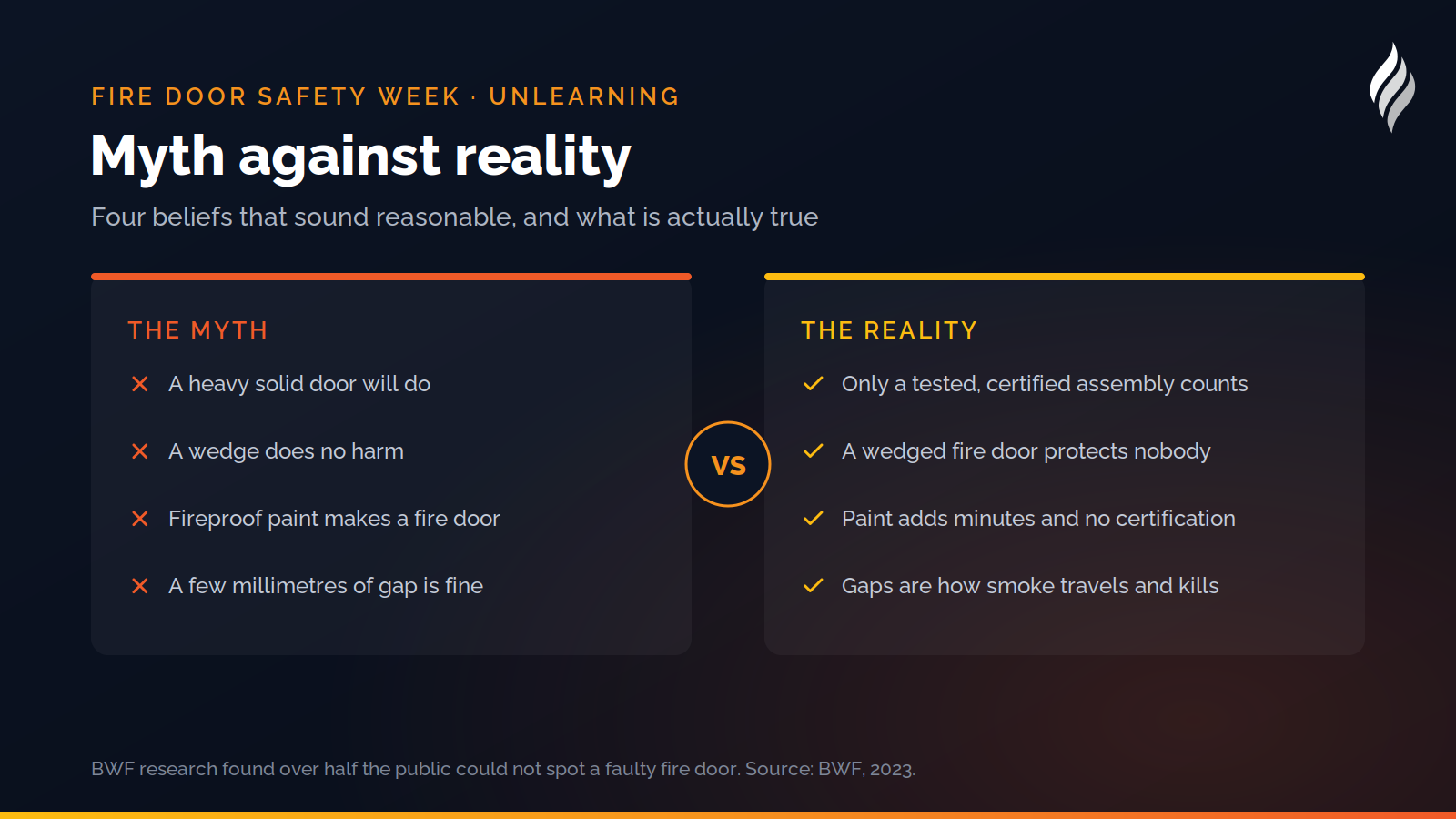
A fire door is not a thick door. It is an engineered assembly, leaf, frame, seals, hinges, closer and any glazing, designed and tested together to hold back fire and smoke for a rated period. The materials, construction and components are specific, and the proof is the certification, not the weight. Our guide to spotting a certified fire door shows what to look for, starting with the label or plug on the top edge.
Myth 2: wedging it open for a bit does no harm
A wedged fire door protects nothing and nobody. Fire doors work by being closed when fire breaks out, and fires do not wait for someone to remember the wedge. If a door needs to be held open for airflow or access, the lawful answer is a hold-open device that releases on the alarm, covered in our guide to self-closing devices and hold-opens, not a wedge, a bin or a fire extinguisher doing a job it was never meant for.
Myth 3: fireproof paint turns a door into a fire door
Fire-retardant paint on an ordinary door adds minutes of resistance at best, and no certification at all. A certified fire door earns its 30 or 60 minutes through tested construction: solid engineered construction, intumescent seals that expand in heat, rated hardware and compatible glazing. Paint changes none of that. If a door needs to be a fire door, it needs to be replaced with one, not decorated into the role.
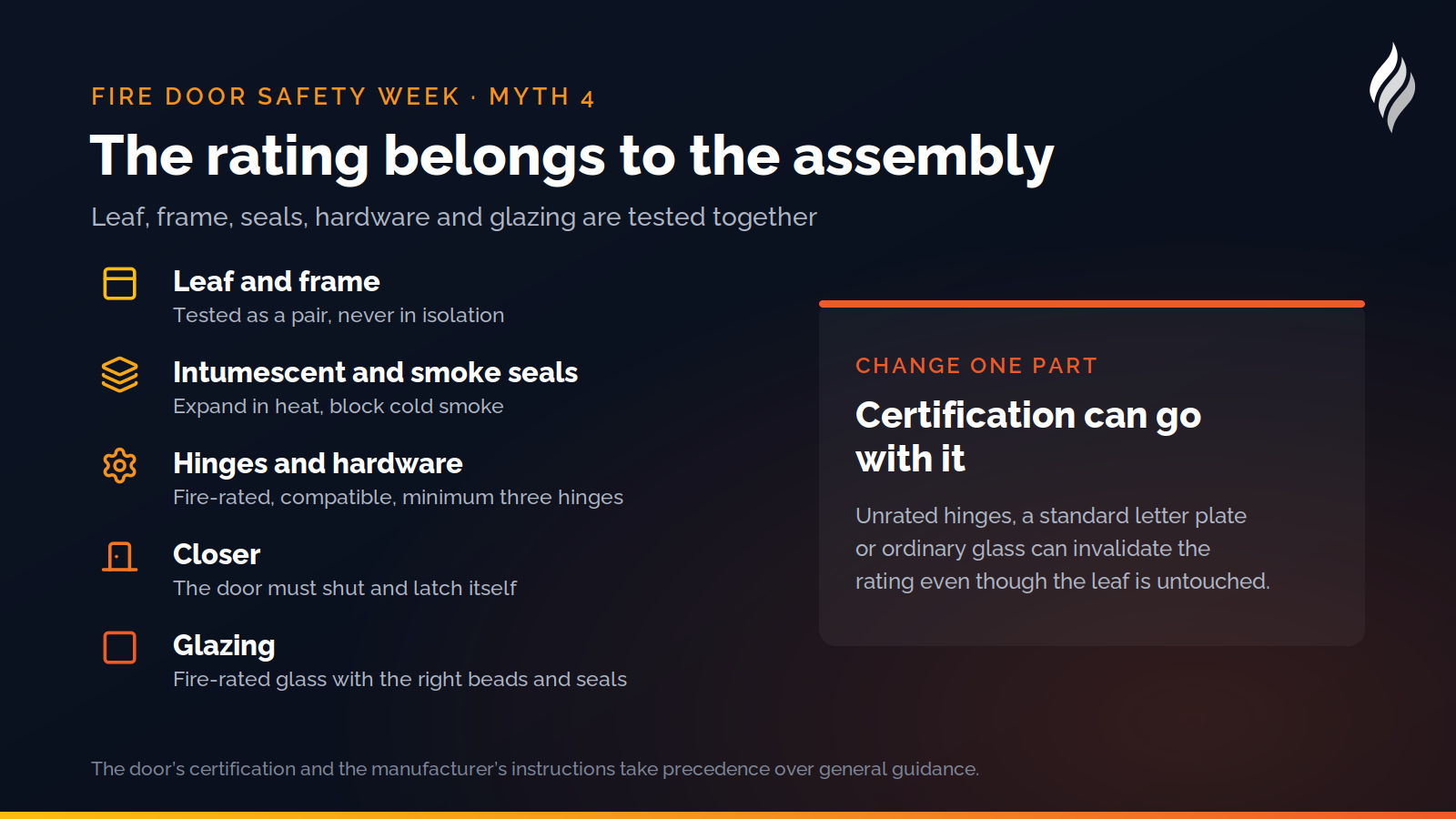
Myth 4: the rating belongs to the door leaf
The rating belongs to the whole assembly as tested. Swap the hinges for a bargain set, fit an unrated letter plate, replace the glazing with standard glass, and the door's certification goes with them, even though the leaf is untouched. This is why repairs need matched, compatible components and why our guide to hinges and hardware treats ironmongery as seriously as the door itself. FD30 and FD60 describe tested assemblies, not planks: the difference is covered in FD30 vs FD60 ratings.
Myth 5: once installed, it is done
A fire door is a working machine that degrades in service. Closers drift out of adjustment, seals get painted over or torn, gaps open as buildings move, latches stop engaging. That is why the law expects fire doors to be maintained in efficient working order, why buildings over 11 metres have quarterly communal door checks, and why the campaign's five-step check exists: it takes minutes and catches most of the common faults. What those faults look like is covered in common fire door defects.
Myth 6: fire doors are a commercial-building thing
Fire doors carry legal duties in far more places than offices and shops. Flat entrance doors in multi-occupied residential buildings are squarely in scope of the fire safety regime, HMOs have their own duties, and the classic shop-with-flats-above joins two regimes in one building. If you live in a flat, your front door is probably the most important fire door in your life: our guide to flat entrance fire doors explains why, and this week's residents' guide covers what residents can do about it.
Myth 7: a few millimetres of gap will not make a difference
Smoke, not flame, is what kills most people in building fires, and gaps are how smoke travels. The commonly cited guidance is around 2 to 4mm at the perimeter, with the door's certification and the manufacturer's instructions taking precedence, and the difference between 3mm and 8mm at the edge of a door is the difference between a sealed compartment and a chimney. Fire door gaps explained covers how to measure them, and intumescent and smoke seals explains the components doing the sealing.
Myth 8: reporting a faulty door is someone else's job
Most faulty fire doors are seen dozens of times before anyone acts, because everyone assumes someone official is dealing with it. BWF research in 2022 found a third of the public would not report a fire door problem, and almost half would not act on a propped-open door because they did not know who to tell. The person who notices the fault is the fire safety system working: report it to your building manager, landlord or employer, and if you manage a building, make the reporting route obvious enough that nobody has to guess. The fire door awareness gap covers why this link in the chain breaks so often.
Unlearning is the point of the week
None of these myths survives contact with a few minutes of attention, which is exactly what Fire Door Safety Week is for. Share the corrections, put the five-step check in front of your staff and residents, and if today is your walk-through day, take the free printable checklist with you.
How DoorTRACE helps
Myths persist where there is no record, because nobody can say when a door was last looked at or by whom. DoorTRACE gives every door its own history: checks logged from a phone, defects photographed and tracked to completion, and evidence on hand when the fire risk assessor asks. See the platform overview or talk to us.
Approved Document B: the second staircase era starts today
The amendments to Approved Document B come into force today: more than one common stair in new blocks of flats with a storey 18m or more, evacuation shafts to support evacuation lifts, and new escape guidance. What changes, who it touches, and the fire door angle.
Remedial work is now free to record on DoorTRACE
Only inspections are charged on Pay-As-You-Go from now on. The form that closes out remedial work joins registrations and reports on the free list, so the cost of a door for the year is known before it starts.
Fire doors in warehouses and industrial units
An open warehouse floor resists traditional compartmentation, so its fire doors concentrate around the edges and take the hardest knocks in any sector. Where the doors are, the fork-lift problem, and a check regime for a hard-wearing site.