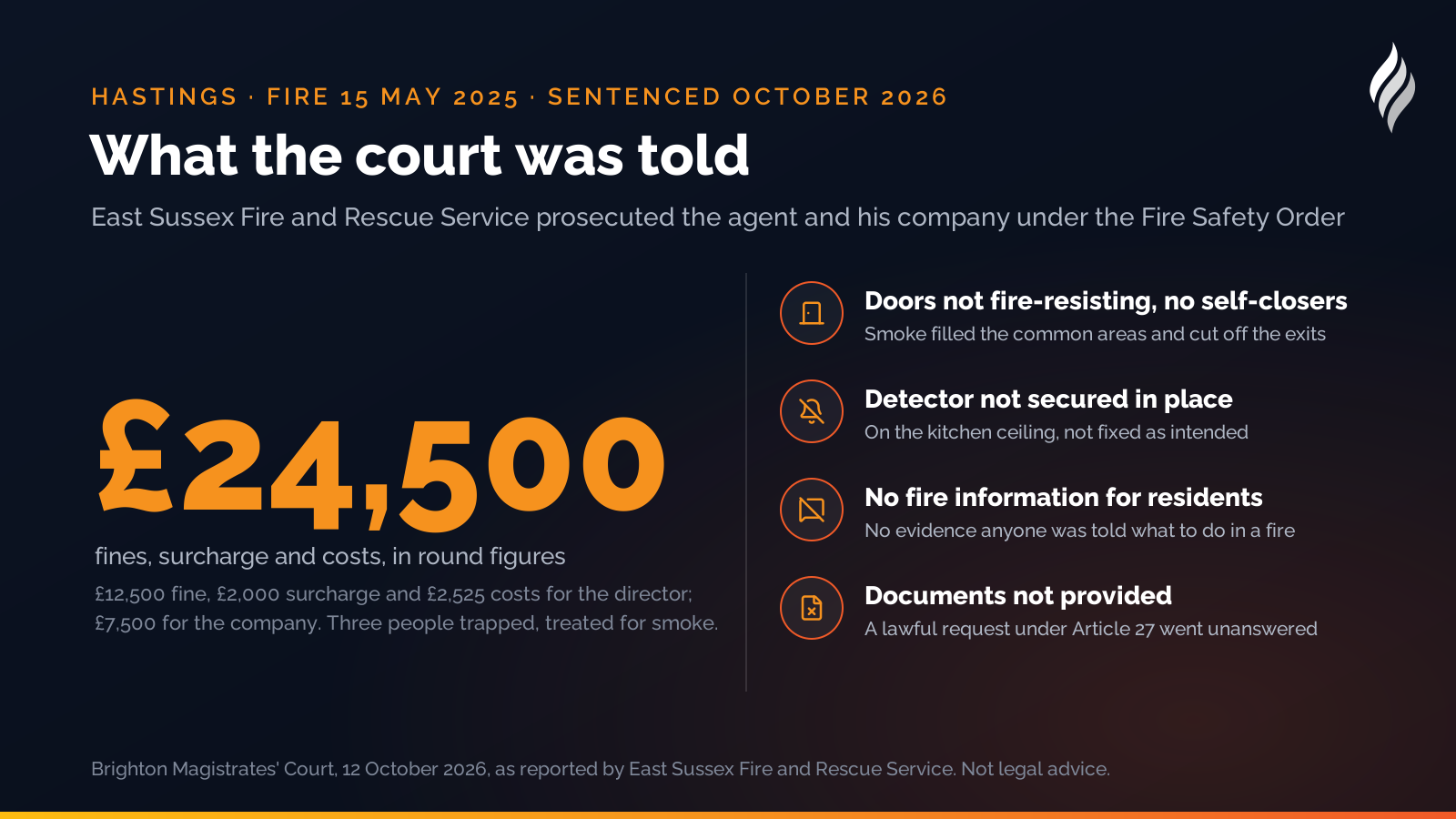
On 15 May 2025 a fire broke out at a property in Hughenden Road, Hastings. Smoke filled the common areas, blocked the residents' escape routes and left three people with smoke inhalation after they were trapped. In October 2026 the man who managed the building, Gareth Reed, and his company, Riverstone-Abbey Estate Agents Limited, were sentenced at Brighton Magistrates' Court under the Regulatory Reform (Fire Safety) Order 2005. The fines, surcharge and costs came to about £24,500.
The case is worth every letting and managing agent's attention, because the defendant was not the freeholder and not the landlord. He was the agent. This article sets out what the fire service found, why an agent can be the Responsible Person, and what an agent who manages blocks or HMOs should take from it.
What the fire service found
East Sussex Fire and Rescue Service, prosecuting for the fire authority, put four failures before the court:
- Doors were not fire-resisting and had no self-closing devices. The doors between the residents and the smoke were ordinary doors, and nothing closed them. That is why the common areas filled and the escape routes were lost.
- A fire detector on the kitchen ceiling did not appear to be secured in its intended position.
- No evidence that residents had been given information about what to do in a fire.
- A failure, without reasonable excuse, to provide documents and information the inspectors had asked for under Article 27 of the Order.
The sentences were a £12,500 fine and a £2,000 victim surcharge for Mr Reed personally, with £2,525.31 towards the investigation costs, and a £7,500 fine for the company. The fire service's station manager for legal and enforcement said afterwards that ignoring a letter or failing to respond to a lawful request for information is not a way to avoid scrutiny.
Why an agent can be the Responsible Person
The Fire Safety Order does not look for a job title. For the common parts of a residential building it places the duty on the person who has control of the premises in connection with a trade or business, and on the owner where nobody else has control. A managing agent who holds the keys, arranges the repairs, instructs the contractors and collects the service charge has control, and is being paid to have it. The freeholder does not stop being responsible because an agent is appointed; the agent is added to the list, and the Order expects the two to cooperate.
In an HMO the same logic applies. A letting agent who manages the house for the landlord, rather than simply finding tenants, shares the duty for the common parts. Our guide to who the Responsible Person is covers the hierarchy, and our article on HMO fire door duties covers the licensing rules that sit alongside the Order.
Two points from the Hastings case stand out in practice. First, the court fined the individual as well as his company, which is what the Order allows where an offence is committed with the consent or connivance of a director or is attributable to their neglect. Second, one of the four charges was about paperwork: the failure to answer the inspectors. The fire service treats silence as a breach in its own right, not a delay.
What the doors tell us
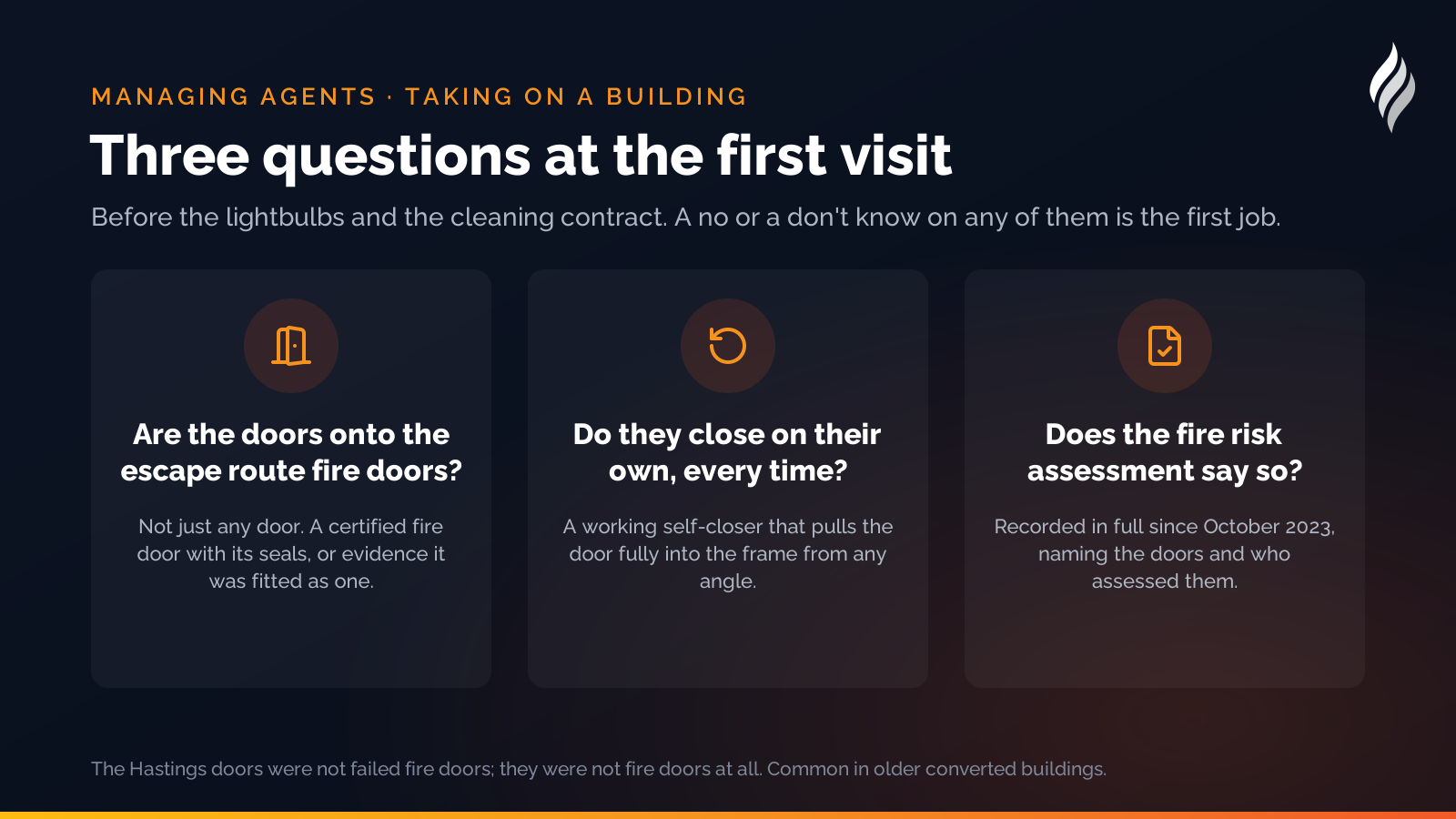
The Hastings doors were not failed fire doors; they were not fire doors at all. In an older converted property that is common. The building was divided into flats or rooms at some point, the doors onto the common stair were whatever was there, and nobody since has asked whether they would hold back smoke. A fire door with a working closer holds smoke and flame back long enough for people to get out past it. A hollow door with no closer does nothing once the first person leaves it open.
For an agent taking on a building, the question to ask at the first visit is simple: are the doors onto the escape route fire doors, do they close on their own, and does the fire risk assessment say so? If the answer to any of the three is no or unknown, that is the first item on the list, before the lightbulbs and the cleaning contract. Our guide to spotting a certified fire door and our article on self-closing devices are the practical starting points, and flat entrance fire doors covers the doors that sit between a home and the stair.
What agents should take from this
- Know which buildings you control, not just which you let. Tenant-find-only is one thing; collecting the keys and managing the common parts is control, and control brings the duty.
- Get the fire risk assessment, read it, and act on it. Since October 2023 it has to be recorded in full whatever the size of the building. If the assessment is old, missing or does not mention the doors, commission one. Our guide to who can carry out a fire risk assessment explains the choices.
- Put the fire doors on a routine. A quarterly check of the communal doors and an annual check of the flat entrance doors is the pattern Regulation 10 sets for taller blocks, and it is a sensible routine for any block an agent manages. Our free checklist takes two minutes a door.
- Give residents the information. What to do in a fire, where the exits are, and why the fire doors must be kept shut. Our article on Regulation 10 resident information sets out the minimum.
- Answer the fire service. A letter from the fire and rescue service asking for documents is a legal request. Reply, with the documents, by the date given. Our guide on what to do when an enforcement notice arrives covers the formal steps.
- Keep the record where you can find it. The agent who can show the assessment, the door checks, the repairs and the resident information in one place is in a different position from the agent who cannot.
Enforcement under the Order runs from advice and informal notification through enforcement and prohibition notices to prosecution, with unlimited fines and, in the most serious cases, imprisonment. This is not legal advice; an agent with a live concern should take advice from a fire safety professional or a solicitor. Our quarterly enforcement roundup tracks cases like this one.
How DoorTRACE helps
DoorTRACE gives a managing agent one record of every fire door in every building they control: which doors are fire doors, when each was last checked, what was found, what was fixed and who signed it off, with photographs. The record is built as the checks happen and is ready when a fire officer, a freeholder or a court asks for it. See the platform, how it works for property managers and HMO landlords, or read about fire door inspection software more generally. The fire door inspection app puts the checklist on the phone of whoever does the visit. Get in touch if you manage buildings and want to see it working.
After the survey: building a fire door remediation plan
The survey is the easy part. A 300-door building produces a list of defects longer than anyone's budget. Here is how to turn it into a plan the board will sign, the fire officer will accept and the engineers can work from.
Building Notes: your statement on every building report
A customer surveying a heritage church needed a statement on the building report that applied to every door in it. Building Notes is the result: formatted text written once per building, printed on every report.
Fire doors in nurseries and early years settings
A nursery's occupants cannot evacuate themselves, and its doors are opened a hundred times a day by people carrying children. Here is how the Fire Safety Order applies, where the doors usually go wrong, and what to check.