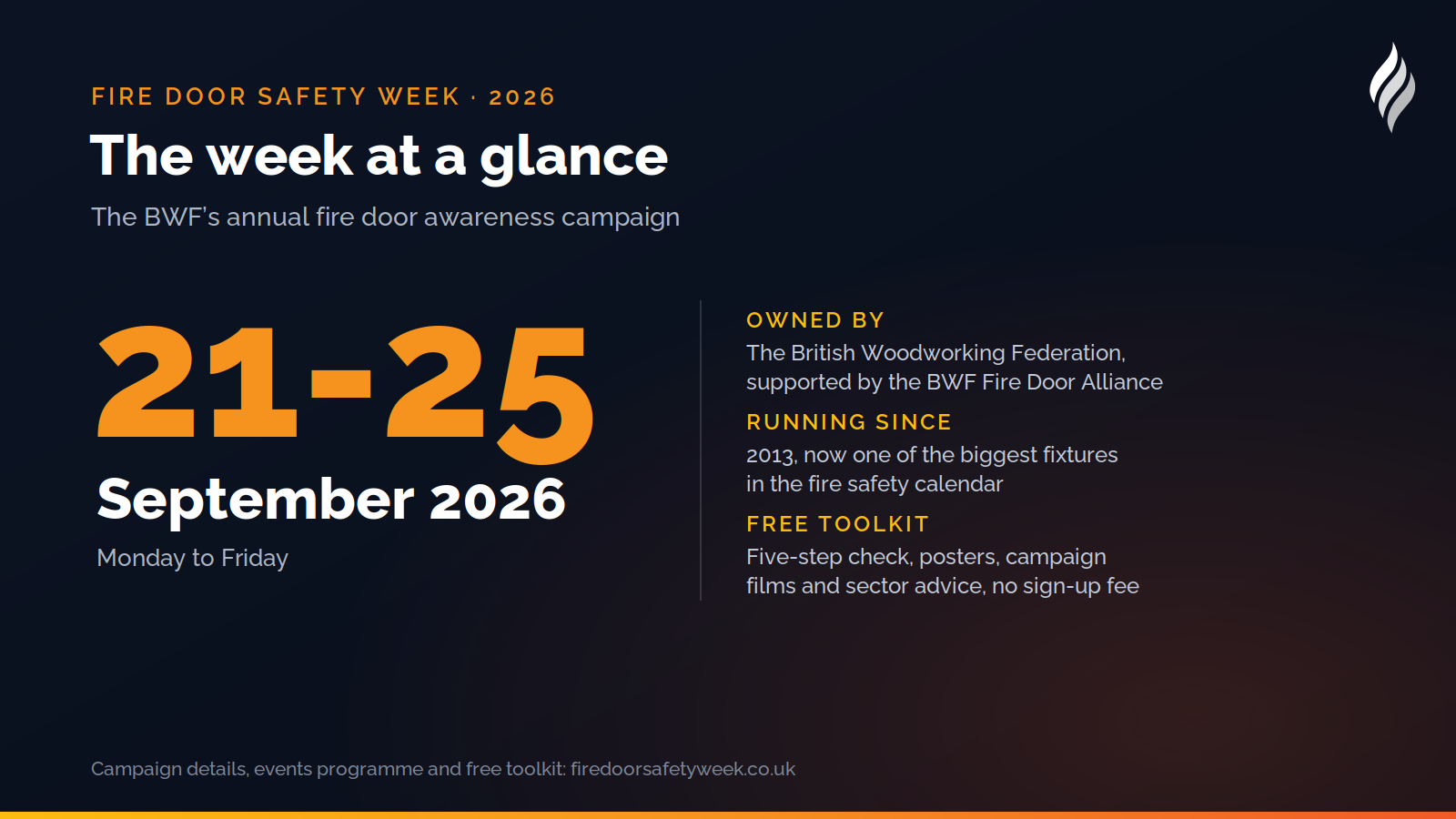
On Monday morning, Fire Door Safety Week 2026 begins. The British Woodworking Federation's annual campaign runs from 21 to 25 September, and if it is not yet in your plans, the good news is that taking part properly needs a weekend of light preparation, not a month of it.
This piece covers what the campaign is, what the free toolkit gives you, what to do between now and Monday, and who in a building's chain of responsibility should give the week an hour of their time.
What Fire Door Safety Week is
Fire Door Safety Week is an awareness campaign owned by the British Woodworking Federation and supported by the BWF Fire Door Alliance. It has run every year since 2013, born out of a simple problem the industry kept seeing: fire doors save lives when they are specified, installed and maintained properly, and the people living and working around them mostly cannot tell when they are not. Our guide to the fire door awareness gap covers the evidence: BWF research in 2023 found over half the public could not spot a faulty fire door.
The campaign has grown into one of the biggest fixtures in the fire safety calendar, with hundreds of supporting organisations and, by the BWF's own reporting, a reach in the tens of millions in a single year through press and social coverage. Last year's campaign, Fire Travels Fast, put lithium-ion battery fires from e-bikes and e-scooters at the centre, a risk we looked at in detail in lithium-ion batteries, e-bikes and fire doors. For this year's campaign focus and the programme of webinars running during the week, keep an eye on the official site at firedoorsafetyweek.co.uk: the events page carries the schedule as it is confirmed.
What the free toolkit gives you
Everything the campaign asks you to do is supported by free materials, and none of it needs a sign-up fee:
- The five-step fire door check. The campaign's centrepiece: certification, apertures, gaps and seals, closers, operation. We walked through it in the BWF five-step fire door check, and it is deliberately simple enough for a non-specialist to learn in minutes.
- Posters and printables. Ready-made material for notice boards, lift lobbies and staff rooms, carrying the messages that do the most good: keep fire doors shut, never tamper with self-closers, report faults straight away.
- Campaign films. Short videos, including burn tests showing what a badly fitted fire door does under real fire conditions, useful for staff briefings because they make the point faster than any memo.
- Sector advice. Guidance pages for housing, schools, hospitals and other settings, so the campaign lands in your context rather than in the abstract.
Organisations can also pledge support for the campaign through the official site, which puts your name alongside the hundreds of businesses, fire and rescue services and industry bodies backing the week. The Fire Door Safety Week logo is a registered trademark of the BWF and can be used for marketing the campaign, but only in line with the brand guidelines downloadable from the site, so pull the official pack rather than improvising with a screenshot.
Three days to be ready
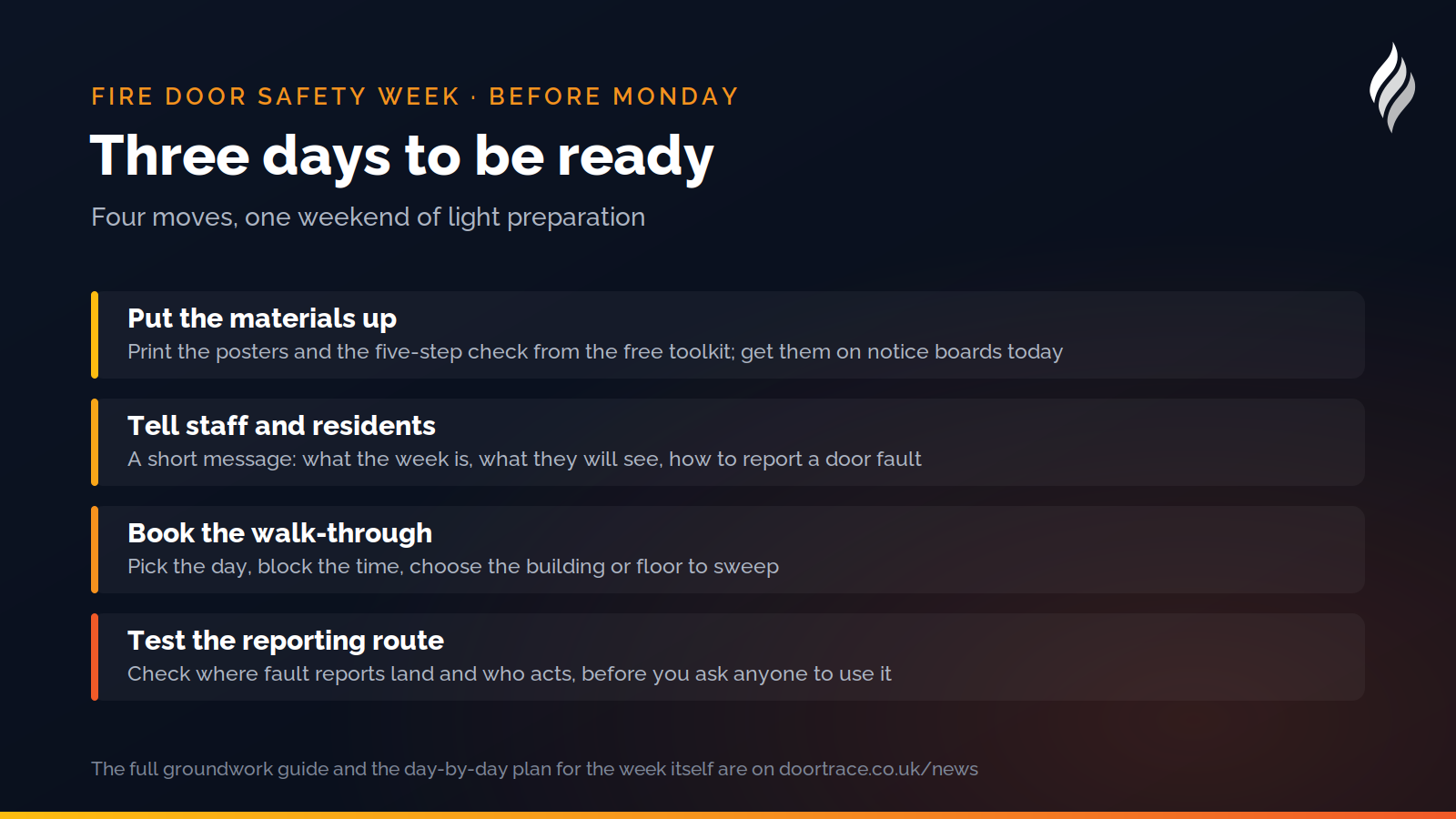
A weekend is enough runway if you keep the preparation to four moves:
- Print and place the materials today. Download the posters and the five-step check from the toolkit, and get them onto notice boards before you leave. A campaign that is visible on Monday morning starts itself.
- Tell people it is happening. A short message to staff, and to residents where you manage housing: what the week is, what they will see, and how to report a door problem. Our residents' guide published earlier this month is written to be shared for exactly this.
- Book the walk-through into the diary. Pick the day, block the time, and decide which building or floor gets swept with the five-step check. An unscheduled inspection is an inspection that does not happen.
- Test your own reporting route. Before asking anyone to report faults, check where those reports land and who acts on them. A reported fault that vanishes teaches people not to bother next time.
If you want the fuller version of the groundwork, our preparing for Fire Door Safety Week guide from August covers it properly, and Fire Door Safety Week 2026 sets out the campaign background. On Monday we will publish a day-by-day plan for the week itself.
Who should give it an hour
The campaign is aimed at everyone, but three groups get the most from it. The Responsible Person under the Fire Safety Order, because an awareness week is the easiest moment of the year to get buildings full of people looking at doors on your behalf. Facilities and housing teams, because the week gives cover to do the walk-through that keeps slipping down the list, and because in buildings over 11 metres the quarterly communal door checks are already a legal duty the week can reinforce. And anyone who trains staff, because a national campaign with films and free materials is a readymade session.
An awareness week does not replace professional inspection, and it is not meant to. What it does is create the one thing compliance programmes struggle to buy: attention. The free printable checklist is a good companion for anyone who wants to put that attention to work on a real door.
How DoorTRACE helps
If the week produces findings, DoorTRACE is where they should land: every door gets its own record, walk-through checks are logged in minutes from a phone, and defects are photographed, triaged and tracked to completion instead of dying in a notebook. When the campaign banner comes down, the evidence stays. See the platform overview or talk to us before Monday.
Approved Document B: the second staircase era starts today
The amendments to Approved Document B come into force today: more than one common stair in new blocks of flats with a storey 18m or more, evacuation shafts to support evacuation lifts, and new escape guidance. What changes, who it touches, and the fire door angle.
Remedial work is now free to record on DoorTRACE
Only inspections are charged on Pay-As-You-Go from now on. The form that closes out remedial work joins registrations and reports on the free list, so the cost of a door for the year is known before it starts.
Fire doors in warehouses and industrial units
An open warehouse floor resists traditional compartmentation, so its fire doors concentrate around the edges and take the hardest knocks in any sector. Where the doors are, the fork-lift problem, and a check regime for a hard-wearing site.